What are the cool abilities of foxes?

Foxes, often painted as the cunning tricksters of folklore, possess a set of biological abilities that genuinely justify their reputation as highly resourceful survivors. They are small to medium-sized canids, distinguishable by their pointed faces, lithe bodies, and bushy tails, yet their capabilities stretch far beyond mere appearance. Their widespread success, making them the most common land carnivores globally, stems from an incredible adaptability, allowing them to thrive in settings as varied as deserts, tundra, woodlands, and even busy suburbs.
# Sensory Acuity

The fox's prowess as a hunter is deeply rooted in its finely tuned senses, which interpret the world in ways humans can only approximate.
# Auditory Mastery
Perhaps the most astonishing sensory gift is their hearing. Red foxes have extraordinary auditory capabilities, reportedly able to hear a watch ticking from forty yards away. Furthermore, they can detect noises from miles away that are completely missed by the human ear, such as a vole scurrying beneath snow or brush.
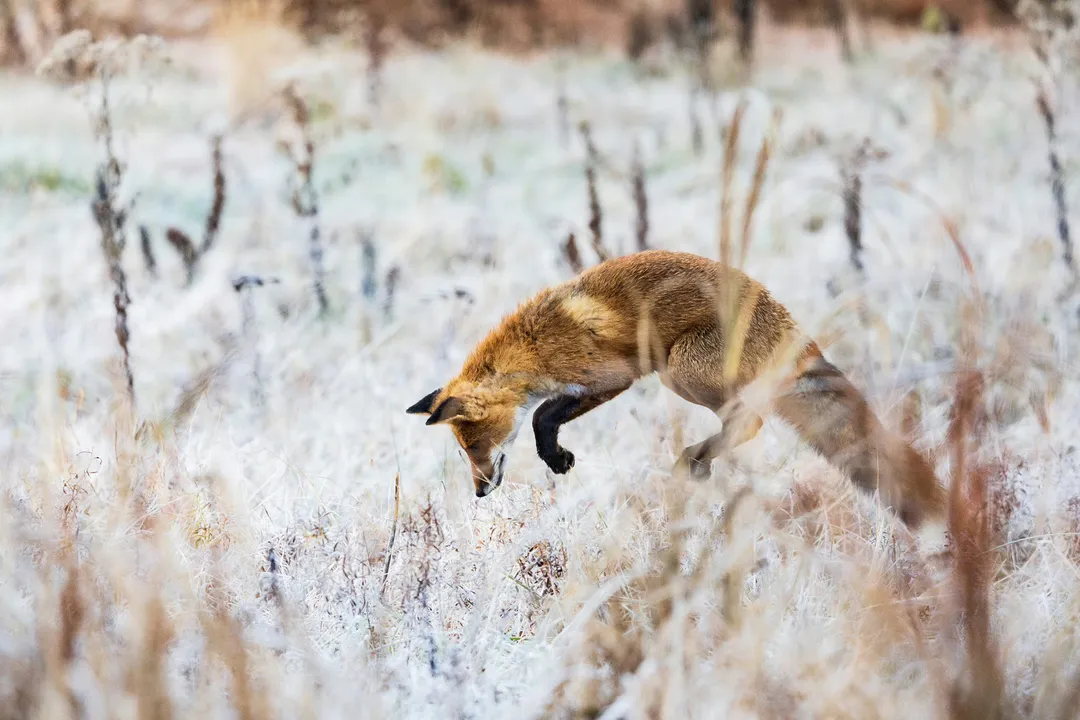
Foxes have highly mobile ears, or pinnae, which they can move independently, rotating each ear by about 150 degrees in opposite directions to triangulate sound sources accurately. The gap between their ears helps them judge the direction of a sound based on minute fractional delays in arrival time, a process similar to how humans use stereo sound. Studies have shown that their hearing is particularly acute for low-frequency sounds—precisely the sounds made by scurrying rodents like mice. Some research suggests their peak sensitivity is around 700 Hz to 4 kHz, which covers the frequencies produced by gnawing rodents and the calls of some gamebird chicks. This precision allows them to perform their famous "mousing" maneuver: leaping high into the air and plunging headfirst into snow or grass to capture prey they've pinpointed using sound alone.
It's worth noting a comparative insight: while humans generally have peak hearing sensitivity around the frequency of human conversation (2–4 kHz), the fox’s superior sensitivity at slightly higher frequencies emphasizes their specialization for tracking small, subterranean prey.
# Vision Adjustments
Fox vision is built for their crepuscular and nocturnal activity patterns. A major feature contributing to this is their vertically-slit pupils, much like those found in cats. This anatomical difference gives them three key advantages over animals with round pupils:
- They can close down more tightly, allowing for precise regulation of light in very bright conditions.
- The slit may help them focus sharply on small, ground-based prey moving laterally along the horizon.
- They maintain the ability to use all rings on their multifocal lens even when the pupil contracts, which helps preserve some color perception in bright light, unlike what happens when a circular pupil shrinks.
Like many other mammals, foxes possess a tapetum lucidum, a reflective layer behind the retina that bounces light back through the retina, significantly improving low-light vision. This layer is responsible for the characteristic eye-shine seen when light hits their eyes at night. However, their vision prioritizes movement over stationary detail; they lack a macula lutea, the human feature responsible for fine detail perception, meaning they struggle to focus on stationary objects for long. Their field of view is wide, spanning about 260 degrees, which helps them scan their surroundings while they move.
# Olfactory and Tactile Senses
Their sense of smell is also keen, aided by long snouts that help amplify aromas, essential for locating food hidden underground. While they possess the necessary internal structures, like turbinates, to process scents, some studies suggest their reliance on smell for finding buried food might be less acute than their reliance on sound. For instance, foxes sometimes struggle to find strongly scented food scattered on the ground if it is hidden under leaves, often relying more on sight to locate it.
Touch is handled by vibrissae, or whiskers, located on the muzzle and forelegs near the carpal or "wrist" joint. These highly sensitive hairs help the fox feel its way around in the dark, detect air currents, and even gauge whether they can fit through a narrow gap, as the whiskers often extend to roughly the width of the body. Additionally, the fur between their paw pads is sensitive, aiding navigation across uneven or thin surfaces like fences or branches.
# Physical and Behavioral Dexterity

Foxes showcase abilities in movement, vocalization, and even social structure that set them apart within the Canidae family.
# Locomotion and Agility
Foxes are fast, agile runners, often averaging around 30 miles (50 kilometers) per hour, which is vital for chasing prey and evading threats. The gray fox is notably fast, capable of reaching speeds up to 42 miles (67 kilometers) per hour. Adding to their physical prowess, gray foxes possess a unique ability among canids: they can retract their claws, similar to domestic cats. This allows them to maintain sharpness for climbing trees, an activity common for the gray fox as an escape mechanism from larger predators like coyotes. The red fox, however, walks in a direct register, meaning the rear paw lands exactly where the front paw was, which is a trait also seen in felines.
Beyond movement on the ground, their adaptability in terms of shelter is impressive; they dig underground dens, sometimes up to 8 feet deep, to care for their young, known as kits, and to seek refuge from predators.
# Vocal Expression
The sheer variety of sounds a fox makes is remarkable. They possess a vocal range spanning five octaves, enabling them to produce over 40 distinct vocalizations—significantly more than the roughly three and a third octaves found in humans. These sounds include barks, whines, growls, and yowls. A specific behavior involving teeth display—often interpreted as a yell because they lack the lip-raising muscles to snarl like dogs—is known as gekkering. While a high-pitched scream-like sound is often heard, potentially mistaken for a human cry, scientists have noted that male foxes tend to ignore this call, suggesting it may not be a primary mating signal.
# Unique Social and Genetic Traits
Though often solitary hunters, foxes exhibit complex social traits that sometimes contrast with the typical canid stereotype. A group of foxes is known as a skulk or a leash. Red foxes are generally noted to be monogamous and mate for life, though some observations suggest they may not practice strict mating exclusivity within that partnership. Female foxes (vixens) are often seen grooming, guarding, and playing with their kin.
One fascinating, though not universally confirmed, theory is that foxes can perceive and use the Earth's magnetic field as a visual aid or rangefinder when pouncing on prey hidden under snow or grass, lining up their attack based on magnetic north. This hypothetical geomagnetic sense would place them among a very elite group of animals using such a navigation tool for hunting precision.
Considering the evidence of genetic malleability, foxes also present an interesting contrast to domesticated dogs. In controlled experiments, selective breeding of docile foxes over decades has produced animals resembling domestic pets, featuring physical traits like floppy ears and curly tails, illustrating a potential for rapid domestication in this species. This genetic flexibility, demonstrated in studies, suggests a deep capacity for change within the species' genome.
When observing a fox trail, distinguishing it from a dog's print is a practical exercise in noticing these subtle physical abilities. Fox tracks typically appear ovoid and lack claw marks because they walk with their claws retracted, like cats, unlike dogs whose claws usually show in their prints.

# An Ecological Role

Foxes, by nature of being omnivores, contribute significantly to ecosystem balance wherever they reside. Their diet is highly varied, encompassing small mammals like rabbits and mice, birds, insects, and plant matter such as fruits and berries. For urban dwellers, this diet can sometimes extend to garbage and pet food. An unexpected benefit they provide is in tick control; research suggests that by keeping small mammal populations (like mice) in check, foxes can indirectly reduce the spread of Lyme disease in an area. Their adaptability means that by managing the rodent population, they influence the presence of ticks, which are the vectors for the disease. The presence of a healthy fox population thus creates a cascade effect that benefits the surrounding ecosystem's health.
Their ability to thrive in human-altered landscapes, including urban settings, is a testament to their resourcefulness. However, this close proximity also necessitates a hands-off approach from humans; feeding wild foxes is discouraged because it causes them to lose their natural hunting instincts and ability to survive independently.
#Videos
Fox Facts for Children - YouTube
Related Questions
#Citations
What Abilities Do Foxes Have? - AAAC Wildlife Removal
15 WILD Fox Facts that Might Amaze You - Wildlands Conservancy
What is your favorite fox fun fact : r/foxes - Reddit
This is What the Fox Says (and Other Cool Things About Foxes)
Fox Facts for Children - YouTube
Top Ten Fun Fox Facts - Earth Rangers
Red Fox Senses | Wildlife Online