What are the adaptations of the Ural Owl?
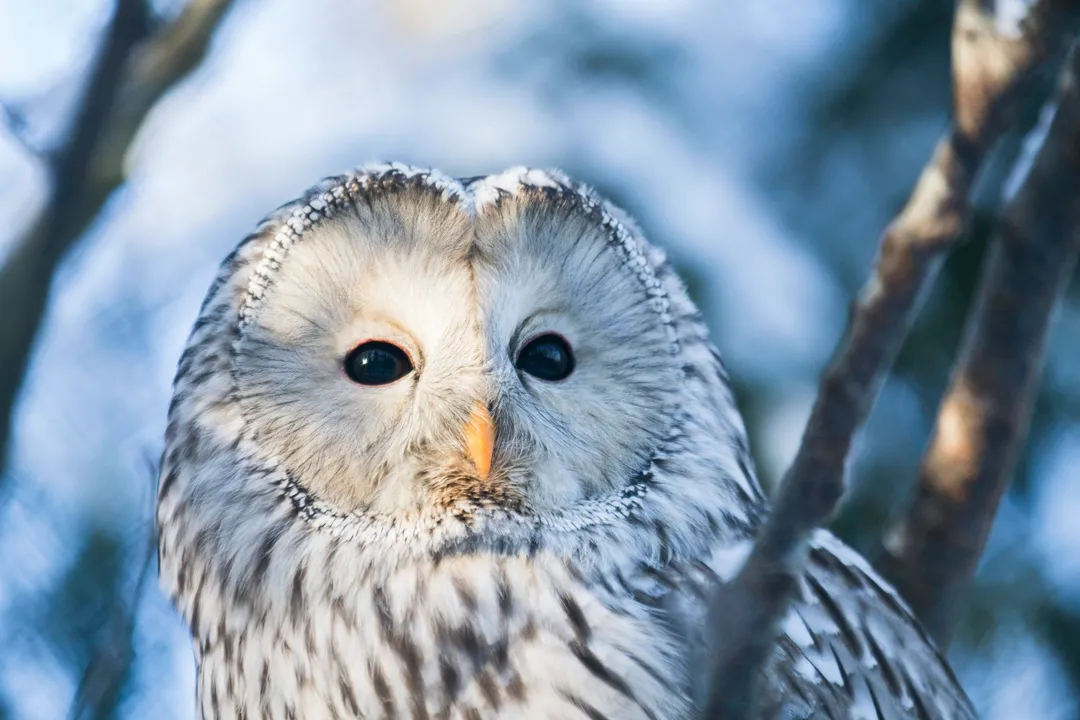
The Ural Owl, scientifically known as Strix uralensis, [1][3] is a masterful inhabitant of Eurasia’s deep woodlands, distinguished by a suite of adaptations honed for a demanding, largely nocturnal existence. [3][5] Unlike some of its more famous cousins, this large owl relies less on sheer size and more on refined sensory apparatus and stealth to secure its meals across vast, often snow-covered territories. [4][1] Its presence is a strong indicator of mature, intact forest ecosystems, ranging from Eastern Europe through Siberia and into East Asia, including Japan. [1][3]
# Plumage Camouflage
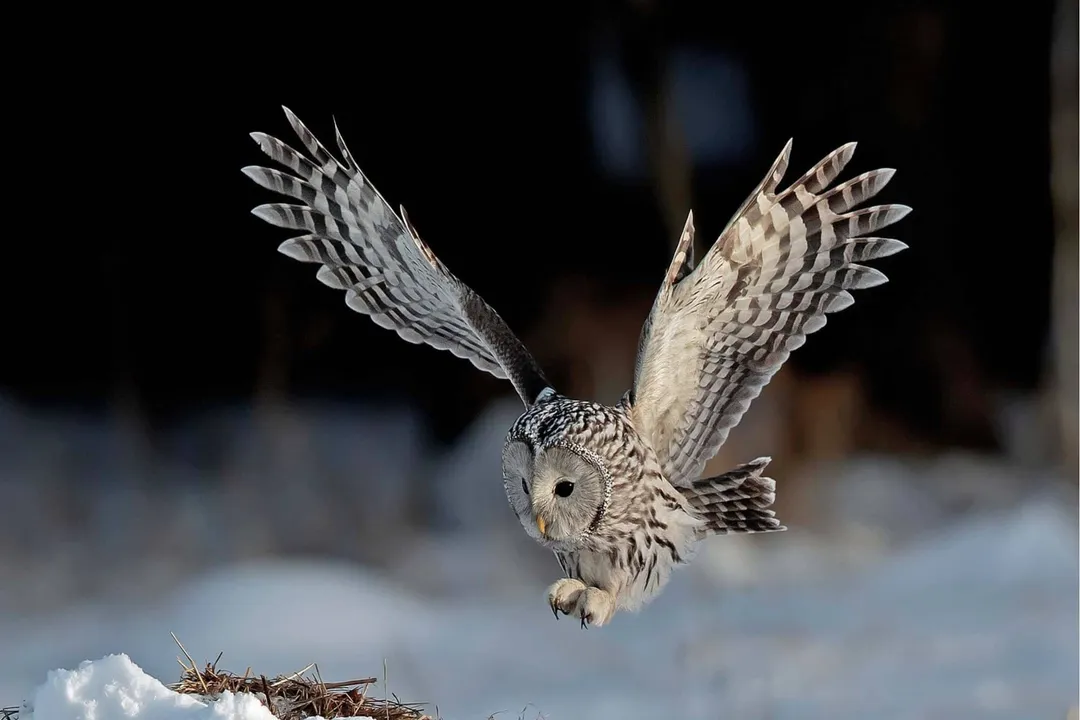
The visual presentation of the Ural Owl immediately speaks to its life spent within dense tree cover. Its plumage is generally a mottled pattern of brownish-grey overlaid with fine dark streaks and small white spots. [1][4] This coloration acts as superb natural camouflage, allowing the bird to blend almost perfectly against the bark of mature trees during its daytime roosts. [4] The underside is typically paler, a light grey or white base heavily streaked with dark brown markings. [4] This cryptic patterning, which breaks up the owl’s silhouette, is a fundamental defensive and predatory adaptation, rendering it effectively invisible to both potential threats and unwitting prey observing from below or nearby branches. [1]
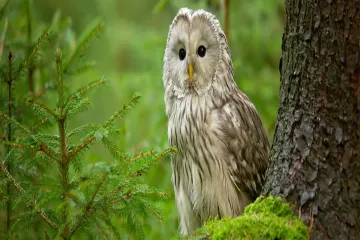
While many owls possess ear tufts, the Ural Owl’s head is conspicuously round. [2][4][5] This lack of feather tufts might seem like a disadvantage, but it contributes to a sleeker, less conspicuous profile against a tree trunk, which is essential for an animal spending daylight hours motionless. [4]
# Sensory Precision
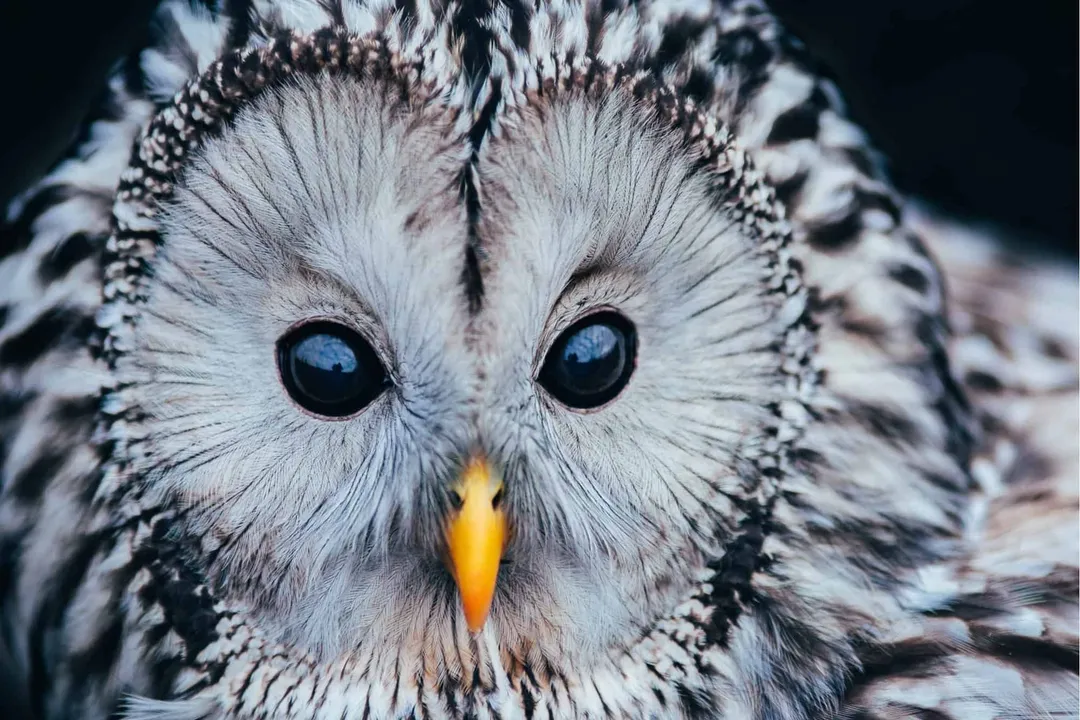
The Ural Owl’s survival pivots on its ability to detect and locate prey in near-total darkness, or even beneath obscuring surfaces like snow or thick leaf litter. [4] This necessity has driven profound adaptations in its auditory and visual systems.
# Dark Sight
Visually, the Ural Owl is equipped with large, dark eyes. [2][3][5] In the dim light of the dense forest or under the moon, these eyes maximize light capture, providing superior vision compared to diurnal birds. [3] However, like most owls, their vision is optimized for low light, meaning activity peaks during the hours when ambient light is minimal. [3]
# Acute Hearing
Perhaps the most critical adaptation for this species is its exceptionally developed sense of hearing. [1][4] The facial disc, typical of owls, acts like a satellite dish, channeling subtle sounds toward the ear openings. [4] The owl's hearing is so precise that it can pinpoint the exact location of a small rodent moving several meters away, often buried under a layer of snow or dense vegetation. [1][4]
This reliance on hearing for prey acquisition in winter environments is fascinating. In regions like Finland or the mountains of Russia, where snowpack can be deep and consistent for months, the ability to hunt subnivean prey—creatures hidden beneath the snow—is not just a bonus; it's a requirement for survival. [1] This suggests that the species’ adaptation is tightly coupled with specific microclimates within its broad geographic range, forcing a specialized sensory approach where sight fails. [4]
# Silent Flight
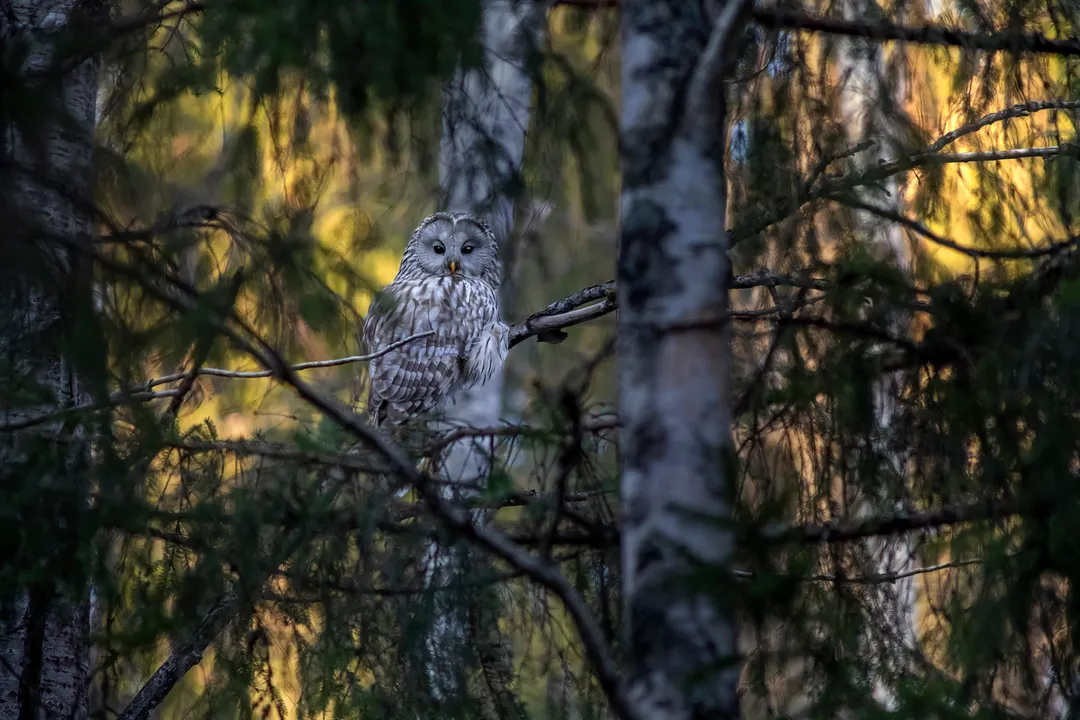
A predator that relies on surprise must deliver its attack without warning. The Ural Owl has evolved specialized feather structures that grant it almost completely silent flight. [7] The leading edge of the primary flight feathers possesses tiny, comb-like serrations. These structures break up the turbulent airflow that normally causes the whooshing sound associated with wingbeats. [7] This silence is paramount when striking prey that is already alert or attempting to hide. It allows the owl to approach its target unheard, maximizing the element of surprise for a swift capture with its talons. [7]
Considering the owl’s physical presence—it can reach a length of up to 60 cm [2] and possesses the robust build necessary for subduing prey like small birds or mammals [4]—the quietness of its flight mechanism contrasts sharply with its visual bulk. This balance between being visually capable of dominating a hunting ground and aerodynamically undetectable during the final pounce illustrates a perfect, refined mechanism for stealth predation. [1]
# Diet Flexibility
Adaptability extends beyond sensory perception and flight mechanics into its feeding habits. The Ural Owl is not an obligate specialist; rather, it is an opportunistic feeder, a trait that aids its survival across varied seasonal conditions. [1][2] Its diet primarily consists of small mammals, such as rodents and voles, which form the bulk of its sustenance. [1][4] However, it readily includes larger prey, such as hares or various forest birds, in its intake when available. [2][4] Reports also indicate that, depending on the local ecosystem, they may consume amphibians or even fish. [1][5]
This dietary flexibility is a key component of its success in surviving the harsh, resource-fluctuating environments of its Eurasian range. When the preferred prey base (like voles) crashes due to population cycles or heavy snow cover, the ability to switch focus to birds or other available vertebrates prevents starvation, supporting a wider distribution than a more specialized hunter could maintain. [2][4]

# Nesting and Territory
The selection of a nesting site is another area where the owl’s adaptations and habitat preferences align. Ural Owls generally do not construct their own nests. [4] Instead, they frequently use large, abandoned stick nests built by other birds, such as crows or even buzzards, often situated high in the canopy of tall trees. [4] Alternatively, they may take up residence in natural tree cavities or old woodcutter platforms. [4][5]
The requirement for large, stable nesting structures further reinforces their dependence on mature, old-growth forests. [5] They tend to favor areas that offer both dense cover for roosting and nearby clearings, meadows, or the edges of wetlands where hunting opportunities are highest. [5] A typical pair may maintain a substantial territory, which must contain enough resources to sustain both adults and, later, their growing young. [4]
The call of the Ural Owl is also part of its behavioral adaptation to its environment. It produces a distinctive, rather melancholic hooting sequence, often described as a huuh-huuh-huuu. [2] This vocalization helps establish territory and communicate with mates across the vast, dense woodlands they inhabit. [2]
# Comparison with Relatives
When considering adaptations, it is useful to briefly contrast the Ural Owl with its close relatives, such as the Eurasian Eagle-Owl or the Tawny Owl. While the Tawny Owl is common in more fragmented or suburban woodlands, the Ural Owl typically demands larger tracts of deep, continuous forest, suggesting its suite of adaptations is geared toward a more remote, less disturbed environment. [1][5]
Compared to the massive Eurasian Eagle-Owl, which can take considerably larger prey and rely more on sheer power, the Ural Owl emphasizes finesse, sensory acuity, and stealth over raw size for its daily subsistence. [2][4] Its medium build and specialized silent flight point toward maximizing efficiency in hunting medium to small animals found on or under the forest floor, rather than engaging in heavy predation on large mammals typical of the larger owl species.
| Adaptation Feature | Primary Function | Environmental Benefit |
|---|---|---|
| Mottled Brown Plumage | Camouflage | Concealment from predators and prey during the day. [1][4] |
| Serrated Wing Edges | Aerodynamic modification | Near-silent approach to prey, enhancing surprise attack. [7] |
| Acute Asymmetrical Hearing | Sound localization | Locating small mammals moving under deep snow or vegetation. [1][4] |
| Large Dark Eyes | Enhanced light capture | Maximizing visibility during low-light nocturnal hunting. [2][3] |
| Generalist Diet | Feeding plasticity | Sustaining population through seasonal resource fluctuations. [2][4] |
The Ural Owl stands as a prime example of evolutionary specialization driven by environmental pressure. Its survival in the dense, often dark and snow-laden forests of Eurasia is not accidental, but the result of refining features like silent flight and unparalleled hearing to turn the scarcity of light and sound into a tactical advantage over its prey. [1][4][7]
Related Questions
#Citations
Ural owl - Wikipedia
Ural owl Bird Facts - Strix uralensis - A-Z Animals
Ural owl facts, distribution & population - BioDB
Ural Owl (Strix uralensis) - Information, Pictures, Sounds
Ural Owl - Stay connected with nature and your friend - Bird Buddy
Ural owl Facts & Photos | Wowzerful
Ural owl | Whipsnade Zoo
Ural owl (Strix uralensis) - Wildlife Photography by Erik Karits
Ural owl - Ranua Resort