What are some interesting facts about the Ural Owl?
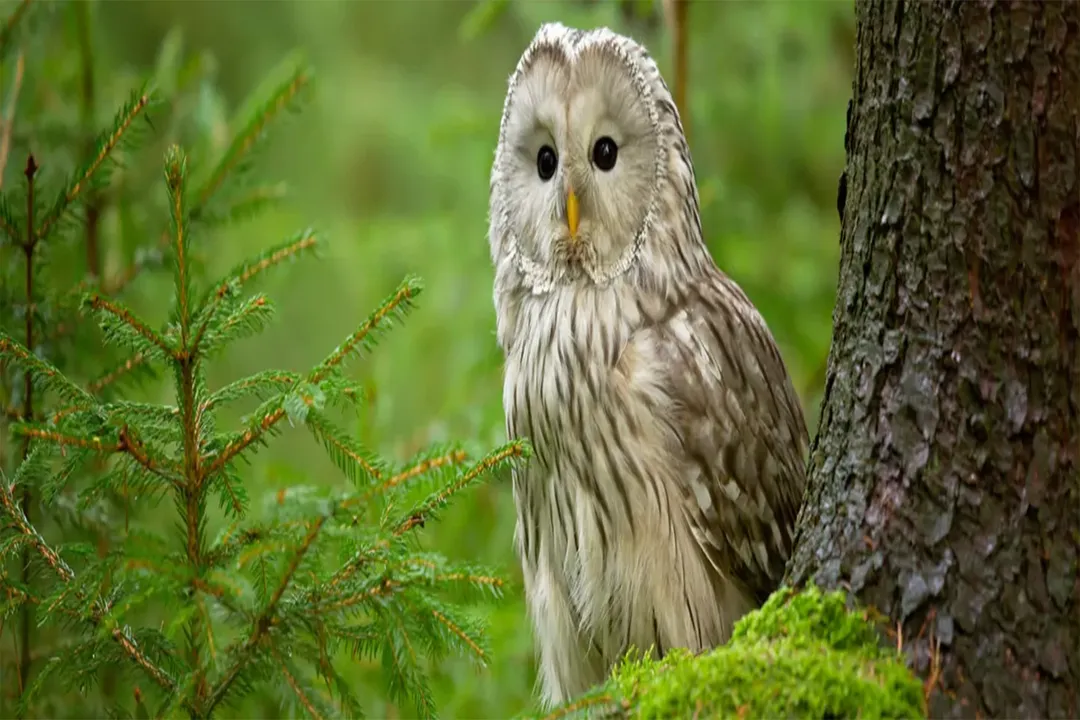
The Ural Owl, scientifically known as Strix uralensis, is a magnificent raptor distributed widely across the vast expanses of Eurasia. [2] Unlike some of the more famous, heavily patterned owls, the Ural Owl presents a somewhat quieter appearance, relying on camouflage within the mature forests it calls home. [2] Its presence is often inferred more by its deep vocalizations than by a fleeting glimpse of its form darting between the trees. [1] This species belongs to the typical owl family, Strigidae, and commands attention due to its considerable size relative to many woodland birds. [1][2]
# Physical Traits
Adult Ural Owls are medium to large in stature, generally measuring between 50 and 70 centimeters in length. [2] A striking feature that sets them apart in silhouette is their relatively long tail compared to many other owl species. [2] Males and females share a similar look, though the females are typically the larger sex, often weighing up to around 1.5 kilograms, while males usually settle closer to 700 grams. [2] Their overall plumage tends toward pale underparts adorned with dark streaks, contrasted by a somewhat less heavily patterned upper side. [2]
The facial structure is particularly notable. They possess a large head with a distinctive, pale facial disc, usually bordered by dark streaks running along the sides. [2] This contrast helps direct sound towards the ears, a critical tool for a nocturnal predator. [2] Beneath the feathers, the bill is a clear, bright yellow. [1][2] With an impressive wingspan that can reach approximately 130 centimeters, they are certainly capable fliers, though their preferred habitat necessitates maneuverability over sheer distance gliding. [2] When observing a Ural Owl, it's the combination of the pale look and that surprisingly long tail that often confirms identification over other large forest owls. [2]
# Forest Dweller
The preferred setting for the Ural Owl is tied closely to old-growth environments. [2] They show a strong affinity for mature coniferous or mixed forests, frequently setting up territories near sources of water, such as rivers or lakes. [2] Their geographical range is quite extensive, stretching from parts of Europe, including Finland, across the breadth of Asia, reaching as far as Japan and the Russian Far East. [2] This wide distribution suggests adaptability, but their dependence on specific forest structures remains a key factor in their local success. [1][2]
Considering their need for older woodland, the Ural Owl acts as an indicator species for forest health. A thriving population here suggests a mature ecosystem that supports a dense base of small mammals and provides ample old trees for nesting cavities. [2] It's interesting to note that while they inhabit cold regions, they are quite widespread, suggesting that the quality of the forest structure—the presence of large, standing deadwood or old deciduous trees with natural hollows—is perhaps more crucial than the absolute temperature range. [2]
# Cavity Nests
Unlike some birds of prey that meticulously build large stick nests in the open canopy, the Ural Owl seeks shelter within enclosed spaces. [2] They are primarily cavity nesters. [2] Their ideal home is often an abandoned nest excavated by a large woodpecker, such as a Black Woodpecker, or a naturally occurring hollow within an old, large tree. [2] This behavior ties them directly to the presence of old trees that have been standing long enough to develop such features. In managed forests where deadwood is quickly removed or where younger trees dominate, suitable nesting sites become scarce, putting pressure on local numbers. [2] Some conservation efforts and dedicated bird enthusiasts even provide large nest boxes designed to mimic these natural hollows to support breeding pairs in fragmented landscapes. [2]
# Night Hunters
As a typical owl, the Ural Owl carries out the majority of its foraging activities under the cover of darkness. [2] They are fundamentally nocturnal hunters, although they can sometimes be spotted active around twilight hours—dusk or dawn. [2] Their diet is heavily skewed towards small, ground-dwelling mammals. Voles and mice form the backbone of their menu, providing a reliable source of calories and protein. [2]
However, their dietary flexibility is more pronounced than some other large owls. When rodents are scarce, they are known to successfully take smaller birds, shrews, and occasionally even amphibians or large insects. [2] Hunting success relies heavily on two primary senses: acute night vision and exceptional hearing, which allows them to pinpoint the exact location of a small creature moving under snow or leaf litter. [2] The ability to hear a vole rustling beneath several inches of snow is what allows them to persist through harsh winters when other food sources are locked away. [2]

# Deep Hoot
The voice of the Ural Owl is one of its most defining characteristics, often being the first confirmation of its nearby presence. [1] Their call is a deep, resonant hooting sound. [2] Descriptions often emphasize its mournful or profound quality, sometimes rendered as a series of rhythmic "hoo-hoo-hooo" calls. [1] This territorial or contact call carries a significant distance through the dense woodland environment, allowing owls to communicate across wide stretches of forest, which is vital for maintaining their space requirements. [2] Unlike the sharp, rattling calls of some smaller owls, the Ural's call has a lower frequency, which travels more effectively around obstacles in the forest understory. [1]
# Status Survival
Globally, the Ural Owl is currently classified as a species of "Least Concern" by major conservation bodies, reflecting its broad geographical spread. [2] This generalized status, however, requires careful interpretation. While the species as a whole appears stable, local populations can face significant pressures. [2] The primary threat across much of its range involves habitat degradation and loss, specifically the logging or removal of the mature, old-growth forests it depends on for both hunting grounds and nesting cavities. [2] Protecting the old-growth elements, such as retaining large, standing deadwood trees, is essential for the continued success of the Ural Owl in any given region. [2] In some captive settings, these owls have demonstrated a respectable lifespan, sometimes exceeding two decades. [4]
#Videos
Focus on the Ural owl (Strix Uralensis) An incredible predator with ...
Related Questions
#Citations
Ural Owl - Facts, Diet, Habitat & Pictures on Animalia.bio
Ural owl - Wikipedia
Ural Owl - Noah's Ark Zoo Farm
Interesting facts about Ural owls and their habits - Facebook
Ural Owl *CURRENTLY OFFSHOW* - New Forest Wildlife Park
Ural owl Facts for Kids
Focus on the Ural owl (Strix Uralensis) An incredible predator with ...
URAL OWL - KYIVZOO
Ural owl | Whipsnade Zoo