What are some interesting facts about the longnose gar?

The longnose gar, Lepisosteus osseus, drifts through North American waters as a relic from deep time, possessing a look so distinct it often inspires immediate curiosity or skepticism. This fish cuts a slender, torpedo-shaped profile, immediately recognizable by the disproportionately long, thin snout that earned it its common name. [2][4] That slender muzzle, in fact, can be nearly twice the length of the rest of its head. [3][8] Far from being merely decorative, this elongated jaw is lined with a single row of long, sharp, needle-like teeth, designed not for chewing, but for securing slippery prey. [3][6]
# Ancient Lineage

The very existence of the longnose gar offers a direct window into ancient Earth history. These fish are classified as living fossils, having persisted for approximately 100 million years, meaning they swam the planet during the time of the dinosaurs, specifically dating back to the Cretaceous period. [1][2][4][6] While many contemporaneous species have drastically changed, the longnose gar’s fundamental structure has remained remarkably consistent, a testament to its initial evolutionary success. [1] This deep history is further evidenced in its internal anatomy; gars retain a spiral valve intestine, a primitive digestive tract feature more commonly associated with cartilaginous fish like sharks and rays. [3][5] Furthermore, their physical defenses are formidable, protected by a covering of hard, interlocking, rhomboidal, diamond-shaped ganoid scales that act as a veritable suit of armor. [3][5][7][8] The species name itself reflects this armor: lepisosteus derives from Greek and Latin meaning "scale" and "bony," respectively. [3]
# Armored Appearance
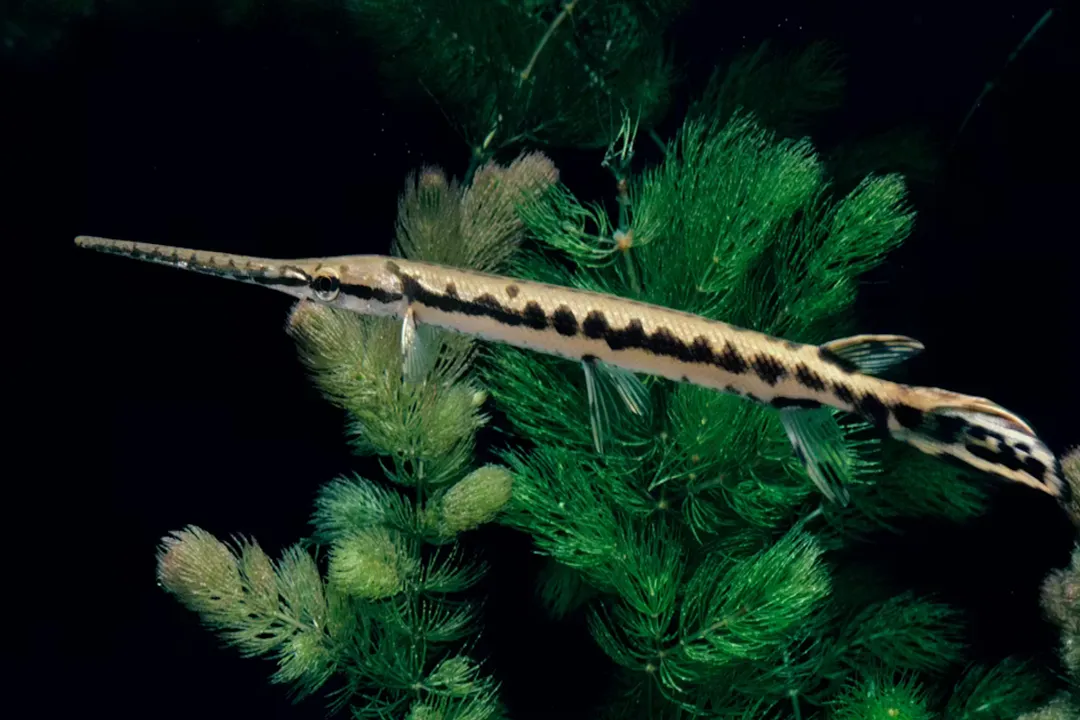
Coloration in the longnose gar is surprisingly variable, often adapting to its immediate surroundings, ranging from olivaceous brown to deep green along the back and upper sides, fading down to a pale yellow or white belly. [3][5][6][9] A key identifying mark across most of the body and on the dorsal, anal, and caudal fins are dark spots; however, these spots typically do not extend onto the head, which helps distinguish it from some relatives. [3][8] Young specimens often exhibit a distinct black stripe running along their sides. [3][9] While they share the gar family with much larger cousins like the alligator gar, the longnose gar remains a large freshwater fish itself. While northern populations might rarely exceed four or five feet, individuals in warmer waters can grow to impressive sizes, with records reaching nearly 7 feet and weights approaching 50 pounds. [2][3][4] Interestingly, sexual dimorphism is clear: females generally grow larger and live longer than the males of the species. [2][3][5]
# Survival Adaptations
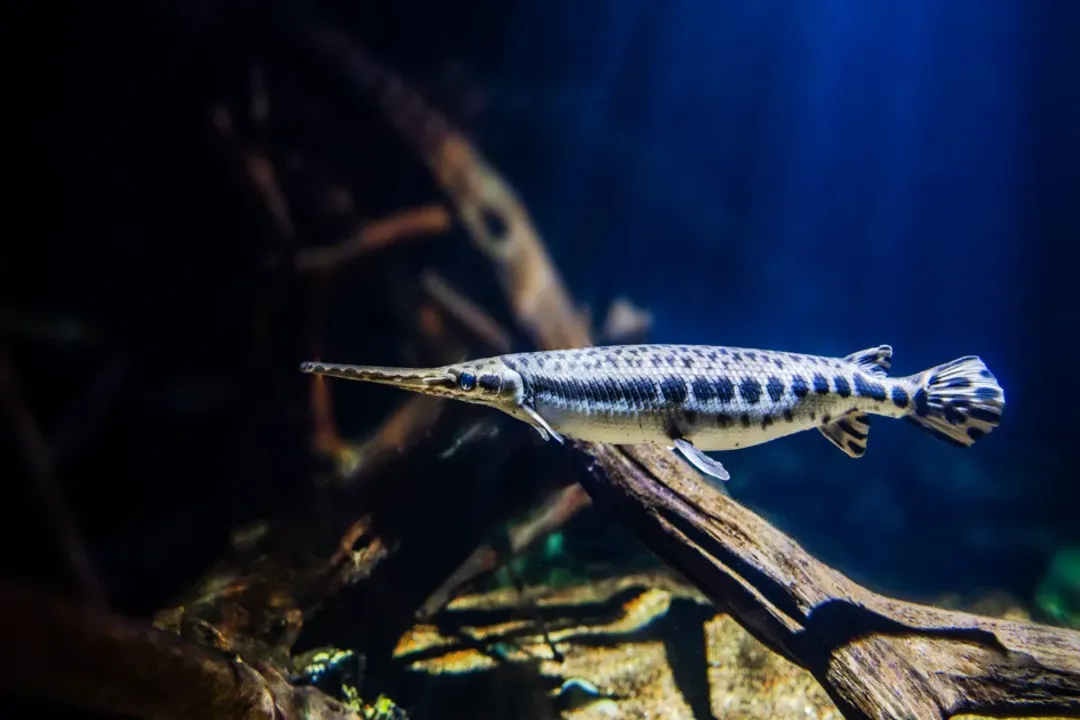
One of the most critical features ensuring the longnose gar’s long tenure on Earth is its unique respiratory system. While they possess gills, gars also have a highly vascularized swim bladder connected to their pharynx or esophagus, allowing them to gulp atmospheric air when necessary. [1][3][6][9] This facultative air breathing is a lifesaver in stagnant or warm waters where dissolved oxygen levels plummet, enabling the gar to thrive where other fish suffocate. [3][6][9] Some reports suggest this adaptation is so effective that they can survive out of water for over 24 hours. [8] This ability has allowed them to colonize a vast geographic range, spanning from the St. Lawrence River in Quebec down to the Rio Grande basin in Texas and northern Mexico, inhabiting everything from slow backwaters to occasionally entering brackish environments. [3][5][9]
# Hunting Tactics
The longnose gar employs a specialized and highly effective predatory strategy rooted in surprise. They are primarily ambush predators, often found floating motionless near the water's surface or slowly stalking their quarry, usually preferring to feed at night. [3][5] When prey—typically small fish like sunfish, perch, or menhaden—wanders into range, the gar executes an explosive strike. [1][3] The body tenses into an S-shape, acting like a coiled spring before the lunge. [1] The characteristic feeding motion involves thrashing the head from side to side, impaling the victim on the needle-sharp teeth before maneuvering the impaled fish to be swallowed whole, always headfirst. [3][8] While their appearance suggests they are built to take down any creature that crosses their path, observations suggest that due to their mouth structure, they are restricted to impaling prey that fits within the gape between their snout-bound teeth. [9] An expert angler targeting these fish might find that setting out a decoy lure made of frayed rope or panty hose can sometimes work, as the gar’s teeth become entangled in the material even without a hook present. [7]
# Reproductive Strategy
Spawning for the longnose gar occurs across the late spring and early summer, generally between April and August, depending on the local climate. [1][3][6] Adults migrate from their usual sluggish habitats into smaller, clearer streams with quicker moving water or gravel shoals to reproduce. [3][5][6] A single female may be accompanied by several males—sometimes as many as 15—who fertilize her sticky, adhesive eggs as they are released and sink to the bottom substrate. [1][5][7] These eggs are notably protected by a substance that is poisonous to both animals and humans. [1][3][8] Parental care ceases after the eggs are laid, but the survival of the young can paradoxically receive a boost from unrelated neighbors. In some areas, like Virginia, gar eggs and larvae are sometimes found in the nesting sites of Smallmouth Bass, where the male bass inadvertently guards the young gars along with its own brood. [6][5] The hatchlings, initially only 8 to 10 mm long, use an adhesive disc on their snouts to cling vertically to submerged objects until their yolk sac is absorbed, which takes about nine days; only then can they take their first aerial breath and begin feeding on tiny invertebrates before transitioning rapidly to a diet of fish. [3][5][9] Males reach sexual maturity around three to four years, while females take longer, reaching maturity closer to six years of age. [1][3]
# Human Perceptions
Despite their ecological importance as apex predators, which keeps other species populations in check, the longnose gar often suffers from a poor public image among recreational fishers. [1][3] This negative view stems from the perception that they compete directly with more "desirable" sportfish species for resources. [1][9] However, studies indicate that their primary diet consists of rough fish or abundant juvenile species, suggesting they are crucial for maintaining overall ecosystem balance rather than solely targeting game fish. [3][8] If one chooses to harvest this fish, the meat requires careful preparation, often described as gritty but high in protein, pairing well with strong flavors like Cajun seasoning. [1] The tough ganoid scales necessitate sharp implements, like tin snips, to cut open the fish, but the top loin meat is reputedly quite good when prepared correctly. [7] This fish, which deserves protection due to its historical significance and ecological function, is common and secure across most of its range, though it has been extirpated from some peripheral northern areas. [1][3] Considering the differing lifespans, where females can live over two decades and males rarely surpass 11 years, [3] local conservation efforts focused on ensuring habitat quality across all life stages—from the protected gravel streams for spawning to the slow backwaters for juvenile feeding—are necessary to sustain this ancient predator.
Related Questions
#Citations
Longnose Gar – Discover Fishes - Florida Museum of Natural History
Longnose Gar - National Aquarium
Longnose Gar Fish Facts - Lepisosteus osseus - A-Z Animals
Longnose Gar: Fish Description & Facts | WVDNR
Creature Feature: Hidden Value of the Longnose Gar
Longnose Gar - Georgia Aquarium
Longnose Gar - Virginia Department of Wildlife Resources
Longnose Gar | Vermont Fish & Wildlife Department
Long-nosed Gar (Lepisosteus osseus) - Mississippi National River ...