What are some fun facts about Egyptian tortoises?
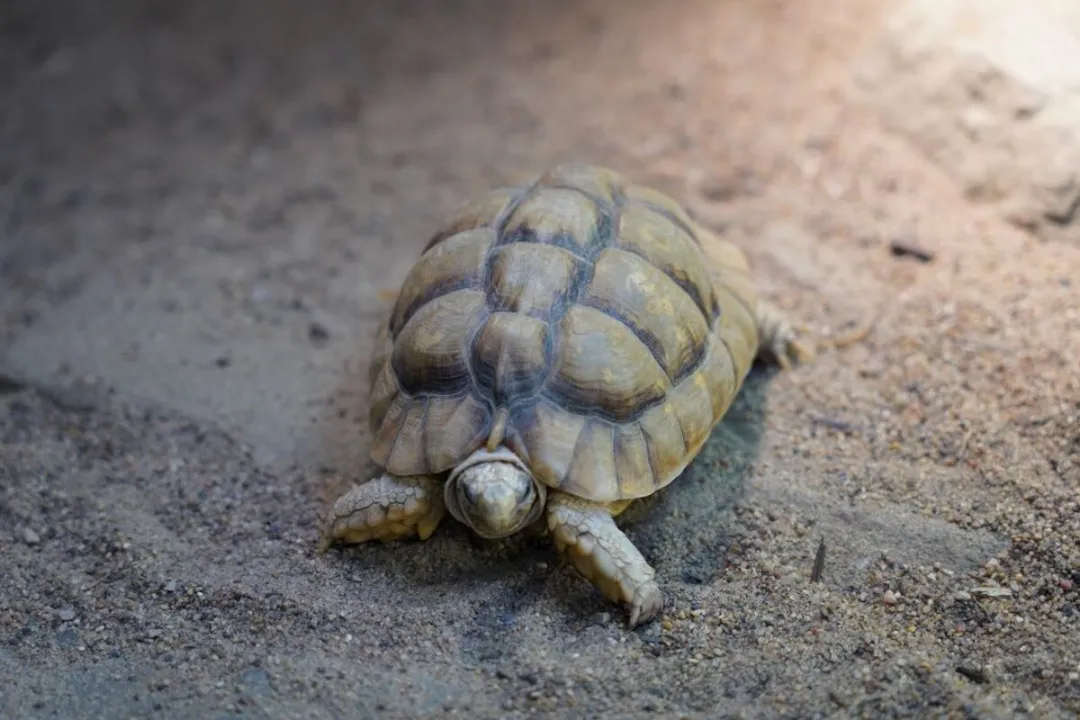
The Testudo kleinmanni, commonly known as the Egyptian tortoise or Kleinmann's tortoise, holds a special, albeit precarious, place in the world of chelonians. [2][3] This creature is remarkable not just for its historical association with ancient Egypt, but for being among the absolute smallest tortoises on the planet. [2][6] While many imagine tortoises as slow, massive reptiles, the Egyptian tortoise defies that stereotype, presenting a tiny package of desert survival mastery. [6]
# Size Marvel
Perhaps the most immediately striking feature of this species is its diminutive stature. It ranks as the smallest tortoise found in the entire Northern Hemisphere, surpassed globally only by South Africa's speckled padloper. [2][7] Full-grown individuals typically reach a shell length of around $14$ to $14.4$ centimeters, or just under $6$ inches. [2][7] In terms of weight, they are incredibly light, usually falling between $150$ and $350$ grams. [2][3] To put that into perspective, one source notes that it would take roughly $400$ Egyptian tortoises to equal the mass of a single Galapagos tortoise. [2]
Sexual dimorphism is present; generally, the females grow larger than the males. [1][2] However, the males compensate with longer tails. [1][7] Their overall shape is also distinct, featuring a relatively high-domed shell sitting atop a tiny body. [2]
# Color and Camouflage
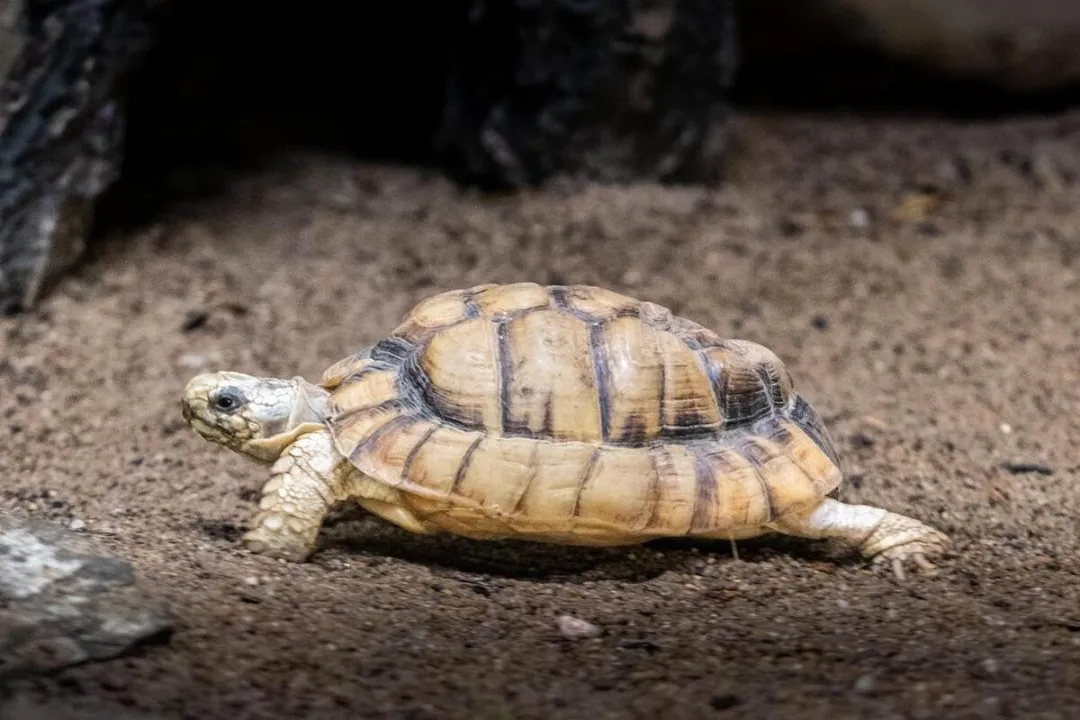
The coloration of the Egyptian tortoise is a textbook example of desert adaptation. Their carapace—the upper shell—is characteristically pale, ranging across shades of ivory, pale golden, brown, and gray. [1][2] This lightness serves two vital functions. First, the pale hue is excellent for camouflage against the sandy and stony desert terrain they inhabit, helping them avoid detection by predators like ravens or monitor lizards. [1][2][7] Second, this light coloring reflects the intense solar radiation of their arid home, actively helping to keep them cool. [2][6] The undershell, or plastron, is usually light yellow, often sporting dark, triangular notches on the abdominal scutes. [2]
# A Desert Existence

The native range of T. kleinmanni is the Mediterranean coastal strip across North Africa. [3][8] Historically, they were found across Egypt, Libya, and Israel. [2][3] A sobering fact, however, is their disappearance from much of this territory. They are now essentially extinct in Egypt, with only scattered, isolated populations remaining in two areas of Libya, specifically Tripolitania and Cyrenaica. [1][3][8]
Their chosen habitat aligns perfectly with their physical adaptations: sandy deserts, semi-desert areas featuring scattered rocks, gravel plains, and even dry woodlands or coastal salt marshes. [1][3] They are terrestrial creatures, preferring to stay on the land. [3]
One of the most interesting behavioral adaptations linked to their habitat is their use of existing structures for shelter. They are known to take over abandoned rodent burrows, digging their own nests only about $3$ to $5$ centimeters down into the sandy earth when it is time to lay eggs. [1][7] This burrowing provides crucial refuge from the harsh, fluctuating desert temperatures. [6]
# The Art of Thermoregulation

As ectotherms, these small tortoises rely entirely on their environment to manage their body temperature. [6] Since they live where temperatures swing dramatically between day and night, timing their activity is essential. They are primarily diurnal, meaning they are active during the day, but they are smart about when during the day they choose to be active. [3] In the cooler months, they forage around midday when things warm up slightly, but when the summer heat peaks, they restrict their activity to the early morning (dawn) and late afternoon (dusk). [1][3][7] For the remainder of the hottest periods, they retreat to shade or their burrows. [3]
It might seem counterintuitive that such a small animal, which loses heat quickly, thrives in the desert. Here is where their size becomes an unexpected asset: being small allows them to warm up quickly when they need to absorb solar energy, but critically, it also allows them to utilize shallow burrows or small shadows to rapidly lose excess heat, preventing fatal overheating better than a larger reptile might in the same surface conditions. [6]

# Hydration and Diet Secrets
The Egyptian tortoise is a strict herbivore. [3][5] In captivity, their diet often consists of grasses, vegetables, and some fruit, requiring a high calcium-to-phosphorus ratio. [1][2] In the wild, sources suggest they eat seasonal plants, including saltwort and sea lavender. [2]
Their most fascinating survival trick relates to water conservation. Due to the extreme scarcity of rainfall in their range, these tortoises have developed exceptional methods for hydration. They rarely need to drink standing water. Instead, they derive the necessary moisture content by consuming plants high in water, such as succulents and cacti. [2][3] Furthermore, they are uricotelic, meaning they excrete waste as highly concentrated uric acid rather than liquid urine, a brilliant adaptation to prevent unnecessary water loss from their bodies. [1]
# Breeding and Life Cycle
Reproduction in this species follows a schedule dictated by the season, generally occurring around March in the wild, though captive breeding can sometimes be observed later in the year. [2][3] The mating system is often described as polygynous (one male with multiple females) and potentially polyandrous (one female with multiple males). [3]
One truly unique detail about their courtship involves sound: unlike many other Mediterranean tortoises, the male Egyptian tortoise produces a loud, distinctive call during mating rituals, often compared to the sound of a mourning dove. [2][3] Following this auditory invitation, the male may physically strike the female with his shell, initiating the mating sequence. [2]
The female lays a small clutch, typically between one and five eggs, depositing them in the excavated nests or existing burrows. [1][7] Because the eggs are quite large relative to the female's small body size, they can only produce a few offspring at a time. [1] The incubation period is long, lasting between $70$ and $111$ days. [1][7] When the young hatchlings emerge, they are minuscule, weighing only $4$ to $5$ grams and measuring about $28$ to $30$ millimeters in length. [1] Interestingly, these hatchlings spend their first period of inactivity resting and feeding minimally until the fall temperatures become more moderate. [2]

# Conservation Concerns
The very characteristics that allow the Egyptian tortoise to survive in the harsh desert—its small size, slow reproductive rate, and reliance on specific coastal habitats—now make it extremely vulnerable to modern pressures. [1][3] Its IUCN Red List status is Critically Endangered. [1][5] The population has seen catastrophic declines; one estimate suggests the total world population is only around $7,470$ individuals, with about $5,000$ mature ones remaining. [2][3]
The primary threats are twofold: habitat loss and direct exploitation. Urban expansion, agriculture, and overgrazing by domestic livestock like goats and camels have destroyed much of their fragile environment and food sources. [1][5][8] Simultaneously, they have been heavily targeted for the international pet trade. [1][7] Although CITES Appendix I listing makes international commercial trade illegal, illegal collection, particularly in Libya where protection is less stringent than in Egypt (where they are functionally extinct), continues to decimate the remaining wild numbers. [1][7] Their long lifespan and low reproductive capacity mean that populations recover very slowly, amplifying the impact of every individual lost. [1]
If you ever encounter one of these amazing, small desert survivors, remember their specialized needs. Trying to keep one as a pet is strongly discouraged, both because of the legal restrictions surrounding this critically endangered species and because their strict environmental requirements—especially regarding precise temperature gradients—make captive care extraordinarily difficult for the average keeper. [6] Providing the right steep temperature drop at night, for instance, is just as vital as providing high basking heat during the day to mimic their natural cycle, a nuance often overlooked when mimicking desert conditions. [3][6] Supporting accredited zoo conservation programs is the best way to ensure Testudo kleinmanni does not vanish completely. [5]
# Collective Nouns
For fun, beyond their scientific classification, a group of these small tortoises is known by a few charming collective nouns. They can be called a creep, a nest, a bale, or a dole. [3][5] It is a fitting set of names for a group that spends much of its time sheltered in burrows or hiding from the sun. [3]
Related Questions
#Citations
Egyptian Tortoise - Facts, Diet, Habitat & Pictures on Animalia.bio
Egyptian Tortoises - Wilder Institute/Calgary Zoo
Egyptian Tortoise - Visit the Virginia Zoo Animals Today!
Egyptian Tortoise - Saginaw Children's Zoo
Egyptian Tortoise | Woburn Safari Park
Egyptian Tortoise - Facts, Size, Habitat, Diet & Pictures - Animal Spot
Egyptian Tortoise - Testudo kleinmanni - Marwell Zoo
Egyptian Tortoise - BCA Zoo