What are some cool facts about American Bulldogs?

This powerful canine, often misunderstood due to its intimidating appearance, carries a rich history rooted firmly in the working class farms and homesteads of the American South. The American Bulldog is not merely a modern creation; it descends from the Old English Bulldog brought over by working-class immigrants centuries ago. Unlike the smaller, heavily modified bulldog breed seen in many show rings today, these ancestors were essential tools for survival, tasked with everything from guarding property to catching unruly livestock like feral hogs. This demanding background forged the breed’s characteristic determination and surprising athleticism.
# Southern Roots

The story of the American Bulldog is intrinsically linked to the agricultural needs of the American South, particularly in states like Georgia and Alabama. When European settlers arrived, they brought their versatile bulldogs with them. These dogs needed to be strong enough to tackle large, dangerous animals but also smart and loyal enough to live closely with the family. This necessity for a multi-purpose farm dog—part protector, part working partner—drove the initial selection process for the breed.
It is important to note the divergence from other bulldog types early on. While the English Bulldog became specialized for bull-baiting and later, companionship, the American version maintained its working structure. This dedication to function meant that early American breeders valued utility over a strict aesthetic standard for many decades, allowing for significant variation in appearance based on regional needs.
# Breed Types

One of the most fascinating aspects of the breed is that it isn't a single, monolithic entity recognized uniformly across all major clubs. The American Bulldog exists in several recognized types, often reflecting the specific bloodlines that were preserved by different dedicated breeders over time. Understanding these differences can clarify why two dogs, both called American Bulldogs, might look quite distinct.
The main classifications generally fall into distinct categories, often named after the foundational breeders whose lines they follow, such as the Johnson or Scott types.
- Johnson Type: These dogs tend to be heavier, more massive, and possess a more pronounced, square-shaped head. They often present a more Mastiff-like appearance and may have shorter muzzles compared to other types.
- Scott Type: Conversely, the Scott type usually maintains a more athletic, agile physique. Their heads are typically less blocky, and they exhibit a look that leans closer to the original working ancestors.
- Hybrid/Performance Types: Many modern lines are crosses or blends, sometimes referred to simply as Performance or Hybrid Bulldogs, aiming to balance the power of the Johnson type with the athleticism of the Scott type, or focusing on specific working drives.
A key point of divergence in the community centers on muzzle length and head size. Some owners strongly prefer the more compact, powerful look associated with the Johnson line, while others prioritize the increased breathing capacity and stamina found in the longer-muzzled Scott or Performance variants. If you are looking at a puppy, asking about its lineage—whether it leans towards the bulky look or the agile look—is crucial for predicting its adult structure and energy level. This variety is a testament to the breed’s history as a working dog where specific tasks dictated desired physical traits, rather than a standardized show ring template.

# Temperament Traits

Despite the breed’s imposing physical presence, the temperament is frequently described by devoted owners as surprisingly soft and deeply affectionate with their immediate families. They often thrive on being central figures in household activities, showing a profound desire to be close to their humans, which sometimes translates into a need to lean heavily against their owners—a characteristic affectionately dubbed the "Bully lean".
However, their history as guardians does not disappear. They are naturally protective and often reserved or wary around strangers. This natural guarding instinct necessitates early, consistent socialization. An American Bulldog that isn't properly introduced to a wide variety of people, places, and situations during its formative months can become overly suspicious or reactive. Owners frequently note that while they are excellent, gentle companions for children within their own family, their sheer size and boisterous play style require supervision around very small toddlers.
The intelligence of the American Bulldog is often overshadowed by its strength and stubbornness. They are intelligent dogs capable of learning complex tasks, but they possess a strong will. Training requires consistency, positive reinforcement, and an understanding that they may question commands they deem unnecessary.
One perspective shared by dedicated owners highlights this duality: "They look like they are carved out of stone, but they melt the second you sit on the couch. You have to treat them like a devoted bodyguard who secretly just wants to be a lapdog."
To successfully manage this combination of devotion and determination, think of training less as establishing dominance and more as developing a clear, respectful partnership. If training is approached as a negotiation rather than a command structure, the dog is more likely to comply willingly. This is an area where owners must be more diligent than they might be with a naturally eager-to-please breed.
# Physical Power

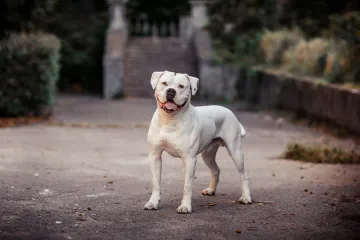
Physically, the American Bulldog is built for power and stamina. They are medium-to-large dogs, sturdy, muscular, and athletic, though the exact height and weight vary considerably depending on which strain of the breed they descend from. Males typically weigh between 60 to 120 pounds and stand between 20 to 28 inches at the shoulder, with females being slightly smaller.
Their heads are characteristically broad and blocky, housing a strong jaw—a necessity for their historical work catching large game. Their coats are generally short, stiff, and smooth, coming in various colors, with white often being the dominant base color. While their short coats make grooming relatively easy, they do shed, and like many powerful breeds, they can be prone to drooling, especially after drinking water or when excited.
A key anatomical feature related to their working past is their athleticism. Even the heavier Johnson types are surprisingly agile. Early breeders selected dogs that could hold up a struggling hog without tiring easily. This physical capacity means that low-impact, moderate exercise is usually insufficient for a well-adjusted adult. They require activities that allow them to use their muscles and minds, such as long, brisk walks, structured play sessions, or even canine sports like weight pulling or agility, adapted to their physical structure.
# Health and Longevity
Generally, the American Bulldog is considered a relatively healthy breed, often benefiting from the genetic diversity retained due to the lack of overly restrictive kennel club standards for many years. Their typical lifespan ranges from 10 to 14 years. However, their robust structure does not entirely shield them from orthopedic concerns common in many large, heavy breeds.
Hip and elbow dysplasia are potential issues, which speaks to the importance of researching breeders who responsibly screen their breeding stock for these conditions. Another condition sometimes seen is "Cherry Eye," which is the prolapse of the third eyelid gland, often requiring minor surgical correction. Furthermore, due to their powerful jaws and potential for skin fold issues depending on their head shape, routine checks of the mouth and skin creases are essential maintenance tasks for owners.
Considering the known predispositions, a practical health checklist for new owners might look like this:
| Health Focus Area | Recommended Action | Frequency/Timing |
|---|---|---|
| Hip/Elbow Health | Source X-rays from parents; avoid excessive, high-impact jumping as a puppy. | Pre-purchase and throughout growth period. |
| Dental Care | Daily brushing is ideal given their jaw strength; check gums. | Daily/Weekly. |
| Skin Folds | Clean and dry any facial skin creases, especially after water activities. | Daily/After bathing/swimming. |
| Exercise Management | Ensure exercise is strenuous but controlled to protect developing joints. | Daily, tailored to age. |
This focused approach to health, rooted in their physical structure, helps ensure they live long, active lives, honoring their working heritage.
# Recognition Status
It is a common point of interest that the American Bulldog has not historically been recognized by the American Kennel Club (AKC). While this may surprise some, it directly relates back to the breed's history. The AKC primarily recognizes standardized breeds based on established written standards and shows, whereas the American Bulldog developed largely outside this formal structure, valued more for its working ability than its conformity to a look.
However, this doesn't mean the breed lacks structure or devoted advocates. Organizations like the United Kennel Club (UKC) and others do recognize the breed, often utilizing standards that account for the different working types mentioned earlier. For those interested in showing, it's vital to check which registry a specific dog or breeder adheres to, as the definition of a "correct" American Bulldog can vary between these clubs. The rescue community also plays a significant role in maintaining and promoting the breed's welfare, often encountering dogs from various backgrounds.

# The Playful Companion
Beneath the protective veneer and the history of tackling livestock lies a dog often described as goofy, playful, and intensely devoted to its immediate family circle. Many owners describe a hilarious contradiction between their dog's massive size and its tendency toward puppy-like antics well into adulthood. They are known to be affectionate with children they are raised with, often seeking physical closeness, which can involve leaning or even attempting to "cuddle" in ways that only a 100-pound animal can manage.
This need for interaction means they do not generally thrive when isolated or left alone for long periods. Boredom in an intelligent, powerful dog like the American Bulldog is a recipe for destructive behavior. They require significant engagement, whether that is structured training, challenging puzzle toys, or simply being involved in household activities. Providing them with an appropriate outlet for their energy is non-negotiable for maintaining a peaceful home environment. Failing to meet this need for mental and physical stimulation often results in the dog finding its own entertainment, which usually involves chewing or digging.
# Training and Socialization Focus
Given their protective nature and inherent stubbornness, the training phase for an American Bulldog puppy is perhaps the most critical period in its entire life. Proper socialization must begin immediately, focusing not just on exposure but on positive association. This means taking the puppy to neutral, safe places—a busy park where they can observe from a distance, a quiet store, or a friend's house—and rewarding calm behavior when encountering new stimuli.
A useful approach that many experienced owners suggest centers around choice during training sessions. Because they are so willful, forcing an interaction often results in resistance. Instead, structure training to make the dog want to offer the desired behavior. For instance, if you are teaching "sit," use a lure that makes the dog choose to sit to get the reward, rather than physically forcing the rear down. This method respects their inherent independence while teaching them that working with you is rewarding. This subtle difference in approach, focusing on building desire over imposing compliance, is key to unlocking the best in this breed.
When addressing their protective instincts, the goal is not to suppress their awareness but to teach them when and how to offer a warning versus when to remain neutral. They must learn that you are in charge of assessing threats, not them. This requires unwavering consistency from every member of the household, as any wavering in leadership can be interpreted as an invitation for the dog to step into the guardian role full-time. Successfully navigating these early training and socialization hurdles results in an incredibly loyal, confident, and well-mannered companion whose strength is only matched by its devotion.
#Videos
The Truth About AMERICAN BULLDOGS - YouTube
Related Questions
#Citations
10 Interesting Facts About American Bulldogs (Vet-Verified) - Dogster
32 facts about American Bulldogs | PetsRadar
5 Fun Facts About American Bulldogs | National Kennel Club
Here are some fun facts about American Bulldogs: athletic, loyal ...
The Truth About AMERICAN BULLDOGS - YouTube
American Bulldog Facts
American Bulldog Breed: Characteristics, Care & Photos | Chewy
How is owning an American Bulldog? : r/americanbulldog - Reddit
American Bulldog - Wikipedia