How can I tell if my dog is an American Bulldog?
Figuring out if the powerful dog trotting beside you carries the genetics of an American Bulldog involves looking closely at structure, history, and a few key physical markers that set them apart from their cousins. These dogs are not merely a generic "bully breed"; they represent a specific lineage developed in the American South for demanding farm work. [2][7] Understanding their heritage—as working catch dogs for livestock like hogs—helps explain the powerful build they carry today. [2][7] Unlike many modern breeds bred primarily for show, the American Bulldog retained a functional physique suited for labor, which is often the first clue to their identity. [2]
# Physical Markers
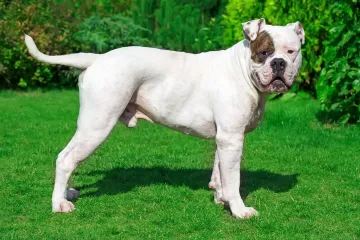
The defining features of the American Bulldog are centered around its impressive musculature and distinct head shape. Generally, an American Bulldog is a powerfully built, stocky dog. [2][7] They are solidly built, conveying strength and agility required for their historical tasks. [9]
# Head Structure
The head is one of the most critical identifiers. An American Bulldog typically has a large, broad, and square-shaped head. [2] The muzzle is relatively short and wide, making the face look substantial. [2] When you look at the dog head-on, the eyes are usually set wide apart. [2] They should exhibit strong jaws, and some may have a slight underbite, which is a characteristic sometimes present in the breed. [1] The overall impression is one of confidence and substance, not delicacy. [2]
# Coat and Coloration
Their coat is short, smooth, and stiff to the touch. [2] Coloration is highly variable, which can sometimes complicate identification if one expects only a solid white dog. Acceptable colors include white, brindle, fawn, red, brown, or black, or any combination of these, often appearing as patches. [2][9] If your dog is mostly white, look for patches of color on the head or body; solid white dogs are often discouraged in breed standards due to potential deafness issues, though they certainly exist in the broader population. [9]
# Size and Weight
Size can vary considerably, which leads directly into the discussion of breed types, but there are general expectations. Reputable breed standards usually place the American Bulldog weight between 60 to 120 pounds. [2] Their height typically ranges from about 20 inches up to 28 inches at the shoulder. [2] If your dog is significantly smaller, say under 45 pounds, or much larger and heavier-boned than 140 pounds without a clear history of mastiff influence, it warrants closer inspection regarding lineage. [9][2]
# Breed Types
One challenging aspect of identification is that the American Bulldog isn't monolithic; it encompasses a spectrum of physical styles stemming from regional breeding preferences over time. [4] Recognizing these types can help you place your dog more accurately within the breed umbrella.
# Johnson Versus Scott
The two most commonly discussed variations reflect differing priorities in breeding. The Johnson type (often called the "Bully" type) tends to be heavier-boned, wider, and possesses a more massive, blocky head. [1][4] They look like a classic, heavy-set bulldog type, optimized for power and mass. [4]
Conversely, the Scott type is generally more athletic, leaner, and taller. [4] Bred more for speed and endurance—traits necessary for catching and holding livestock over rough terrain—these dogs look functionally fit, sometimes resembling a large American Pit Bull Terrier but with a distinctly broader head and chest. [4] Some registries also acknowledge a Hybrid type, which is simply a mix of the Johnson and Scott characteristics. [4] When assessing your dog, look at where it falls on this spectrum: is it built like a tank (Johnson), or built like a powerful middle-distance runner (Scott)?. [1]

# Temperament Clues
While physical traits confirm the look, temperament often confirms the spirit of the breed. American Bulldogs are fundamentally loyal, confident, and possess strong protective instincts. [2][7] They bond deeply with their families and can be quite affectionate with them. [2]
This protective nature means that while they may be gentle giants with their inner circle, they require consistent training and early socialization to ensure they understand appropriate boundaries with strangers and other animals. [2][7] A dog that seems overly timid or extremely aggressive without any positive exposure to new sights and sounds might suggest a mixed heritage, as true American Bulldogs generally possess an inherent, sturdy confidence. [7]
One interesting behavior often seen in well-bred American Bulldogs is their intense focus when given a task, which speaks directly to their working background. If your dog seems to hyper-focus on controlling the movement of your family members (herding behavior) or exhibits an almost obsessive interest in retrieving toys, it’s a strong indicator of the breed’s deep-seated drive to work. [2] However, channeling that drive is key; if you are seeing excessive anxiety or reactivity when faced with novel situations, consider that this is where intensive early exposure (before 16 weeks, if possible) makes the difference between a confident protector and an overly anxious guardian. [7] The genetics provide the capacity for guarding, but the environment sculpts the expression.
# Sorting Similar Breeds
The most common hurdle in identifying an American Bulldog is distinguishing it from breeds that share similar ancestry or physical characteristics, most notably the American Bully and the American Pit Bull Terrier (APBT).
# American Bulldog Versus American Bully
This is perhaps the most confusing pairing today because the American Bully breed was developed using American Bulldog stock, among others. [3] The key differentiator here is refinement and compactness.
American Bullies are generally shorter, stockier, and lower to the ground than the American Bulldog. [3] While both are muscular, the Bully often has a more exaggerated, almost "pear-shaped" body composition, with an extremely wide chest relative to its height. [3] Furthermore, the head shape in many American Bullies can appear more rounded or "pushed in" compared to the broader, more defined square muzzle of the American Bulldog. [3] If you have a dog under 70 pounds that looks incredibly thick and low-slung, leaning toward the appearance of a bodybuilder, it's more likely to be an American Bully or a mix thereof. [3]
# American Bulldog Versus Pit Bull
When comparing the American Bulldog to the APBT, size and bone structure are the tell-tale signs. [8] The American Bulldog is structurally heavier and larger than the typical APBT. [8] While APBTs are athletic and muscular, they tend to be leaner and possess a more streamlined appearance. [8] An American Bulldog carries more bulk and exhibits heavier bone mass throughout its frame compared to the APBT. [8] Think of the APBT as a middleweight boxer and the American Bulldog as a heavyweight—both strong, but the weight distribution and frame are noticeably different. [8]
# A Quick Comparison Table
To help simplify the visual assessment, here is a breakdown of general expectations for these three breeds, keeping in mind that mixes will blur these lines:
| Feature | American Bulldog (AB) | American Bully (AmBully) | American Pit Bull Terrier (APBT) |
|---|---|---|---|
| General Build | Muscular, sturdy, athletic to blocky [2][9] | Compact, low to the ground, exaggerated muscle [3] | Lean, athletic, medium build [8] |
| Head Shape | Large, broad, square muzzle [2] | Rounder, potentially more pushed-in muzzle [3] | Wedge-shaped, moderate stop [8] |
| Weight Range | 60–120+ lbs [2] | Often smaller than AB, highly varied standards | Generally lighter, under 70 lbs common [8] |
| Purpose | Farm Work, Catch Dog, Guardian [2][7] | Companion, Show Dog [3] | Performance, Companion [8] |
# Tracing Heritage and Next Steps
If physical identification still leaves you uncertain, looking at documented history and official recognition status can offer supporting context. The American Bulldog is recognized by the United Kennel Club (UKC), [9] but notably, it is not recognized by the American Kennel Club (AKC). [2] If your dog came with AKC paperwork, it cannot be a purebred American Bulldog, though it could certainly be a mix. [2]
For many owners, especially those with rescue dogs, determining the exact makeup requires more direct evidence. DNA testing services offer a path to gaining clarity on genetic percentages, which can be extremely helpful when dealing with generations of mixed-breed dogs. [6]
It's worth noting that even within purebred lines, variations in size can exist based on the specific working lines bred. [1] For instance, some American Bulldogs descended from lines specifically kept for intense physical work might be unusually large, sometimes exceeding 130 pounds, even without introducing other breeds, simply due to generational focus on maximum working mass. [1] If your dog is unusually large but retains the characteristic square head and powerful build, check if the heritage leans toward specific performance-focused American Bulldog bloodlines rather than immediately assuming a Mastiff mix. [1] This variability means that looking at one isolated trait, like height or weight, without considering the whole structural package can be misleading.
If you are in an area where the American Bully breed has become popular, you may find that many dogs identified casually as "Bulldogs" are actually the newer American Bully strain, simply because they are currently more widespread in pet communities than the traditional American Bulldog. [3] Trusting your eye for the classic, functional structure described in the breed standards—that powerful, working silhouette—will serve you best when trying to confirm this distinctive breed identification. [2][9]
Related Questions
#Citations
How to identify american bulldog or pitbull breed?
American Bulldog - Dog Breed Information
How to determine if your dog is part of the American Bully ...
Anyone here know how to really tell the difference between ...
French, English, or American: How to Know if the Bulldog is ...
American Bulldog Facts - Wisdom Panel™ Dog Breeds
American Bulldog Guide | Complete Breed & Care ...
American Bulldog vs. Pit Bull: Breed Origins and Recognition
Breed Standards : American Bulldog | United Kennel Club ...
I have a pedigree American Bulldog; she is unusually large ...