Waterbuck Physical Characteristics
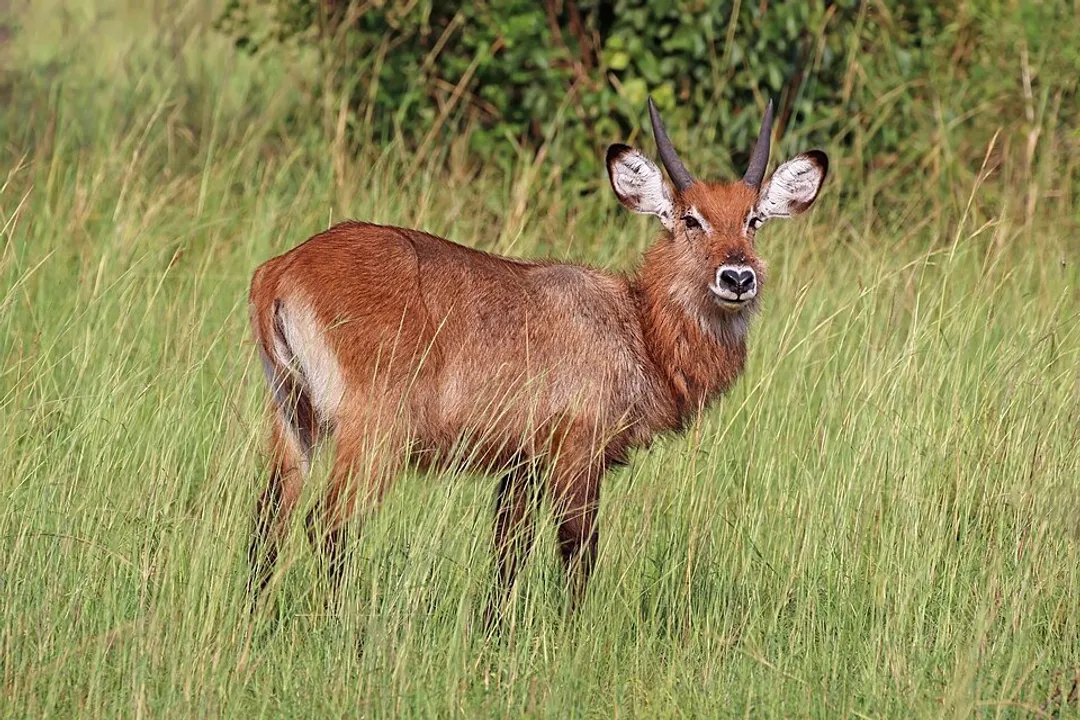
The waterbuck presents an instantly recognizable profile among the large African antelope, characterized by a robust physique and a distinctly shaggy coat that hints at its close association with water sources across its range. These herbivores are built for strength, possessing a powerful frame that aids in navigating marshy terrain and evading predators like lions and hyenas. Their appearance is heavily influenced by subtle variations between subspecies, though several key features remain consistent anchors for identification.
# Size and Build
Waterbuck are among the larger antelope species, exhibiting a noticeable difference in size between the sexes, a common characteristic known as sexual dimorphism. Males generally carry significantly more bulk than their female counterparts. An adult male can stand about 1.3 meters (4.3 feet) high at the shoulder. In terms of mass, weights typically range from 150 kilograms (330 pounds) up to 270 kilograms (600 pounds) for the larger individuals. A good average for a male often settles around 240 kg, while females are usually closer to 160 kg. The overall impression is one of sturdy muscularity, necessary for their lifestyle near rivers and floodplains.
# Coat Texture
The coat of the waterbuck is perhaps its most distinguishing textural characteristic. It is notably coarse and rather shaggy, setting it apart from the smoother coats of many other savanna antelope. This hair appears somewhat dense and tends to have an almost oily sheen, which may contribute to its water-repellent nature, allowing the animal to shake off moisture quickly after wading or swimming. This coarse texture, sometimes described as rough, provides a degree of insulation and protection in their humid environments. It is worth noting that this heavy, oily coat is linked to a strong, musky odor that pervades the animal, which is a separate, though related, physical trait we will examine later. The very nature of this coat suggests an evolutionary adaptation favoring insulation and water shedding over aerodynamic sleekness, contrasting sharply with, say, the fine, velvety coats of gazelles that thrive in arid conditions.
# Coloration Patterns
The base color of the waterbuck’s coat generally falls within shades of gray-brown or reddish-brown, depending on the specific regional population and the animal’s age. However, the true identifier that separates the waterbuck visually is the presence of distinctive white markings.
# White Markings
The most famous marker is the conspicuous white ring circling the rump, situated around the tail area. This feature is so characteristic that it is often the first thing observers notice.
Specific subspecies display this marking differently:
- The Common Waterbuck (Kobus ellipsiprymnus) typically displays this distinct, clear white ring.
- The Defassa Waterbuck (Kobus defassa), found further west, possesses a much broader white patch covering the entire rump area, rather than a sharply defined ring.
Beyond the rump, other areas of white provide additional clues:
- There are usually white rings circling the eyes.
- The muzzle often features white coloration.
- A prominent patch of white hair is frequently visible on the throat.
When observing an animal in the field, noting the clarity and extent of these white signals—especially the rump configuration—is key to subspecies identification, even from a moderate distance.
# Male Horns
Horns are exclusively a feature of the male waterbuck; females are entirely hornless. These impressive appendages start relatively short and gradually grow, developing prominent ridges or rings along their length. The shape is distinctive: they curve backward from the head, then sweep outward, curving forward or upward at the tips.
In terms of length, horns can reach up to 100 centimeters (39 inches). On average, they commonly measure between 30 to 36 inches in length. The spiraled, ridged nature of these horns adds to their imposing appearance, serving as a visual signal of maturity and dominance within the herd structure.
# Scent Glands
One of the most biologically peculiar physical characteristics of the waterbuck relates to its scent production, a feature that significantly influences its interaction with the environment and predators. Waterbuck possess large, complex scent glands situated just below the tail, known as preorbital glands. In addition to these, they have scent glands located on the knees.
These glands excrete a thick, oily, musky substance. This secretion is so potent and pervasive that it often transfers to vegetation the animal brushes against, leaving a noticeable odor. While the exact purpose is complex, it is widely believed that this strong scent acts as a deterrent to predators, making the waterbuck unappetizing or difficult to stalk effectively. This contrasts with many other herbivores that rely more heavily on visual camouflage or speed. Considering the very strong odor, it raises an interesting functional question: if the scent is so easily detected by carnivores, does it present a trade-off? It seems the strong musk provides such an effective chemical defense that it outweighs the disadvantage of being traceable by scent, suggesting that for the waterbuck, being chemically identifiable as "not good to eat" is preferable to being visually concealed but palatable. Their strong odor is certainly memorable to any visitor to their habitat.
# Identifying Features Summary
For anyone attempting to identify a waterbuck in the African bushveld, focusing on a combination of these physical traits provides the best accuracy. Start with the build: large, robust, and often seen near water. Next, examine the coat: it should look shaggy and brownish-gray. Finally, confirm with the distinctive markings: look for the white eye rings and, most importantly, the signature white marking on the rump—either a clear ring or a broad patch—and confirm that only the male possesses the large, ridged, backward-curving horns.
A practical way to visualize the combination of these traits is to imagine an animal the size of a large roan antelope, but with the texture of a bison's winter coat, wearing a stark white "bullseye" painted directly onto its rear end. This combination is rarely mistaken for any other species within the African plains ecosystem. The very existence of such pronounced, almost contrasting, features—the rough, smelly coat versus the bright, contrasting white ring—speaks to a specialized niche where visual signaling and chemical defense are paramount to survival.
Related Questions
#Citations
Waterbuck - Wikipedia
Waterbuck | African Wildlife Foundation
Kobus ellipsiprymnus (waterbuck) - Animal Diversity Web
Waterbuck - Facts, Diet, Habitat & Pictures on Animalia.bio
The Uniqueness of Waterbuck - Londolozi Blog
Fun facts about Waterbuck - Tanda Tula
Defassa Waterbuck Facts and Information | United Parks & Resorts
Waterbuck (Kobus ellipsiprymnus) - Kruger Wildlife Safaris
The waterbuck (Kobus ellipsiprymnus) is a large antelope found ...