How rare are Texas spiny lizards?
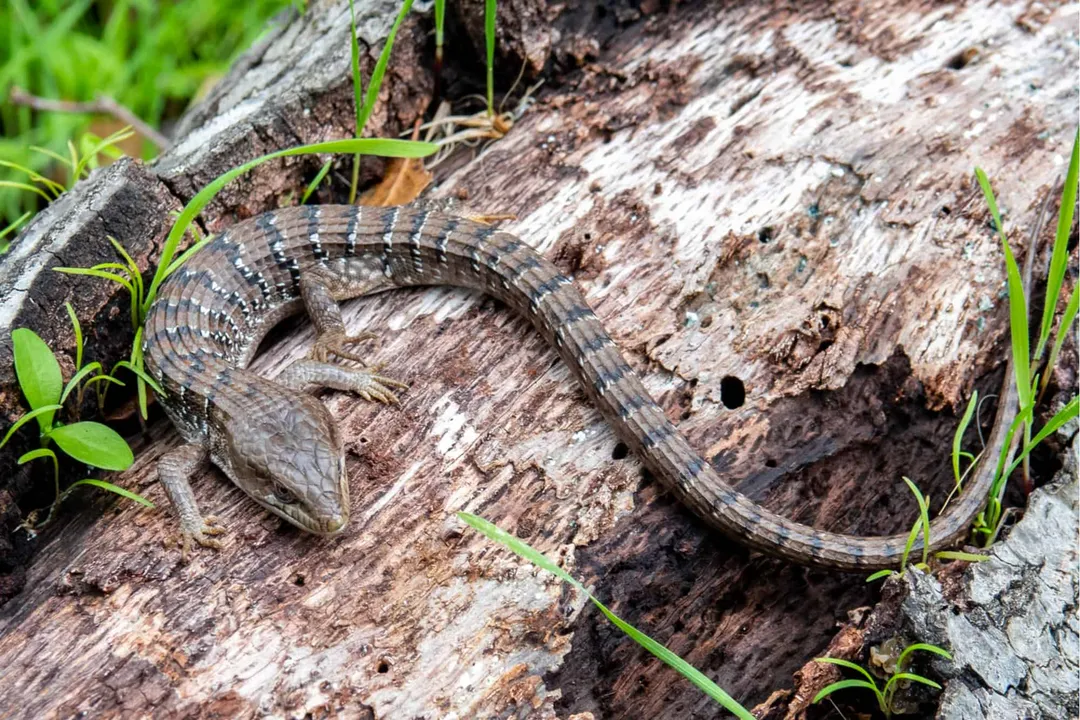
The question of the Texas spiny lizard's rarity is fascinating because it often hinges entirely on where one happens to be looking. This reptile, scientifically known as Sceloporus olivaceus, is not generally considered a species in decline or one facing imminent threats across its entire range; rather, its visibility fluctuates based on local habitat quality and the presence of its close competitors. [2][6] For many residents within its established territory, these lizards are a fairly common, visible fixture, sunning themselves on fence posts or tree trunks. [8] However, in areas where habitat has been heavily altered or where a competitor has gained the upper hand, they can seem decidedly uncommon, leading observers to wonder if they are rare. [5]
# Geographic Spread
The natural distribution of the Texas spiny lizard is concentrated primarily in Texas, stretching across the eastern half of the state. [2] Its range generally lies east of the Balcones Escarpment, extending south to areas near the Gulf Coast and north into the regions bordering Oklahoma. [2] Beyond Texas’s borders, their territory creeps into adjacent states, including parts of Louisiana, Arkansas, and Oklahoma. [2] This geographic spread indicates they are well-established within the subtropical and warm temperate zones they inhabit. [1] They favor environments where they can find abundant vertical surfaces for basking and hunting. [8]
It is worth noting that what constitutes "Texas" in a general sense covers vast ecological differences. A spiny lizard thriving in the dense oak and brush country of the Post Oak Savannah will likely occupy a different microhabitat than one found in the rapidly developing suburbs surrounding Dallas or Houston. [5] Their presence is strongly tied to the availability of specific substrate or structure, such as cedar, mesquite, or even man-made features like utility poles and wooden fences. [1][5]
An interesting observation for those mapping populations is the interplay between this lizard and the Eastern fence lizard (Sceloporus undulatus). Where the ranges of these two species overlap—particularly in the eastern parts of Texas—the dynamics of local abundance become crucial. If a neighborhood features mature, dense shade from traditional, large deciduous trees like established pecan or oak groves, the Eastern fence lizard may have the competitive edge, leading a resident to rarely spot an S. olivaceus and assume it’s rare, when in fact the conditions are just favoring its cousin. [6] Conversely, in areas dominated by mesquite thickets or newer xeriscaped yards featuring more native, scrubbier growth, the Texas spiny lizard often reigns supreme. [5] This local dominance can create a misleading perception of rarity across the state as a whole.
# Visual Profile
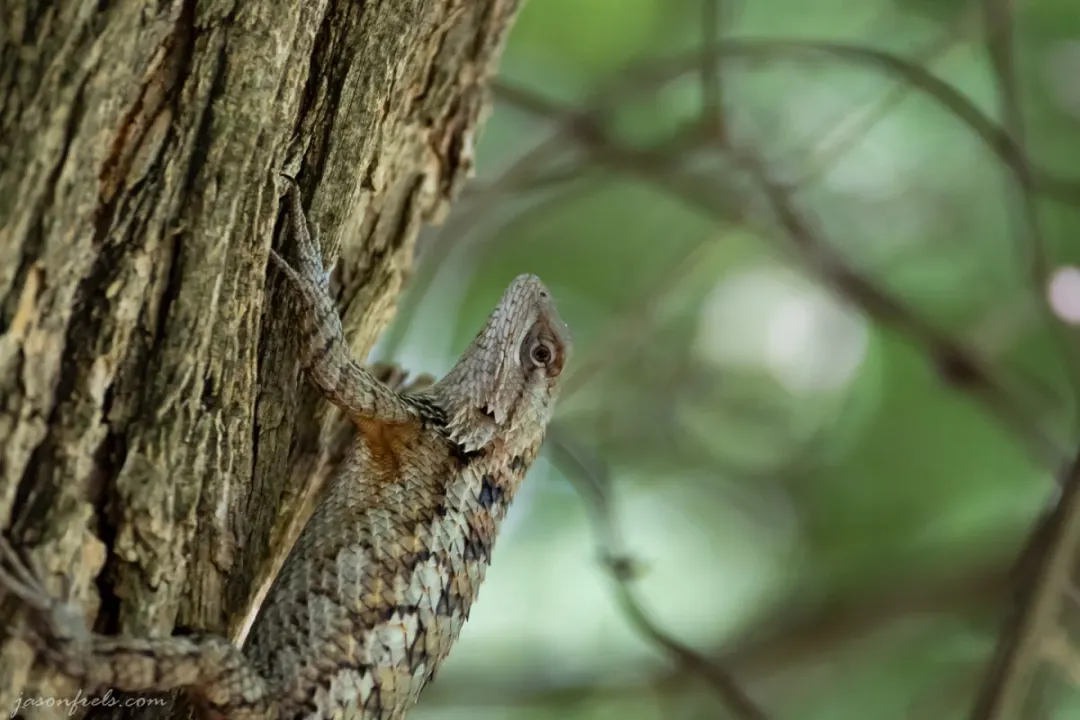
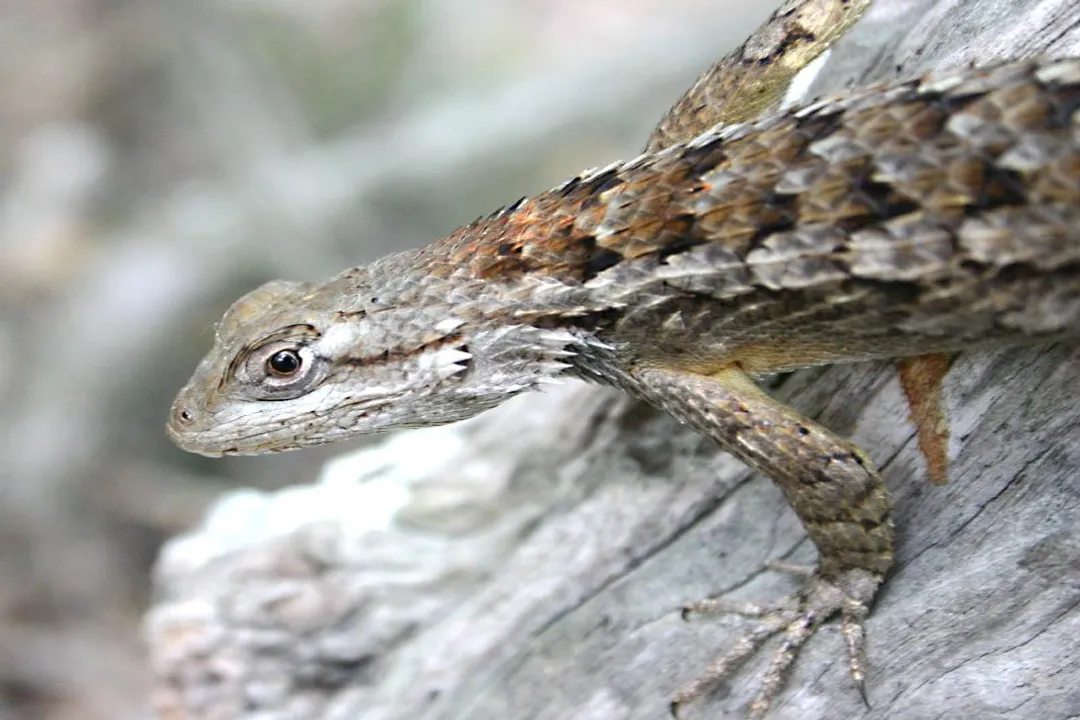
Distinguishing the Texas spiny lizard in the field relies on a few key physical markers, though their camouflage is effective. [8] Adult males often exhibit striking bright blue patches on their throat and sides, which serve as visual signals, particularly during mating displays or territorial disputes. [1][3] Females possess less pronounced markings, often showing pale stripes or a less vibrant overall coloration. [1] Their common name derives from the nature of their scales; they possess prominent, spiny scales, which are characteristic of the Sceloporus genus. [2]
They are medium-sized lizards, generally measuring between 5.5 to 8.5 inches in total length, including the tail. [9] Their coloration usually consists of shades of gray, brown, or olive green, which helps them blend into the bark and soil of their preferred habitats. [1] One distinguishing feature separating them from some other Sceloporus species is the absence of dark banding near the forelimbs, though identification can still be tricky without a close look. [2]
Their diet confirms their role as active, diurnal insectivores. They consume a variety of arthropods, including grasshoppers, beetles, caterpillars, spiders, and ants. [1] This dietary overlap with other small predators means they are constantly competing for resources in their immediate environment. [1]
# Rivalry Explained
The interaction between the Texas spiny lizard and the Eastern fence lizard (S. undulatus) is a classic example of species interaction within a shared habitat, and it directly impacts how "common" one species appears versus the other. [6] These two lizards frequently compete for the same basking spots and insect prey. [6] Research, including work done by biologists at the University of Texas at Arlington, has looked closely at how these two species partition resources. [6]
In areas where both are present, one species often outnumbers the other significantly. [6] This isn't necessarily due to an invasive threat or mass extinction event, but rather resource competition that favors one species under the current local conditions. [6] A key difference noted is that S. olivaceus seems to favor climbing higher up on structures like tree trunks and vertical posts more readily than S. undulatus, though both use fences and walls. [6] This slight difference in vertical stratification can sometimes be just enough to allow both populations to persist, albeit at different local densities. [6] For the backyard observer, if you only see fence lizards darting off the ground-level rocks, you might not realize the spiny lizards are occupying the upper branches of the nearby oak. [8]
When planning habitat restoration or even just backyard landscaping, understanding this competitive relationship offers an actionable tip. To encourage the presence of Sceloporus olivaceus specifically, prioritize planting species that yield sturdy, upright trunks or provide numerous low, south-facing structures for quick morning basking. Mesquite, cedar, and even native prickly pear with stiff pads can offer better microhabitats for the Texas spiny lizard than a lawn dominated by broad, low-growing shade trees, which may better suit S. undulatus. This landscape management choice can directly influence the local population balance you observe. [7]
# Habitat Needs
The ideal environment for the Texas spiny lizard combines two necessities: abundant sunlight and plenty of rough, vertical surfaces for shelter and thermoregulation. [1][8] They are highly dependent on sun exposure, spending significant time basking to raise their body temperatures, a critical behavior for cold-blooded reptiles. [1]
Their preferred substrates for basking and shelter include:
- Mesquite trees and juniper (cedar) [5]
- Fence posts and wooden structures [1][8]
- Utility poles and rock piles [1]
- Structures in suburban yards [5]
They are frequently seen moving quickly between exposed basking spots and the safety of crevices or ground cover when disturbed. [8] This reliance on specific physical structures means that development that removes all deadfall, brush piles, and native woody vegetation can severely limit their local population, even if the overall climate is suitable. [5] While they are adaptable enough to live near humans—even tolerating suburban settings—their presence is still conditional upon the presence of these specific basking and hiding resources. [5]
# Citizen Science
Because the Texas spiny lizard is so widespread and often overlooked in favor of its more generalized cousin, documenting sightings is valuable for understanding its true population dynamics. Citizen science initiatives provide a way for local enthusiasts to contribute data that counters anecdotal assumptions about rarity. [3]
For those interested in tracking their local populations, observing a lizard that exhibits the following characteristics is likely an S. olivaceus:
| Feature | Texas Spiny Lizard (S. olivaceus) | Eastern Fence Lizard (S. undulatus) |
|---|---|---|
| Throat/Belly Color | Bright blue patches on throat and sides (males) [1][3] | Smaller, duller blue/black markings [2] |
| Scale Type | Noticeably spiny scales [2] | Spiny, but often less pronounced overall [2] |
| Preferred Height | Often higher on trunks/vertical surfaces [6] | Tends to stay lower to the ground/rocks [6] |
Seeing one of these lizards actively pushing another lizard off a fence post, as has been documented, is a strong confirmation of its presence and territorial vigor in that spot, suggesting it is far from rare locally. [6]
In summary, the rarity of the Texas spiny lizard is largely a matter of perspective, tied to microhabitat availability and competitive exclusion by the Eastern fence lizard in overlapping zones. [6] If you live within the eastern half of Texas or the adjacent regions, these lizards are likely present; you may simply need to look higher up on the trees or focus your search on mesquite thickets rather than open, grassy areas to confirm their commonality. [1][5] Their visibility is a direct reflection of the structure of the immediate landscape. [7]
#Videos
Texas spiny lizards: The best close-up video you will ever see
Related Questions
#Citations
Sceloporus olivaceus (Texas Spiny Lizard) - Animal Diversity Web
Texas spiny lizard - Wikipedia
Everything to know about the Texas Spiny Lizard
Texas spiny lizards: The best close-up video you will ever see
Suburban Wildlife: Texas Spiny Lizard | City Limits
The Battle Between Two Lizards In Texas Is a Win for UT Arlington ...
Shout Out to Texas Spiny Lizards (Sceloporus olivaceus)... If you ...
Texas Spiny Lizard - Jason Frels
Texas Spiny Lizard - Sceloporus olivaceous - A-Z Animals