How rare is the Pacific footballfish?
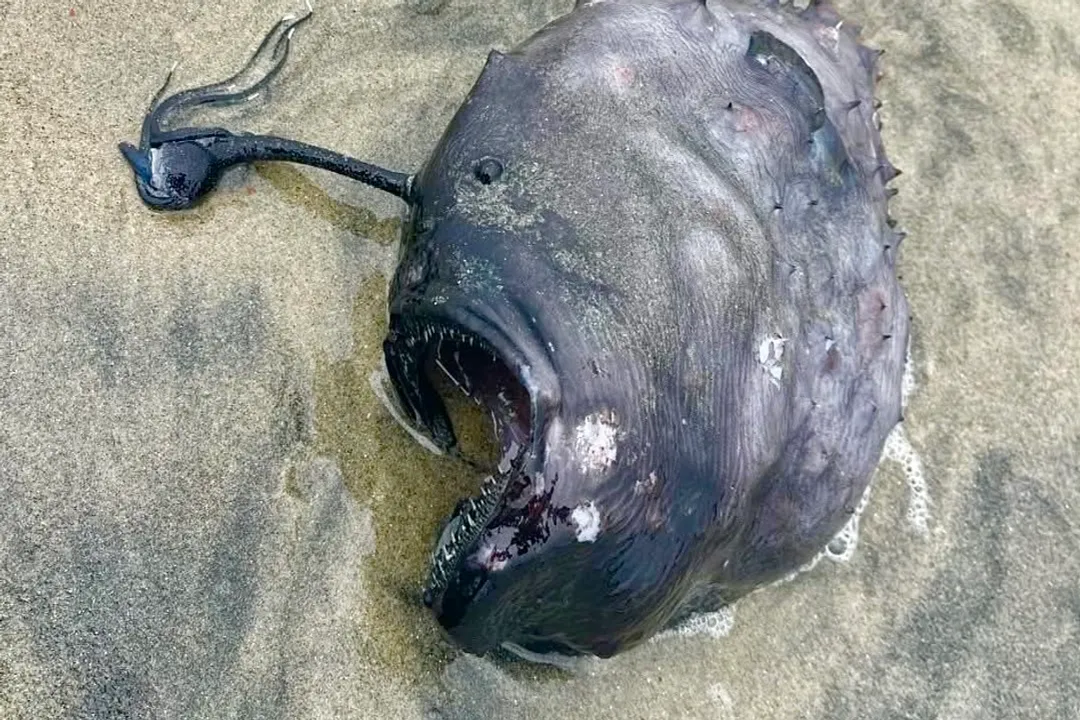
The arrival of a Pacific footballfish onto a sunlit beach or into shallow coastal waters is an event that immediately captures public attention, signaling a rare connection to the crushing darkness miles beneath the waves. These deep-sea dwellers are seldom seen by human eyes, making any documented encounter a noteworthy occurrence for marine biologists and coastal residents alike. [2][4][7] The very nature of their existence—far removed from the surface world—is what makes their occasional, often accidental, appearance so compelling. [4] When these fish wash ashore along the Pacific coast of the United States, it becomes front-page news, sparking widespread curiosity about the creatures that inhabit the ocean's abyss. [5]
# Deep Habitat
The Pacific footballfish, scientifically known as Melanocetus murrayi, is fundamentally an inhabitant of the deep ocean. [6] They reside in zones where sunlight simply cannot penetrate, specifically the mesopelagic and bathypelagic layers of the marine environment. [6] To give some context to how extreme this environment is, consider that sunlight fades significantly below 1,000 meters, and the Pacific footballfish is found well into the aphotic zone where perpetual darkness reigns. [6] The fact that these specimens end up stranded on beaches suggests an extraordinary, and likely fatal, journey, perhaps driven by powerful currents, internal physiological distress, or shifts in deep-sea conditions that force them upward into a water column they cannot tolerate. [1][5] It’s rare to find a creature adapted to immense pressure and total darkness suddenly exposed to the open air and bright sun; such an event is usually the endpoint of their life cycle when interacting with the surface world. [2]
# Physical Form

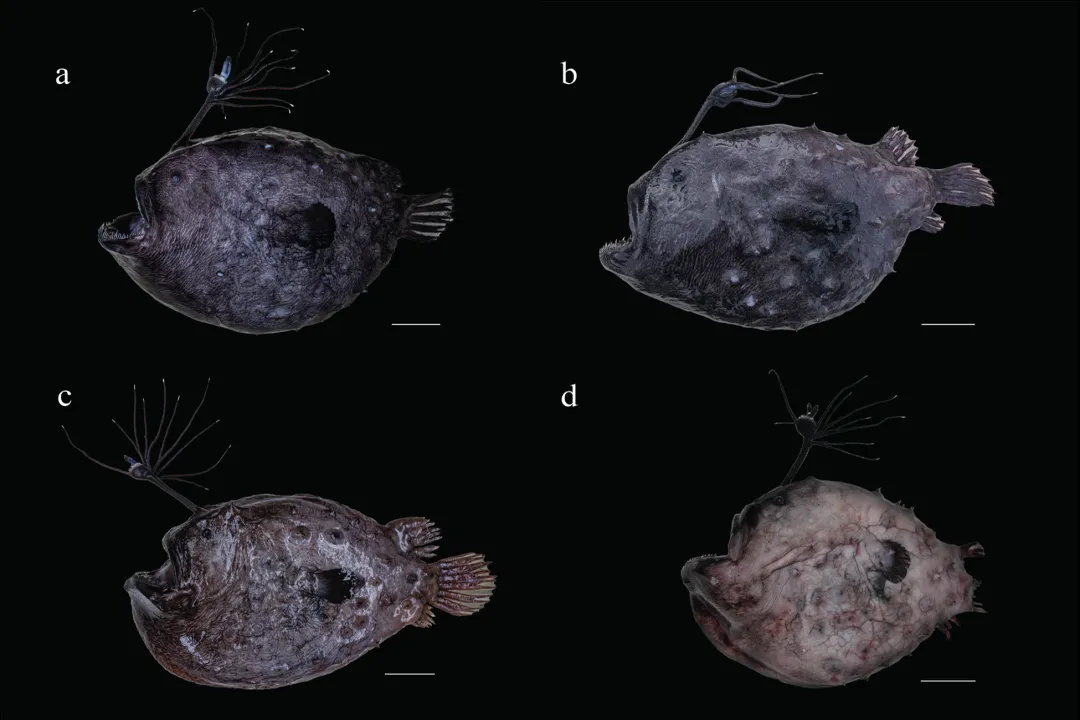
The female Pacific footballfish is instantly recognizable due to its distinct, almost comical, yet terrifying, appearance. [2] They are characteristically black and possess a notably round or bulbous body shape. [1][2][7] The most famous feature, shared with other anglerfish, is the specialized dorsal fin spine, known as the illicium, which extends forward from the head. [6] At the tip of this spine dangles the esca, a bioluminescent lure that glows to attract unsuspecting prey in the absolute blackness of their home. [2][6] This predatory adaptation is critical for survival in a food-scarce environment. [6] One female specimen documented by the California Academy of Sciences measured about 13.5 inches in length, while another reported sighting in California noted a fish over a foot long. [2][6] Beyond the lure, their appearance is often emphasized by their menacing teeth, perfectly suited for grasping any creature unfortunate enough to approach the glowing bait. [7] The combination of the black, round body, and the illuminated appendage gives the fish its unique profile, making it stand out even among other bizarre deep-sea species. [2]

# Rarity Factors
The actual frequency of the Pacific footballfish in the ocean is unknown, as they live far beyond routine observation depths. [6] However, sightings of the fish are unequivocally rare occurrences. [2][4] They are not regularly caught by standard fishing gear targeting shallower waters, and research submersibles rarely encounter them. [6] This scarcity in observation is the primary indicator of their rarity to the general public. When a new specimen is documented, it is treated as a significant find. For instance, several notable strandings have occurred along the Pacific coast over recent years, including one in 2021. [2][5] The appearance of a specimen off the coast of Oregon, for example, immediately generates local and national media coverage because it is such an unusual event. [1] Similarly, when one surfaced in San Diego, it garnered attention across various platforms, including social media feeds, highlighting how unusual these deep-sea visitors are when they reach populated coasts. [4][7]
A fascinating aspect often overlooked in the immediate shock of seeing a deep-sea fish washed ashore is the sheer geographic spread of these events. While one is found in Oregon, another appears in Southern California or Baja California. [1][6] This suggests that the population isn't restricted to one narrow trench but is distributed across vast stretches of the Eastern Pacific deep sea, only occasionally being pushed toward the surface by large-scale oceanic processes. [5]
# Public Reaction
The public response to a footballfish sighting is immediate and intense, often amplified by the visual nature of the fish itself. Social media platforms become a showcase for these "monsters" of the deep. [2][9] Videos and images circulate rapidly, from news segments to short-form content, capturing the unsettling beauty of the creature. [3][8][9] For many viewers, this might be their only exposure to the life existing in the aphotic zones. The reaction is a mixture of awe at the creature's otherworldly looks and perhaps a slight primal fear evoked by its toothy grin and strange structure. [2][7] The fact that a major museum, like the California Academy of Sciences, archives and displays these specimens underscores their scientific and public value. [6] The sheer novelty often overshadows the scientific context, turning the stranded fish into a temporary viral celebrity before it is preserved or studied. [4][7]

# Scientific Significance
From a scientific perspective, every recovered specimen offers a chance to learn about a largely unexplored biome. [5][6] Data collected from a stranded Melanocetus murrayi, such as its physical measurements, gut contents (if intact), and overall condition, contribute to the broader understanding of deep-sea ichthyology. [6] While the creature may have died due to barotrauma (pressure change) or thermal shock upon reaching the surface, its presence tells researchers something about the connectivity of deep-sea ecosystems along the coast. [5] If multiple strandings occur in a short period across a wide area, it might prompt an investigation into localized deep-sea currents or upwelling events that are unusually strong, effectively carrying these deep-dwellers upward into the less-dense water layers near the surface. [1] This scientific gain happens precisely because of the rarity; if they were common, individual strandings wouldn't warrant such detailed reporting or collection efforts.
Considering the immense depth they typically inhabit, one can estimate the pressure difference involved in their journey to the coast. If a fish lives at, say, 1,500 meters, the pressure exerted on its body is around 150 atmospheres (atm), or over 2,100 pounds per square inch (PSI). [6] The surface pressure is just 1 atm. The biological systems of the footballfish—its proteins, cell membranes, and gas-filled spaces—are exquisitely tuned to that high-pressure environment. When this equilibrium is broken, the physical trauma is catastrophic, which is why strandings are almost always fatal and why seeing one alive at the surface is essentially unheard of. [5] This extreme physical barrier reinforces just how rare and special any documented case truly is.
#Videos
The Mysterious Pacific Footballfish - YouTube
Related Questions
#Citations
Rare sighting of 'unusually fascinating' deep-sea fish in Oregon
Rare and frightening footballfish washes up in California – again | Fish
The Pacific footballfish typically lives between 2,000 and 3,000 feet ...
A rare deep-sea visitor has surfaced! This Pacific footballfish was ...
New Records of Pacific Footballfish Strandings in California
Pacific Footballfish - California Academy of Sciences
Extremely Rare Deep-Sea Pacific Footballfish ... - SanDiegoVille
The Mysterious Pacific Footballfish - YouTube
The Pacific footballfish typically lives between 2,000 and 3,000 feet ...