How fast can Harrier birds fly?
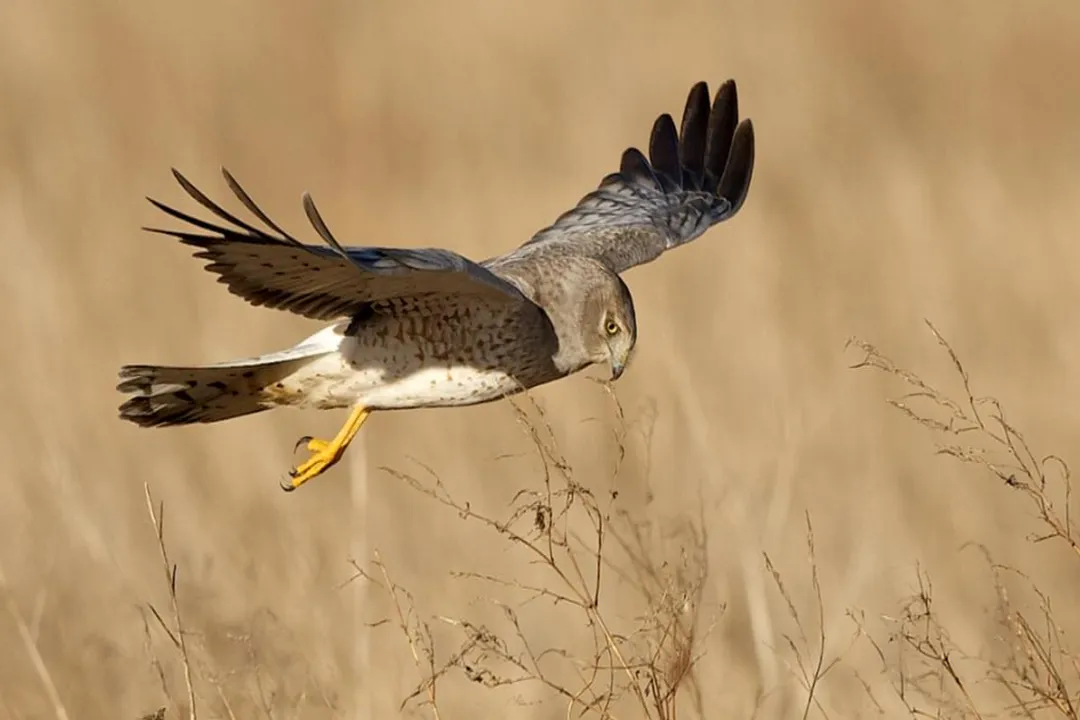
The defining characteristic of a Harrier in flight is not raw velocity, but rather an almost paradoxical grace and slowness that allows it to excel at finding prey hidden in dense cover. When you observe a Northern Harrier (Circus hudsonius) gliding over a marsh or open field, the first thing that strikes an observer is the buoyancy of its movement. [1] This bird is built for aerial patience, favoring an energy-efficient, methodical search over a high-speed chase.
# Built for Buoyancy

The physical structure of the Harrier explains its unique aerial capabilities. It is a medium-sized hawk, yet it is described as being notably slender and light of build. [1] Proportionally, the Northern Harrier possesses the longest tail of any raptor found in North America, coupled with very long, narrow wings. [1][6] This combination translates directly into its signature flight style. Instead of the bulky power needed for a short burst, the Harrier has a mothlike buoyancy. [1] This structure permits the bird to fly exceptionally slowly without the risk of stalling, a critical adaptation for its hunting strategy. [1]
The two sexes differ significantly in size, which may affect their hunting preference, but both share these specialized wings. The female is considerably larger and heavier than the male, yet both rely on this light-bodied design to remain aloft with minimal effort. [1][6] The males, sometimes dubbed the "Grey Ghost," possess striking silvery-gray plumage that only adds to their ethereal, seemingly unhurried appearance as they cruise the landscape. [6]
# Hunting Posture
The question of "how fast" a Harrier flies is best answered by describing how they fly when hunting. The preferred technique is called coursing, where the bird systematically moves back and forth, or quarters, across an open area. [1] This is executed with a series of slow, deep, and regular wingbeats. [1] Even from a distance, the downstroke of the wing is often accompanied by a distinct snap. [1]
This deliberate pace is maintained just feet above the ground—typically between 10 and 30 feet high for the Northern Harrier—as the bird closely follows the contours of the terrain below it. [1] During these glides, the wings are held stiffly in a pronounced V-shape, known technically as a dihedral. [1][2][8] This posture, combined with the bird's lightweight frame, makes it seem as though it is teetering unstably from side to side, pushed and pulled by air currents. [1] The bird is highly maneuverable within this slow flight envelope, constantly tipping and tilting. [1]
It is important to note that Harriers are not always slow. They are capable of stooping, which means diving from a height, and can make quick bursts of speed and directional changes when needed. [8] However, the energy-saving, slow coursing is their primary mode of searching. [1]
The low, slow, coursing flight is intimately tied to the Harrier’s superior hearing, facilitated by an owl-like facial disc that channels sound to its ears. [1][2] While other raptors, like the Peregrine Falcon, rely on incredible diving speeds from great heights, the Harrier’s method prioritizes thoroughness over speed. When a vole or mouse is detected—perhaps only by a faint rustle—the bird can instantly drop from its slow cruise to strike with its long legs. [1] This immediate vertical drop, made possible by low forward speed and high maneuverability, is far more effective for ambushing prey hidden in grass than a high-speed approach that would likely blow the prey away or require a much longer detection window. [5]
# Energy Efficiency and Endurance
One remarkable aspect of Harrier flight is its endurance. They are described as tireless, capable of flying non-stop for hours while migrating or hunting. This sustained capability is a direct consequence of their flight mechanics. By utilizing their highly efficient, long wings in a buoyant manner, they minimize the energy cost of staying airborne. This stands in contrast to birds that rely more on powerful, rapid flapping or high-speed dives, which consume energy quickly.
Considering the Northern Harrier spends its daylight hours actively hunting, its ability to fly for hours suggests an average cruising speed that is just fast enough to cover territory effectively while maintaining lift and maximizing sensory input. If we consider the typical airspeed of a bird using a dihedral glide while holding a position against the wind—which some commentators have suggested can be effectively zero ground speed in a strong headwind—the bird is using the wind for lift rather than propulsion. [5] In the absence of high-speed pursuit data, it is logical to conclude that their effective speed over the ground while hunting is relatively low, perhaps only slightly exceeding the speed of a walking human, allowing for the constant auditory and visual scanning necessary for their unique predatory style. [1]
# Stationary Flight
Perhaps the most breathtaking display of Harrier aerodynamics is their ability to hover stationary in the air, a skill shared by few hawks. This is not the lazy circling of a thermal, but true mid-air station-keeping. This requires the bird to precisely match its forward airspeed with the speed of an opposing wind current, effectively achieving zero ground speed while still moving air over its wings to generate lift. [5]
The skill required to achieve this, even in a light breeze, involves constant, tiny adjustments to each wing and the long tail to counteract turbulent air—an act akin to an expert helicopter pilot managing a complex hover. [5] This ability, whether purely wind-assisted or supplemented by minor flapping, allows the Harrier to lock its gaze onto a specific patch of ground for a protracted period. For a predator relying heavily on sound to locate small, concealed mammals, this stationary position is far more valuable than the momentum of a fast flight path, which dictates a constant change in the visual and auditory scene below. [5]
# Variations Across Species
While the Northern Harrier is the focus across much of North America, other species like the Black Harrier (Circus maurus) of Southern Africa share this low-level hunting technique. [7] The Black Harrier is also observed flying low, less than five meters off the ground, employing slow, quartering flights before delivering a "lightning-like strike" to catch prey like mice. [7] This consistency across the genus Circus confirms that the aerodynamic strategy of low, slow, sound-aided hunting is central to the success of Harriers globally, suggesting that high-speed dashes are secondary maneuvers rather than the norm.
In summary, while specific top speeds are rarely cataloged because they are not the bird’s main aerial advantage, the Harrier's flight is characterized by a slow cruising speed enabling exceptional buoyancy and endurance, punctuated by the ability to hover precisely for targeting prey. Their speed is best measured not in miles per hour, but in the time they can spend meticulously searching a small area aloft, making them masters of the low-altitude hunt. [1]
Related Questions
#Citations
Northern Harrier Overview, All About Birds, Cornell Lab of Ornithology
Black Harrier | The Peregrine Fund
Northern Harrier Using Wind And Thermals To Stationary Hover ...
Northern harrier - Wikipedia
NORTHERN HARRIER Circus cyaneus - WINGMASTERS Species
Northern Harrier - South Dakota Birds
Northern Harrier Fact Sheet - HawkWatch International
Northern Harrier - Cascades Raptor Center