Xiaotingia Evolution
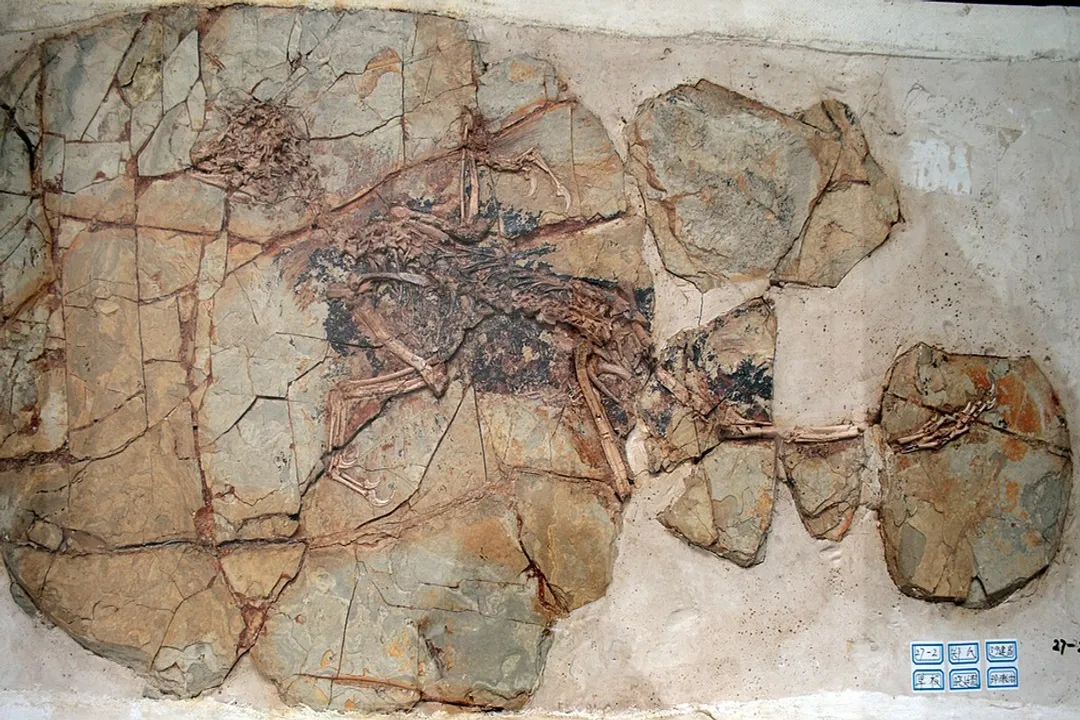
The discovery of Xiaotingia zhengi provided paleontologists with a fossil specimen that immediately complicated one of the most iconic narratives in evolutionary biology: the origin of birds. This small, feathered creature, unearthed from the Tiaojishan Formation in western Liaoning, China, was not merely another feathered dinosaur; its specific combination of features forced a critical re-evaluation of where the line between non-avian dinosaurs and the earliest birds should actually be drawn. For decades, Archaeopteryx had occupied a sacrosanct, almost singular position as the definitive "first bird," a creature frozen halfway between reptile and avian. Xiaotingia, being a close relative, threatened to demote Archaeopteryx from its perch, relocating it firmly within the dinosaur family tree, specifically among the deinonychosaurs. This was more than just swapping labels; it required scientists to rework the foundational structure of avian evolution and rethink which anatomical traits were truly bird-defining versus those shared among closely related, yet distinct, theropod groups.
# Anatomy and Features

Xiaotingia zhengi, first formally named in 2011 by Xu Xing and colleagues, is represented by a beautifully preserved, articulated, and nearly complete skeleton. Morphologically, it sits near other advanced paravians like Anchiornis. In terms of sheer size, it was modest, estimated to be about 60 centimeters in length and weighing around 0.82 kilograms, comparable to the famed Archaeopteryx.
This small creature was clearly feathered, possessing plumage across its head, body, forelimbs, and notably, its hind limbs. The feathers on the femur were quite long, measuring up to 55 millimeters, and there were also long pennaceous feathers present on the tibia and metatarsus. The presence of long feathers on the feet suggests that if Xiaotingia possessed limited flight capability, it might have employed its hind limbs as secondary wings, an idea sometimes also explored in the context of Archaeopteryx.
Skeletal characteristics further blurred the dinosaur-bird distinction. Xiaotingia featured long forelimbs, reminiscent of those seen in primitive birds, and a femur that was longer than its humerus—a proportion that hints at the necessary musculature for flapping locomotion. Furthermore, its dentary tooth count was likely under ten, and the morphology of these teeth resembled those of basal avians. Yet, it also retained characteristics strongly associated with the deinonychosaurs, such as the highly extensible second toe, a hallmark of that group, which also includes famous predators like Velociraptor. The interplay between these primitive, bird-like traits (feathers, long arms, wishbone presence implied by context) and dinosaurian traits (the extensible toe, specific skull architecture) is precisely what made its placement so contentious.
# Phylogenetic Revision
The immediate impact of the Xiaotingia discovery was felt in the construction of the evolutionary family tree, or cladogram. The initial phylogenetic analysis performed by Xu and his team suggested that when Xiaotingia was included, both it and Archaeopteryx grouped together more closely with the Dromaeosauridae and Troodontidae, effectively placing them outside the clade traditionally defined as birds (Avialae). Under this specific interpretation, Archaeopteryx was redefined as a primitive deinonychosaur, perhaps an ancestor to the Velociraptor line rather than the avian line. This was a startling conclusion, leading to popular reporting that Archaeopteryx was "no longer a bird".
This new arrangement proposed a significant divergence in the theropod lineage: one branch retained features like robust, rigid skulls and led toward modern birds, potentially becoming primarily herbivorous; the other, carnivorous lineage, included the deinonychosaurs like Velociraptor and, crucially, Xiaotingia and Archaeopteryx. The shared possession of a large hole above the nose (the premaxillary fenestra) and a distinctive hip bone were cited as shared features between Archaeopteryx and deinonychosaurs that supported this grouping. The idea that primitive birds might have been herbivorous, rather than flying carnivores, was a radical shift in perspective, suggesting that the evolution of flight might have occurred in a context unrelated to catching fast-moving prey.
# Competing Hypotheses
The scientific community did not immediately accept this reorganization of the base of the bird family tree. The initial revision by Xu et al. was noted as being statistically tentative, and other experts voiced immediate reservations. For instance, Gerald Mayr argued that the conclusions were perhaps over-hyped and suggested an alternative where deinonychosaurs themselves were considered flightless members of the bird group, alongside Archaeopteryx.
Almost immediately, competing analyses emerged that challenged the new placement. Within months, an analysis utilizing different methodological approaches recovered Archaeopteryx back within the Avialae, while Xiaotingia was allied more closely with Anchiornis within the Troodontidae family. By 2012, further revisions supported Archaeopteryx as avialan but placed Xiaotingia as the most basal member of the Dromaeosauridae, separating it slightly from Anchiornis. The ongoing scientific dialogue demonstrates that the fossil record is subject to interpretation based on the traits prioritized by the analysis method. More recently, as of 2017, some re-evaluations suggested Xiaotingia was an anchiornithid, with that entire group being considered avialan, pulling it back toward the bird side of the divide. Even more recently, in 2025, another study placed Xiaotingia as a sister taxon to Avialae, but explicitly outside the anchiornithids.
It is fascinating to observe how the perceived relationship of one species—Xiaotingia—has been so fluidly placed: basal Deinonychosaur, Troodontid relative, Dromaeosaurid, Anchiornithid, or sister to Avialae. This instability is what makes the study of early bird origins so dynamic and, for the general reader, potentially confusing.
When looking at the features that separate these closely related groups, consider the pelvis structure. While Archaeopteryx and some deinonychosaurs share that distinctive hip bone, the evolution of the avian pelvis involved specific modifications that allowed for an upright stance and better support for powered flight. The fact that Xiaotingia possesses the extensible toe of the Deinonychosauria while simultaneously boasting forelimb proportions suggestive of flapping creates a diagnostic challenge: Which trait is an evolutionary innovation inherited by birds, and which is a shared dinosaurian trait retained by both groups? The answer, it seems, depends on the mathematical model applied to the traits present in the fossil assemblage.
| Feature | Xiaotingia zhengi | Archaeopteryx (Typical View) | Troodontids (General) | Implication |
|---|---|---|---|---|
| Forelimb Length | Long (Femur > Humerus) | Long, feathered | Varied | Shared bird-like potential |
| Feet | Highly extensible 2nd toe | Standard theropod/avian structure | Defining Deinonychosaur feature | Ties Xiaotingia to Dromaeosauria |
| Skull | Lightly built | Typically depicted as light | Often contrasted with primitive birds | Suggests primitive birds not necessarily light-skulled |
| Feathers | On head, body, limbs (including feet) | Iconic asymmetric flight feathers | Present on many relatives (e.g., Anchiornis) | Confirms feathered transition widespread |
An interesting pattern emerges when comparing the interpretations of skull structure. The traditional view, often guided by Archaeopteryx's historical importance, sometimes implied that primitive birds needed lightly built skulls for aerial agility. However, Xu’s initial research suggested primitive birds (excluding Xiaotingia and Archaeopteryx based on their analysis) had robust and rigid skulls. This suggests that the very features we use to define "bird-ness"—like skull rigidity versus lightness—may have evolved multiple times, or that the evolutionary pressures on skull mass diverged early on. If Xiaotingia and its cohort represent a lineage that retained a more generalized, perhaps more robust, skeletal structure while developing feathers, it implies that the key adaptations for flight were acquired after the initial split between the lineage leading to modern birds and the Deinonychosaur branch that retained those dinosaurian features.
# The Messy Reality
The controversy surrounding Xiaotingia's placement is a microcosm of the broader challenge in reconstructing evolutionary history, particularly in periods of rapid diversification. The consensus that birds evolved from dinosaurs remains firm, but the precise route, the identity of the "first bird," and the constellation of traits that constitute "Avialae" remain debated.
What Xiaotingia unequivocally proves, regardless of its exact spot on the cladogram, is that the dinosaur-to-bird transition was not a simple, linear progression where one species cleanly transforms into the next. Instead, the fossil record suggests a period rich with "experimental trials," where numerous dinosaurs developed sophisticated integument (feathers) and forelimb structures, testing various body plans through natural selection. Some of these experiments, like the branch that gave rise to modern birds, succeeded; others became evolutionary dead-ends, preserved alongside the successes.
This reality of diversification means that relying too heavily on one single fossil to anchor an entire evolutionary group carries inherent risk. Archaeopteryx served that function admirably for over a century, providing a tangible anchor point. The arrival of Xiaotingia—and other feathered dinosaurs discovered in the preceding years like Epidexipteryx and Jeholornis—demonstrates that the initial definition of "primitive bird" was too narrow, potentially excluding equally primitive or even slightly earlier relatives that didn't fit the established mold.
If we consider the concept of evolutionary convergence or trait retention, it becomes clear why classification is so difficult. Perhaps the ability to grow pennaceous feathers evolved early and spread widely among Paraves. If so, Xiaotingia and Archaeopteryx both inherited this trait from a common ancestor, but Xiaotingia retained more primitive predatory features (like the extensible toe), while Archaeopteryx retained a different suite of features that later studies emphasized as "bird-like". Therefore, deciding whether to classify based on the most derived (advanced) features or the most ancestral (primitive) features determines where one draws the line. The very act of studying Xiaotingia forces researchers to confront this necessary ambiguity in defining the earliest members of any successful clade. This discovery encourages the view that evolutionary origins are inherently "messy affairs," and the next significant fossil find could easily shift the placement of these key transitional forms again.
Related Questions
#Citations
Xiaotingia - Wikipedia
New Archaeopteryx-like Dinosaur Found in China
Earliest bird wasn't a bird? New twist to Archaeopteryx story