Wildebeest Physical Characteristics
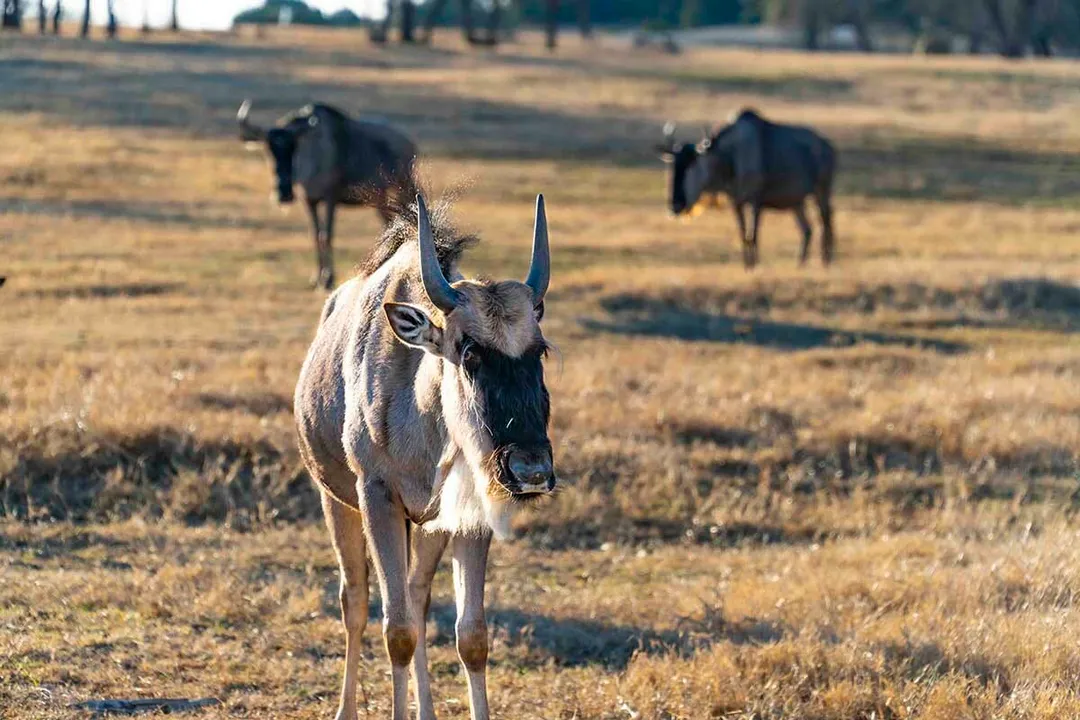
The wildebeest, an animal instantly recognizable to anyone familiar with the African plains, presents a rather striking, almost ungainly figure. Its unique silhouette, characterized by a heavy forequarters and a somewhat disproportionate head, belies the incredible endurance packed into its frame. [6] These large antelopes are generally divided into two distinct species, the Blue Wildebeest (or Common Wildebeest) and the Black Wildebeest, and understanding their physical characteristics requires looking at both, as they possess notable, though subtle, differences. [3]
# Two Kinds
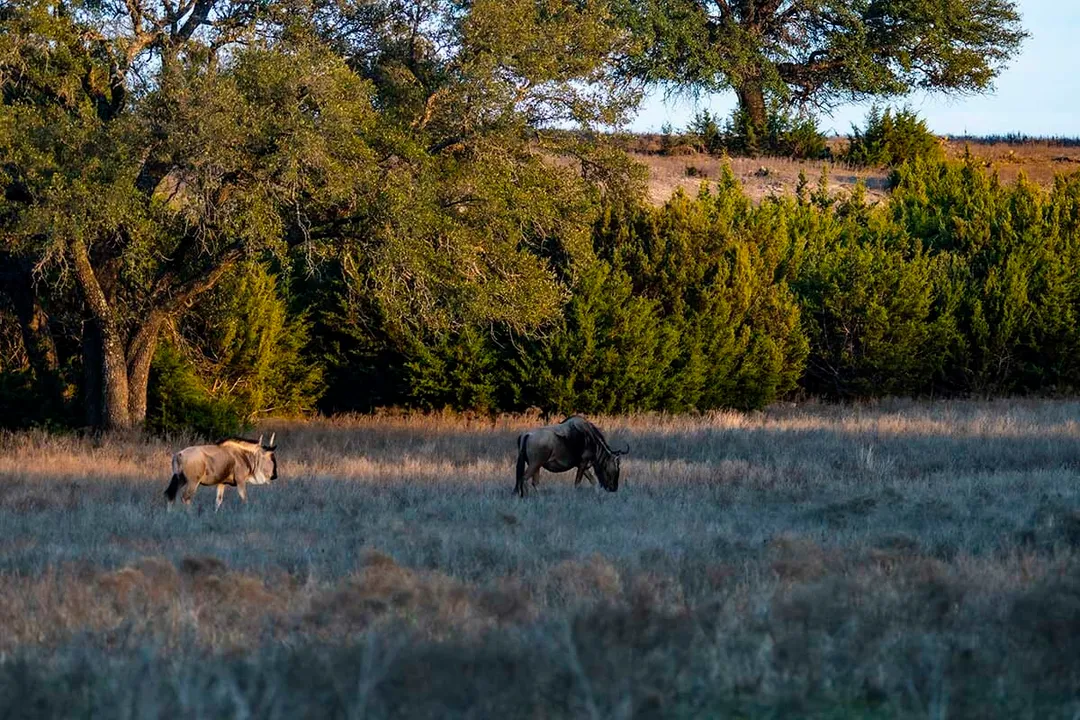
The most commonly seen species across Eastern and Southern Africa is the Blue Wildebeest (Connochaetes taurinus), sometimes called the Brindled Gnu. [4][5] Despite its name, its coat is predominantly greyish-brown, set apart by distinct, dark vertical stripes running down its neck and shoulders, giving it a "brindled" appearance. [3][5] It also typically sports a black mane and tail. [4] In contrast, the Black Wildebeest (Connochaetes gnou) lives primarily in South Africa and has a coat that ranges from dark brown to true black. [3][5] While both share the characteristic mane, the Black Wildebeest has a striking white, hairy tail, distinguishing it visually from its blue cousin. [3][5] This fundamental color difference is the easiest way to separate the two species when observing them in the wild, though the sheer numbers of the Blue Wildebeest often mean it dominates general perceptions of the genus. [3]
# Stature Weight
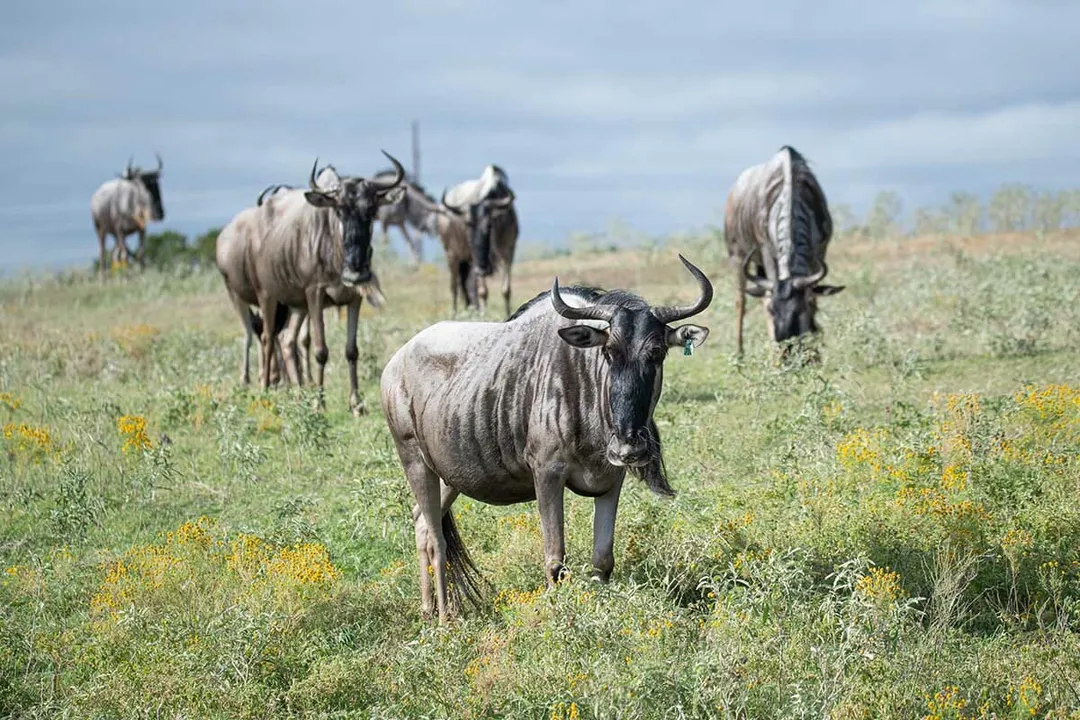
Wildebeest are powerfully built, even if their proportions can look unusual. They are solidly muscled animals, particularly across the neck and shoulders, to support that large head. [5] The Blue Wildebeest exhibits noticeable sexual dimorphism, meaning males are generally larger and heavier than females. [4] A mature male Blue Wildebeest can weigh anywhere between 300 to 600 pounds (about 136 to 272 kilograms), while females usually fall between 260 and 490 pounds (118 to 222 kilograms). [4][5] Their overall height, measured at the shoulder, typically ranges from about 4.1 to 4.8 feet, or 1.25 to 1.45 meters. [4] The Black Wildebeest is generally smaller overall than the Blue Wildebeest. [5]
Their legs, although appearing somewhat slender in proportion to their heavy bodies, are essential to their survival, enabling the massive annual migrations that define the species. [4] While one might assume such a bulky animal would be slow, these long limbs are adapted for covering vast distances efficiently. [6] It’s fascinating to consider how this build balances the need for sheer migratory stamina—where efficiency over miles is key—with the need for sudden bursts of speed to evade predators like lions or cheetahs, where high maneuverability might be sacrificed for sustained pace. [1] They stand taller than many other antelopes, which aids in keeping watch over the herd across the open savanna. [6]
# Horns Mane
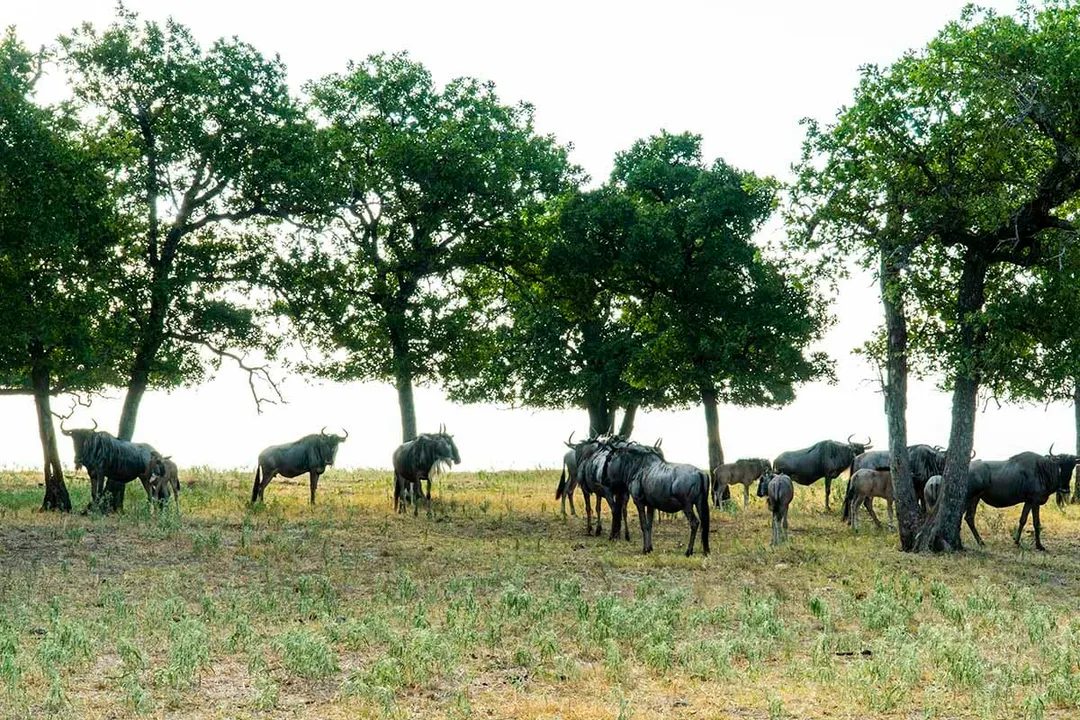
Perhaps the most defining characteristic shared by both male and female wildebeest—a feature often used to identify them immediately—is the presence of prominent horns. [3][4][5] The horn structure is distinct: they emerge from the sides of the head, curve outwards and slightly backwards, and then turn up toward the tips. [4] In the Blue Wildebeest, these horns can grow quite substantial, sometimes reaching lengths of up to 28 inches (70 cm). [5] They are heavy and dark, curving around the eyes, giving the animal a fierce expression. [4]
The head itself is large and somewhat boxy, contributing to the overall impression of mass up front. [5] Adding to the rugged appearance is a thick, shaggy mane that runs along the neck and shoulders. [3] Specifically in the White-bearded Wildebeest (a subspecies of the blue wildebeest), a very long, dark, shaggy beard hangs from the throat, which gives the subspecies its common name. [5] This combination of heavy horns, a broad muzzle, and heavy mane contributes significantly to the common perception that the wildebeest looks perpetually stressed or disgruntled. [6]
# Color Markings
Beyond the species-level difference in overall darkness between the blue and black varieties, the markings on the Blue Wildebeest are particularly noteworthy. [5] While the base coat is a muted grey or brownish-grey, the defining feature remains the dark, almost black, vertical striping across the neck and shoulders. [4][5] They also possess a noticeable dark stripe running down the spine. [4] This striping pattern likely serves as disruptive camouflage within the flickering shadows of tall grasses, breaking up the outline of the massive animal against the background during daylight hours, which is a common survival adaptation in open plains animals. [2]
The tail in the Blue Wildebeest is black, contrasting with the body color, just as the Black Wildebeest has a white tail. [4][5] The hair texture across the body is generally coarse rather than sleek, fitting their harsh environment. [6] Examining the coat texture closely reveals that it is designed more for protection against the elements and insects than for sleek speed, suggesting evolutionary prioritization toward surviving long, dry seasons where physical wear and tear is more likely than predator evasion requiring maximum aerodynamic efficiency. This durable hide is a key physical asset in their unforgiving habitat. [1][7]
To organize the key physical differences succinctly, one can compare the primary species:
| Feature | Blue Wildebeest (C. taurinus) | Black Wildebeest (C. gnou) |
|---|---|---|
| Primary Color | Greyish-brown with dark stripes [4][5] | Dark brown to black [3][5] |
| Tail Color | Black [4] | White, hairy [3][5] |
| General Size | Larger and heavier [4][5] | Generally smaller [5] |
| Habitat | Widespread East and South Africa [3] | Restricted mainly to South Africa [3] |
This physical distinction between the two species highlights how even closely related animals can adapt slightly different color palettes based on local camouflage needs or perhaps even slight variations in social signaling within their respective territories. [3]
Related Questions
#Citations
Wildebeest - African Wildlife Foundation
Wildebeest Facts | Southern Africa Wildlife Guide
Wildebeest - Wikipedia
Connochaetes taurinus (blue wildebeest) - Animal Diversity Web
White Bearded Wildebeest - Columbus Zoo
10 Fun Facts About Wildebeests | Ultimate Kilimanjaro
Common Wildebeest - Fossil Rim Wildlife Center
Wildebeest Worksheets & Facts | Species, Habitat, Conservation
Species Spotlight: Wildebeest | Akari Photo Tours