What does an orange tanager look like?
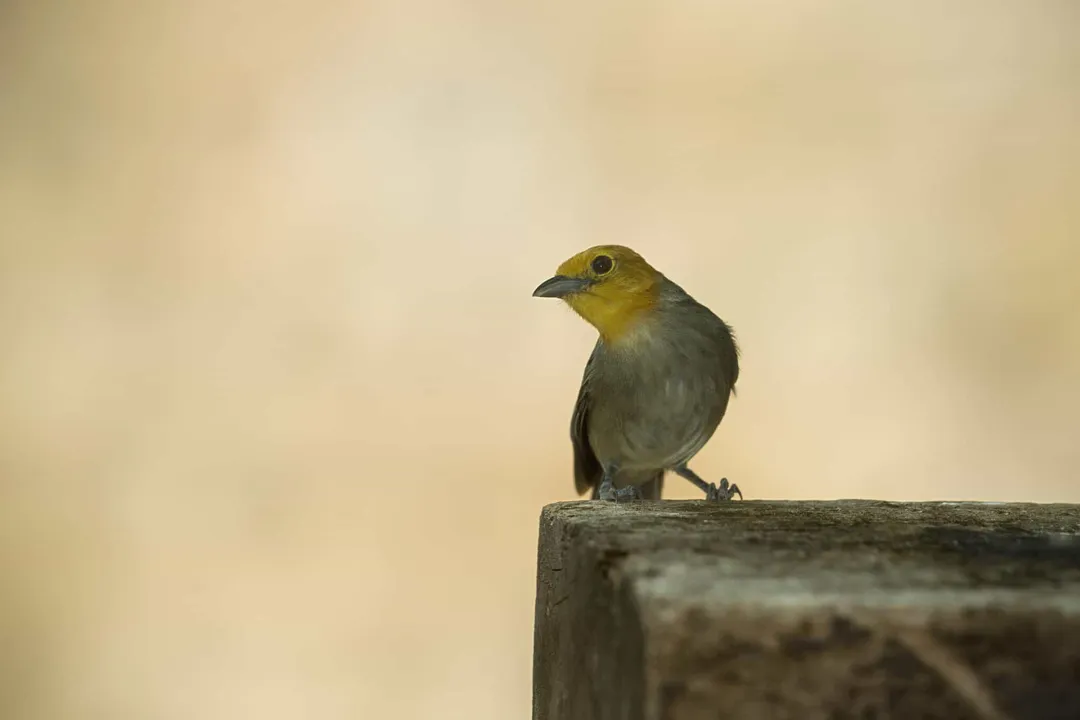
The search for the quintessential "orange tanager" often leads birdwatchers to a bird with a strikingly warm head that contrasts beautifully with its cooler body tones: the Orange-headed Tanager (Thraupis guanayana). This vibrant South American species immediately captures attention, though its appearance varies significantly depending on whether you are observing a male or a female, and can be easily confused with other brightly colored members of the Piranga genus found further north.
# Plumage Variation
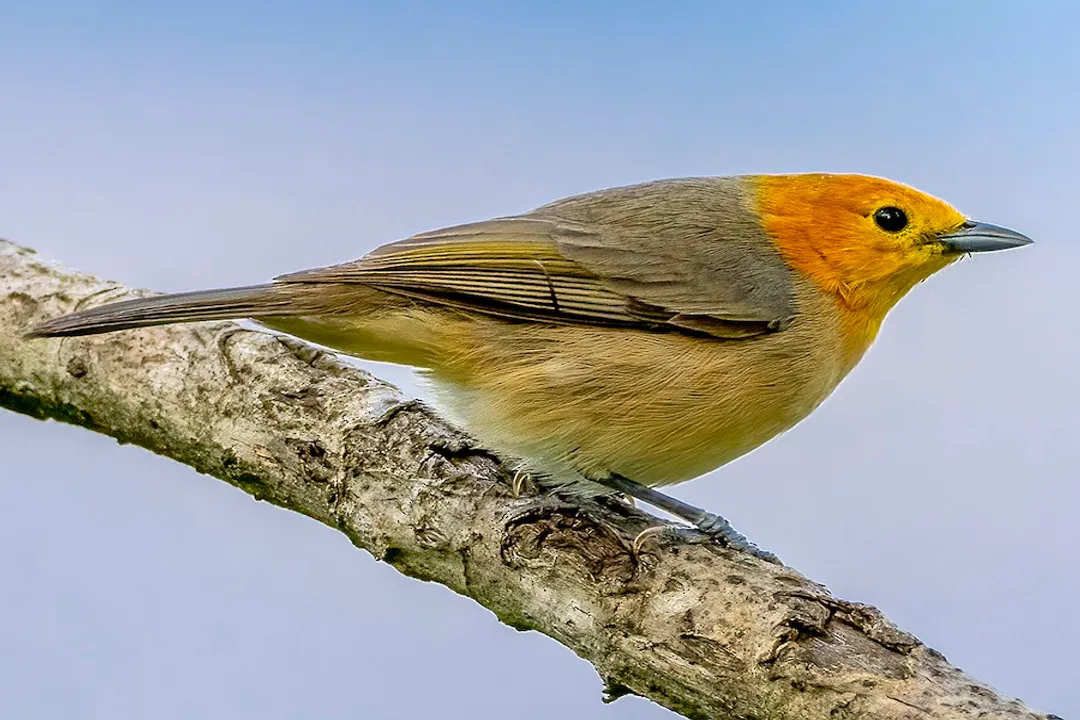
The male Orange-headed Tanager presents the most spectacular version of this bird's coloration. Its head and throat are a vivid, warm color, typically described as orange or sometimes a yellowish-orange hue. This rich coloring sets it apart from the rest of its body, which is generally a shade of blue-gray. Specifically, the upperparts, including the back and wings, lean toward a dusky blue-gray. The underparts, from the breast down to the belly, continue this grayish theme. It is this stark contrast between the fiery head and the muted blue-gray body that makes the male so distinctive in its native environment.
The female Orange-headed Tanager, as is common in many bird species, exhibits a duller, more subdued plumage compared to her male counterpart. While she retains the species' namesake feature, the orange on her head is less intense or may appear more yellowish. Her entire body plumage tends to be a paler, duller blue-gray or grayish-olive, lacking the crisp contrast seen on the male. This sexual dimorphism is a key feature for identification in the field.
When examining the finer details, the wings and tail feathers are typically dark, though the wing coverts might show some blue tinges that blend with the body color. The bill is relatively short and stout, appropriate for a fruit-eating bird, and is dark in color. Furthermore, observers note that the legs and feet are dark.
# Body Structure
Beyond the captivating colors, the overall build of the Orange-headed Tanager gives clues to its identity. It is considered a medium-sized songbird. While precise measurements can vary, the bird typically falls within a certain size range for tanagers, often being similar in size to other members of the Thraupis genus. Its profile is generally rather stocky, lacking the long, slender look of some other tropical passerines. The tail is relatively short for a bird of its overall shape. Understanding the general body architecture—stocky build, medium size, and a relatively short tail—is just as important as memorizing the head color, especially when dealing with distant or partially obscured views.

# Habitat Distribution
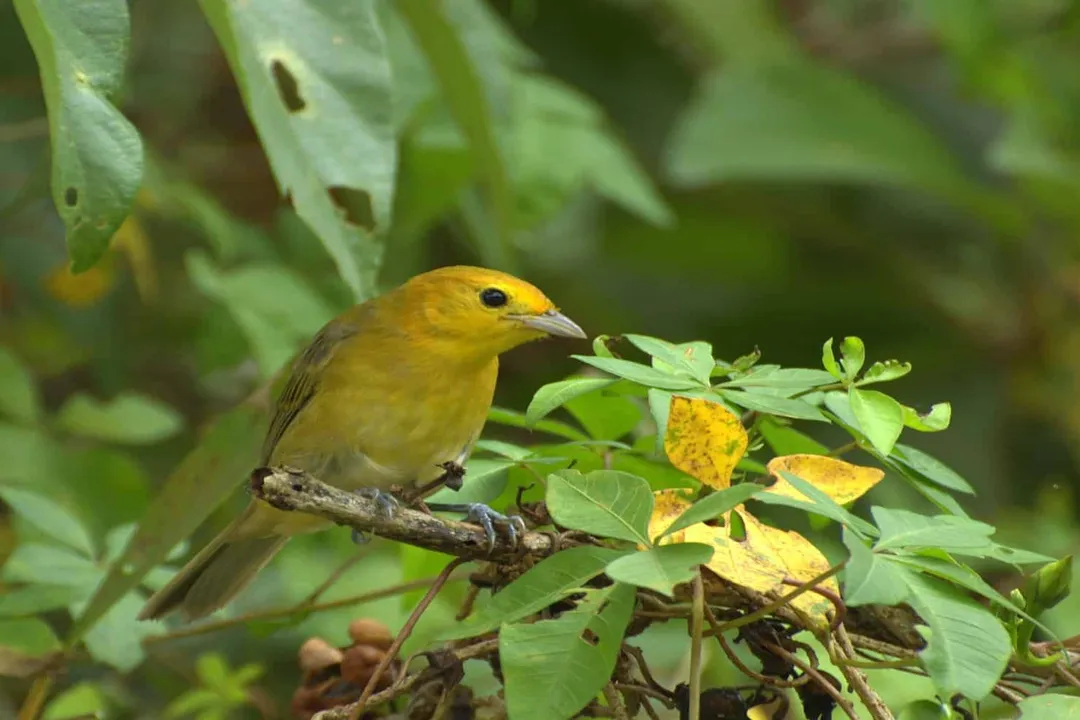
To truly understand the appearance of the Orange-headed Tanager, one must consider where it lives, as this helps rule out lookalikes from different continents or regions. The Orange-headed Tanager is an inhabitant of South America. Its range is strongly associated with the Amazon basin, where it is found in countries like Brazil, Colombia, Ecuador, and Peru, among others. It prefers humid forests and forest edges, often showing up in disturbed areas and clearings within its range, rather than deep, dense jungle.
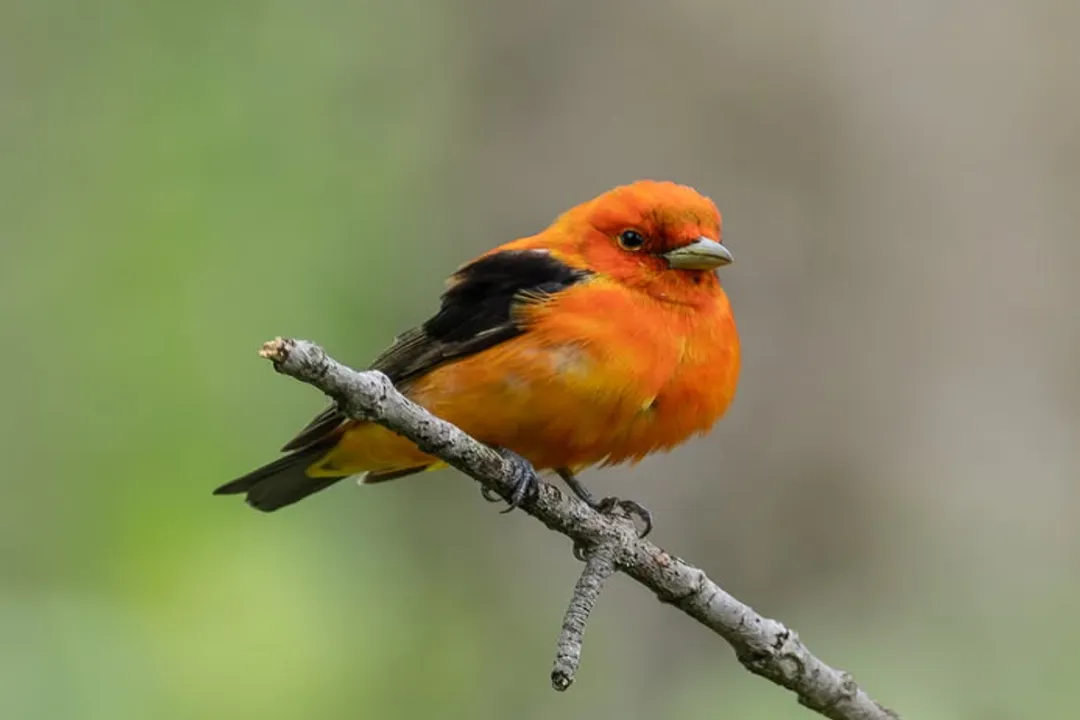
This geographic restriction is crucial because some of the most famous "red" or "orange" tanagers are found entirely elsewhere. For instance, the Western Tanager (Piranga ludoviciana) is a bird of western North America. While the male Western Tanager has a brilliant scarlet-red head that some might simply call "orange," its body is a clean, bright yellow, making it quite different from the blue-gray Orange-headed Tanager. Similarly, the Scarlet Tanager (Piranga olivacea), found in eastern North America, is famous for its brilliant red plumage, though worn males or females can appear yellowish, making color perception a potential pitfall in identification. A bird observer in a South American rainforest is highly unlikely to mistake the Western Tanager for the Orange-headed Tanager based on body color alone, but recognizing the difference between the male's orange head on a blue-gray body versus a yellow body is a primary distinction.
# Color Comparisons
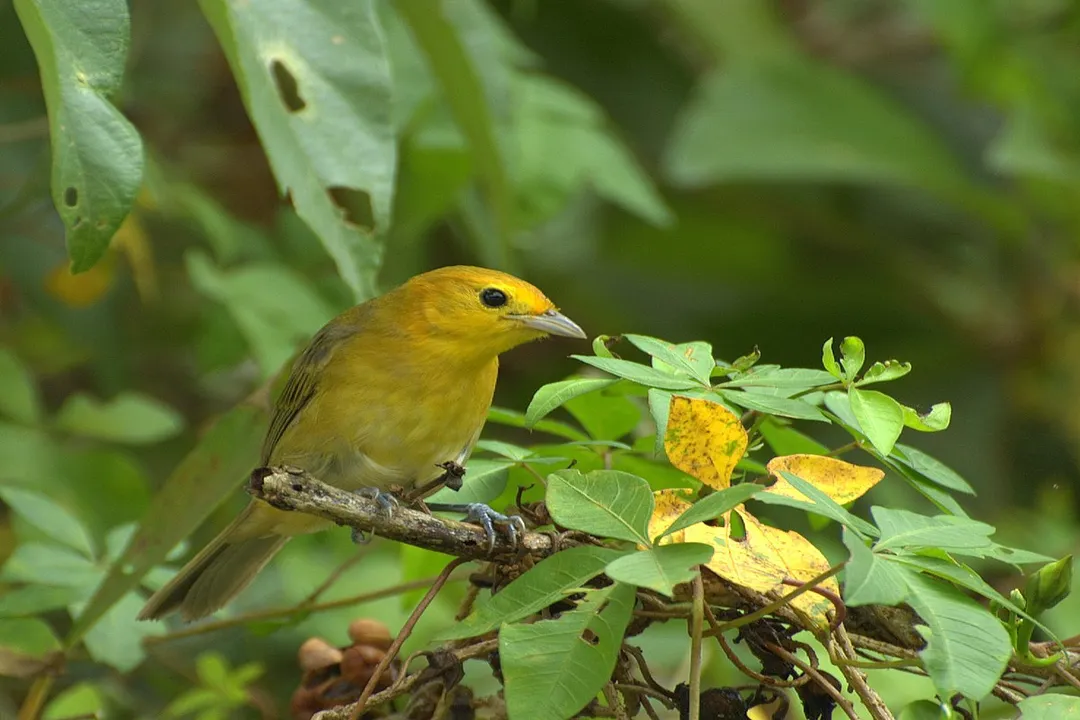
The word "orange" in a bird's name can be subjective, leading to potential misidentification, particularly when distinguishing between the Orange-headed Tanager and members of the Piranga genus. The perception of color can even change based on the light quality in the bird's environment.
If you are observing a bird in the central or eastern United States, what you might be seeing is the male Scarlet Tanager in peak breeding plumage, which is an intense, saturated red. However, if you see a tanager with a red head and a distinctly yellow body, you are almost certainly looking at a male Western Tanager. The Orange-headed Tanager never has a solid yellow body; its body is consistently blue-gray. This single difference—body color—is perhaps the most reliable immediate visual check when trying to separate these genera across continents.
One interesting way to frame the difference lies in the intensity and context of the color:
| Feature | Orange-headed Tanager (T. guanayana) | Western Tanager (P. ludoviciana) (Male) |
|---|---|---|
| Head Color | Orange to Yellowish-Orange | Brilliant Scarlet-Red |
| Body Color | Blue-Gray / Dusky | Bright Yellow |
| Range | South America (Amazon Basin) | Western North America |
It is helpful to consider that the Thraupis genus, which houses the Orange-headed Tanager, generally features more blue and gray tones in its makeup compared to the brighter reds and yellows dominating the North American Piranga species. Thinking about the bird's overall tone—cool (blue-gray) vs. warm (yellow)—can sometimes be more accurate than fixating solely on the exact shade of orange or red on the head.
# Key Identifiers
For someone actively looking to confirm they have spotted an Orange-headed Tanager, a few checklist items can narrow down the identification quickly, assuming they are within its South American range.
- Head Coloration: Check for that distinct orange or yellowish-orange cap on the head. Remember that in the female, this will be muted.
- Body Contrast: The most important secondary feature is the body. Is it blue-gray or dusky? If yes, you are likely on the right track for T. guanayana. If the body is bright yellow or brilliant red, it is one of the Piranga species found further north.
- Vocalization Context: While not strictly visual, the sounds a bird makes can often confirm its identity before a perfect visual sighting is made. Although the provided material does not detail the specific song of the Orange-headed Tanager, knowing that many tanagers, like the Scarlet Tanager, have distinct songs can prompt a listener to use auditory cues alongside visual ones.
An insightful way to practice field identification of this species involves focusing on how the head patch interacts with its light absorption characteristics. Because the head is relatively matte orange compared to the glossy, light-reflecting scarlet of some Piranga species, the Orange-headed Tanager often appears slightly softer in definition, especially in the dappled light of the forest edge where it forages. This subtle difference in how the light plays off the feathers can be a useful cue for experienced observers who have spent time contrasting the two plumage types in various light conditions. Paying attention to this textural difference, rather than just the hue, adds another layer to visual confirmation.
Another useful analytical point relates to juvenile birds. While source material focuses primarily on adults, generally, young tanagers across various species display less defined and duller plumage than adults. For the Orange-headed Tanager, one would expect juveniles to show a washed-out version of the female's dull blue-gray, with only a hint of the orange developing on the head as they mature, making them less conspicuous than the definitive adult male. If you encounter a uniformly dull, grayish bird in the Amazon basin where Thraupis species are common, it might be a juvenile or a female, requiring a closer look at the faint orange wash on the crown.
Related Questions
#Citations
Orange-headed tanager - Wikipedia
Orange-headed Tanager Thlypopsis sordida - eBird
Western Tanager Overview, All About Birds, Cornell Lab of Ornithology
Scarlet tanager orange variant spotted in Wilmette, IL - Facebook
Orange Variant Scarlet Tanager - Nerdy for Birdy
Orange Tanager (Orange-Headed Tanager) - Birds - A-Z Animals
USA East Coast, flame-colored tanager look-alikes? : r/birding - Reddit
Scarlet Tanagers are bright red – but this one is yellow - Sibley Guides