What did Carolina parakeets look like?
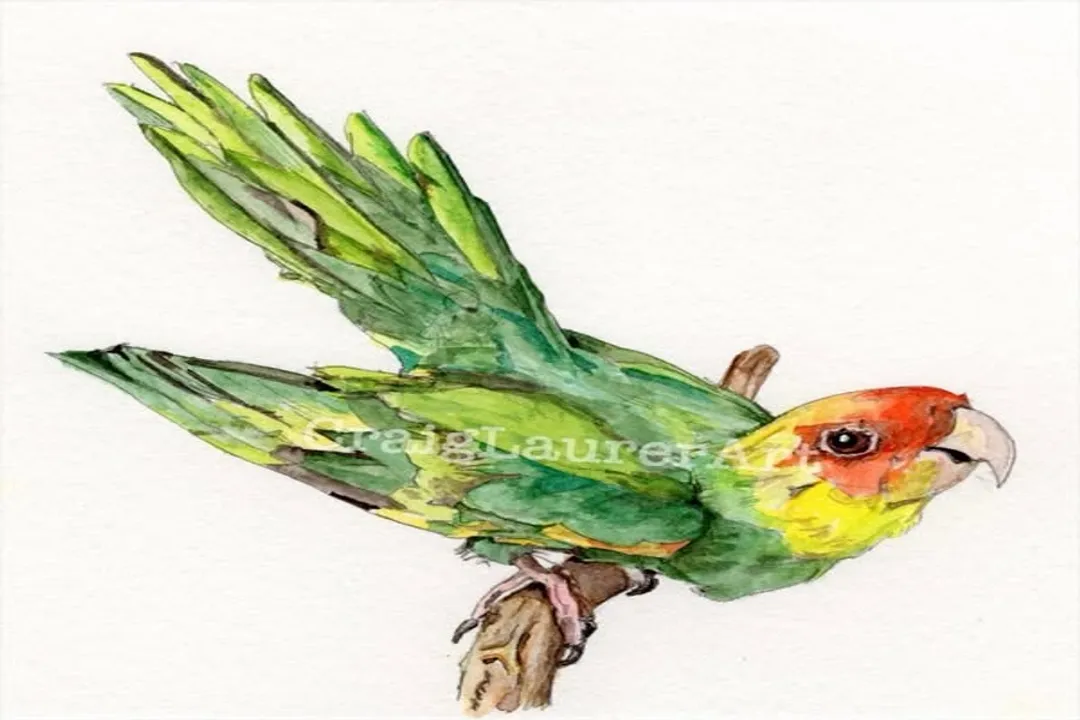
The Carolina Parakeet, Conuropsis carolinensis, was a vibrant splash of color across the eastern woodlands of North America, a bird whose visual presence was as striking as its eventual absence is profound. [1][7] Describing its exact appearance relies heavily on historical accounts, collected specimens, and the masterful, though sometimes interpretive, artwork produced before its extinction. [3] Imagine a parrot, but one perfectly adapted to a more temperate forest canopy, roughly the size of a small crow but far more slender in build. [2][7]
# Size and Shape
The average length of a Carolina Parakeet was approximately 12 inches from the tip of its beak to the end of its long, pointed tail feathers. [2][7] This measurement places it roughly in the size category of a mourning dove or a slightly larger pigeon, though its body structure was distinctly avian-parrot, meaning it was sleeker and less bulky than a typical pigeon. [2] The tail itself was a key feature, being notably long and sharply tapered, contributing significantly to that overall length. [2][7] While detailed measurements of wingspan or weight are less consistently cited across general sources, the impression left by preserved specimens and illustrations is one of a bird built for agile flight within a forested environment, rather than the robust structure seen in many larger tropical parrots. [2]
It is interesting to consider the bird's size relative to the environment it inhabited. In the dense hardwood forests stretching from the Ohio Valley down to the Gulf Coast, a twelve-inch bird would have been conspicuous when flying in groups, yet small enough to blend into the mottled canopy when perched among the leaves and twigs. [1] This moderate size might have offered a survival advantage against certain predators while still allowing for the social flocking behavior that characterized the species. [4]
# Plumage Coloring
The most captivating aspect of the Carolina Parakeet was undoubtedly its brilliant, yet complex, coloration, which varied significantly across its body. [2][7] Unlike some parrots that maintain one dominant bright hue, the Conuropsis carolinensis displayed a stunning gradient from fiery head colors to a deep, leafy green body. [1]
# Head and Chest
The crown, face, and upper breast were the bird’s fiery focal point. [2][7] The forehead and the area immediately surrounding the eyes were often described as a brilliant red or scarlet. [2][7] This vibrant red transitioned backward across the crown and down the throat and upper chest into brilliant yellow and orange tones. [2][7] This combination of red and yellow on the head made the bird instantly recognizable, even from a distance in good light. [5] The exact saturation and pattern of these colors could vary between individuals, and historical descriptions sometimes noted differences that might have indicated age or sex, although definitive documentation on such subtle dimorphism is rare now. [3]
# Body and Wings
Moving past the chest, the body plumage settled into a beautiful, yet comparatively subdued, shade of green. [2][7] This main body color was often described as a yellowish-green or perhaps a lime green, providing excellent camouflage against the deciduous leaves of its eastern North American habitat. [1][7] This deep green covered the back, belly, and the majority of the wing feathers. [2]
The flight feathers, or primaries, on the wings were particularly noteworthy, often displaying a clear yellowish-green tint, contrasting slightly with the deeper green of the inner wing coverts. [2] When the bird was not actively displaying or calling, this green cloak would have helped it melt into the summer foliage, a visual strategy quite different from the solid bright colors of many tropical parrots that thrive in constant, high light environments. [4]
# Features Beyond Plumage
While the feathers captured most of the attention, other physical features defined the parakeet’s structure.
# Beak and Eyes
The beak, designed for cracking seeds and nuts, was relatively sturdy but pale in appearance. [2] It was described as horn-colored or a light, pale shade, offering a strong visual contrast against the bright red and yellow feathers surrounding it. [2][7] The eyes, set within the colored facial feathers, were dark, providing a sharp focal point for the head. [2]
# Tail Structure
As mentioned, the tail was long and distinctly pointed. [2][7] Unlike some parrot species that possess rounded or squared-off tails, the Carolina Parakeet's tail ended in a sharp taper. This pointed tail, combined with the slender body, suggests a bird built for swift, directional flight rather than long-distance soaring or gliding, though this is an interpretation of structure rather than a direct observation in the source material. [2]
# Artistic Records Versus Reality
Much of what we "know" about the Carolina Parakeet's appearance comes from the illustrations of artists like John James Audubon. [3][5] Audubon’s famous plates capture the birds in dynamic poses, emphasizing their coloration and social interaction. [3] These pieces are invaluable, yet they require a critical eye. Artists, even masters like Audubon, often enhance colors for dramatic effect or to ensure their depiction stood out when painted on paper. [3][5] For instance, the reds and oranges on the head, while certainly present according to specimen descriptions, may have been intensified in his famous paintings to convey the bird’s vibrancy to a public that had never seen one. [2]
The few existing photographic records, though often grainy or debated, offer a more sober confirmation of the general palette, sometimes suggesting the reds were less fiery and the greens more muted in real-world lighting conditions than depicted in the famous hand-colored lithographs. [4] Comparing the vivid, almost incandescent portrayal in an Audubon print to the slightly duller tones often seen in the earliest surviving photographs suggests the true color likely fell somewhere in between: exceptionally bright for a temperate bird, but perhaps not quite as flaming as the art implies. [3] This gap between artistic representation and lived reality highlights the difficulty in fully reconstructing the visual experience of this extinct creature. [7]
# Differentiating from Similar Species
The Carolina Parakeet held a unique ecological niche as the only native parrot species found east of the Great Plains in the United States. [1] This lack of similar native birds meant there was little chance of confusing it with other local fauna when seen up close. [1][7] However, as they flew in flocks, they might have occasionally been mistaken for larger finches or even small pigeons at a great distance, although their erratic flight pattern and vivid flashes of color would usually give them away. [4]
In terms of the broader parrot family, the Conuropsis carolinensis shared the general Psittacidae body plan—curved beak, zygodactyl feet (two toes forward, two back)—but its proportions were distinct from the large macaws or smaller budgerigars of the time. [2] Its slender profile and long tail set it apart from the chunkier, short-tailed parrots sometimes introduced to North America later on. [2]
# A Look at Variation
While the general description holds true—green body, red/yellow head—historical accounts hinted at slight variations that could relate to age or location. Juveniles likely had less intense coloring, with the bright reds and oranges developing as they matured into adulthood. [7] Furthermore, given the species' range spanned thousands of miles, subtle regional variation in the exact shade of the body green might have existed, a phenomenon common in widespread bird populations. [1] It is plausible that populations in more southerly, evergreen-heavy regions evolved a slightly different shade of green for optimal camouflage compared to those living in the deciduous forests of the upper Ohio River Valley. [4] Unfortunately, the catastrophic decline in their numbers meant this potential for local adaptation was lost before naturalists could fully catalogue it. [7]
The collective portrait of the Carolina Parakeet is that of a bird brilliantly adorned, with its head serving as a jewel-toned beacon atop a body perfectly camouflaged for the American forest canopy—a beautiful anomaly in the birdlife of the continent. [1][2]
#Videos
Carolina Parakeet: Ecology, Extinction, and Resurrection? - YouTube
Related Questions
#Citations
There was once a conure species, the Carolina Parakeet, that was ...
Carolina Parakeet - | Outdoor Alabama
The last Carolina Parakeet - John James Audubon Center
The only known picture of a living Carolina parakeet circa 1900
Carolina Parakeet: Ecology, Extinction, and Resurrection? - YouTube
The Extinct Carolina Parakeet - Florida State Parks
Carolina Parakeet: Removal of a "Menace" | All About Birds
Conuropsis carolinensis (Carolina parakeet) - Animal Diversity Web