What is the history of the Norwich Terrier?
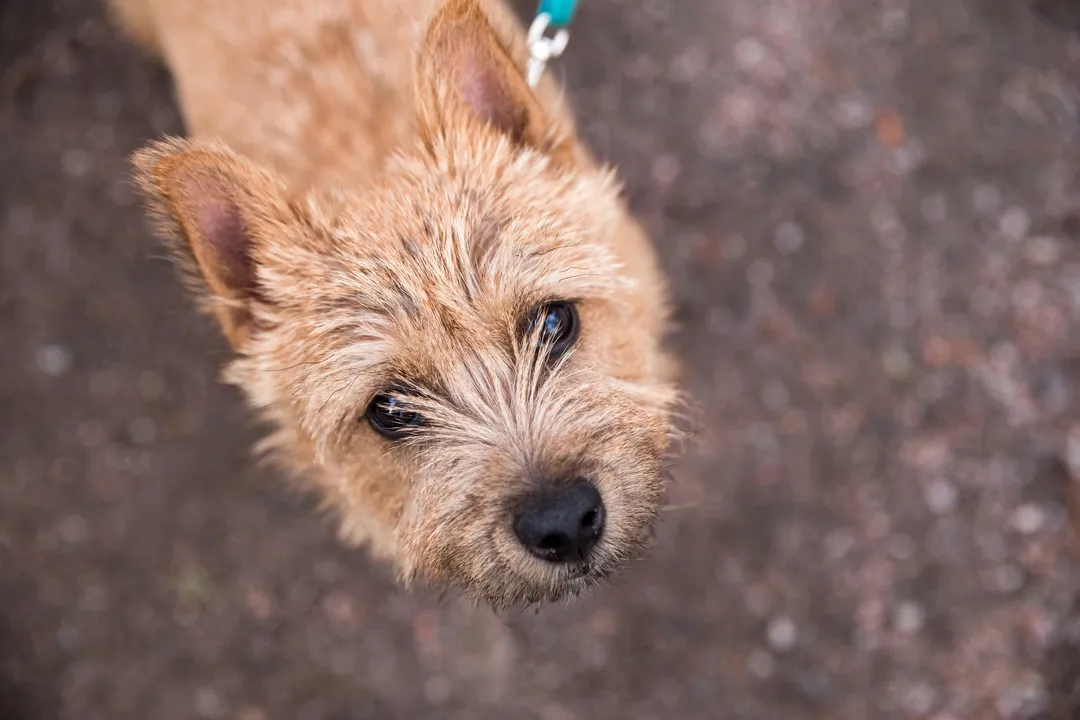
The story of the Norwich Terrier is deeply rooted in the flat, marshy terrain of East Anglia, England, particularly around the town of Norwich in Norfolk County. [2] This region, historically characterized by "The Fens"—marshes largely drained by Dutch engineers in the 16th century—created an environment rife with vermin infesting the vast cereal crops and storage barns. [2] In the late 19th century, the small, determined terrier was an indispensable partner to the farming and sporting communities, serving primarily as a ratter and general vermin controller. [2][6]
# Fens Origins
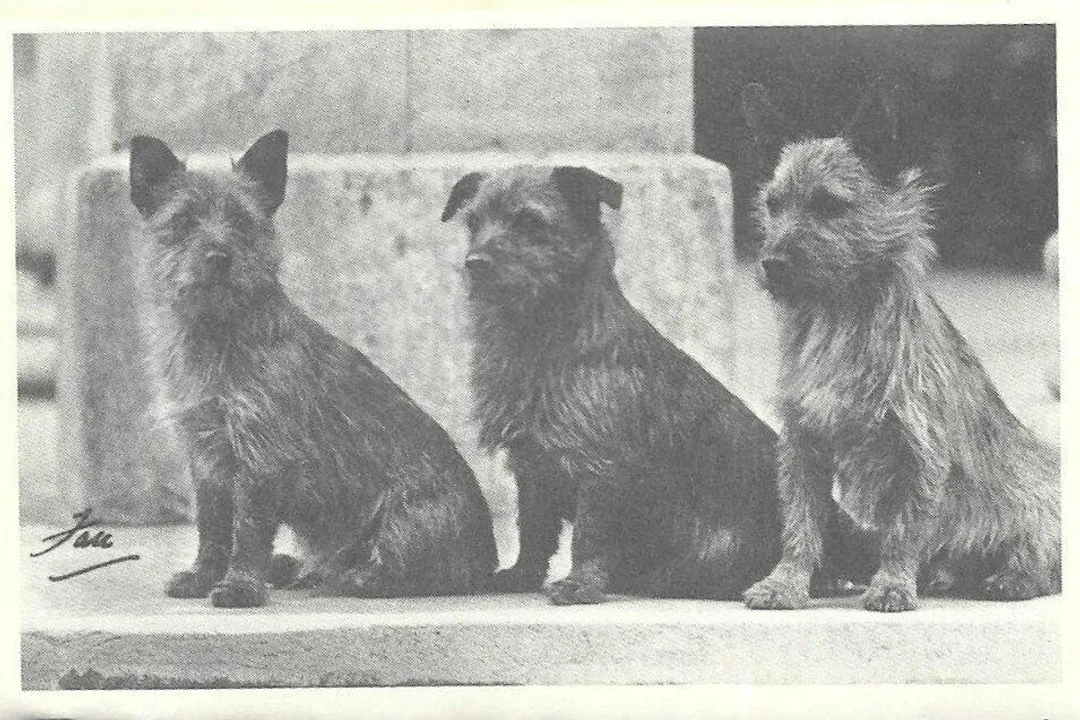
These early dogs were not a standardized breed but rather a local type, sought after for their temperament and working aptitude: tenacity, energy, and, most critically, gameness and fearlessness in a compact package. [1] Breeders freely crossed various terriers, including hounds and harriers, to enhance these working traits. [1] The dogs were small enough to be carried in a saddlebag to a hunt, yet ferocious enough to be thrown into a barn to dispatch rats. [1]
The selection process, driven entirely by function, resulted in several distinct local lines that, while possessing similar core traits, varied in appearance, including coat texture (ranging from wire to smooth). [1] These lines were often associated with the people or places that produced them, such as the CanTab Terriers, the Trumpington Terriers, and the Jones Terriers. [1] This initial stage of development highlights a crucial aspect of the breed’s foundation: form followed function exclusively, making the type fluid and geographically named rather than breed-standard defined. [1]
# Cambridge Students
As the turn of the 20th century approached, these small, effective ratters found a new appreciative audience: the undergraduates at Cambridge University. [2][6] Located near the edge of the Fens and the River Cam, the colleges were not immune to vermin problems. [2] A local dog dealer named Charles "Doggy" Lawrence, operating out of nearby Chesterton, supplied these students with small terriers, often black and tan or tan. [2][4] These dogs became known as Cantab Terriers. [2][4] Lawrence’s stock was rumored to include smaller versions of the Irish Terrier and a larger type of Yorkshire Terrier. [2] Because the students socialized together, these dogs were sometimes worked in packs, necessitating a temperament that was both tenacious and enjoyable as a companion. [1][2]
A breeder associated with these early dogs was Jodrell Hopkins of Trumpington Street, Cambridge. [2] Hopkins bred terriers that became known as Trumpington Terriers. [2][6] He bred a dark brindle Aberdeen-type Scottish Terrier bitch he inherited to a game, red, long, silky-coated Cantab terrier named 'Jack'. [2] This mating produced a rough-coated, primarily red dog named Rags, and a darker, smaller bitch named Nell. [2] Rags, who displayed prick ears, proved to be an excellent worker and sire. [2]
It is a point of historical interest that the emphasis remained heavily on temperament over looks. The coat color and texture of Rags (harsh, red coat) were less important than the desired gentle yet tenacious working terrier disposition he possessed. [1] The progeny of Rags and Nell established the foundational temperament that would influence both the Norwich and its drop-eared cousin. [2]

# Founding Fathers

The lineage becomes clearer through the key dogs that solidified the desirable traits. Jodrell Hopkins concentrated on the red line from Rags, which mostly bred true to type, except for occasional grizzle or brindle offspring—never black and tan. [2]
Mr. Lewis (Podge) Low owned a smooth-haired, white, prick-eared bitch named 'Ninety'. [2] When Ninety was bred to Rags by Low, the resulting puppies were all red. [2] Frank "Roughrider" Jones, who later worked as a whip to the Norwich Staghounds, acquired some of these terriers and found them highly sought after by the local sporting fraternity, leading him to begin breeding them himself. [2] Jones exported some of his stock to America, where they were initially called "Jones Terriers". [1][2] Jones favored erect ears and dogs that were whole-colored red or black and tan, explicitly avoiding white markings. [4]
Another critical figure was Jack Read, who would become the first President of the Breed Club. [2] Read acquired a puppy from a litter sired by Rags out of Ninety in 1909. [2] Read’s breeding program involved further infusions from other breeds to refine the dog he wanted. [2] He used a Bedlington Terrier to introduce "more drive," followed by a 'brown' Staffordshire Bull Terrier to correct the Bedlington's coat texture. [2] After later crossing with a small Irish Terrier, he bred back to Mr. Cooke's strain, eventually producing Horsted Mick in 1929—a prick-eared dog used extensively at stud who influenced many future winners of both ear types. [2]
The collective efforts across these breeders—from the East Anglian farmers to the Cambridge students and figures like Roughrider Jones and Jack Read—were focused on stabilizing a small, friendly, yet capable working terrier, predominantly red in color. [2][3] The underlying thread, which the later show era would challenge, was the commitment to the dog's inside—its working heart—over its outward appearance. [1]
# Standard Conflict
The popularity of the emerging type spread beyond Norfolk, drawing buyers from further afield. [2] With increased demand, the focus began an inevitable transition toward formal standardization, moving slightly away from pure working ability toward appearance. [1]
The first Breed Standard was drafted around the early 1920s, immediately sparking controversy, primarily over the ear carriage. [1] The official recognition by The Kennel Club in England took place in 1932. [2][4] At this point, the recognized breed included both the drop-eared and prick-eared varieties. [2] The initial Standard, passed in July 1932, called for a red coat exclusively (though white on the throat/chest was allowed, though undesirable) and defined the ears: if erect, slightly larger than a Cairn's; if dropped, very neat and small. [2]
The first champion, Ch. Biffin of Beaufin (a drop-ear, 1935), reportedly had his prick ears weighted down by his owner, who preferred the drop ear—a telling anecdote about the early conflict over the desired look. [2] A significant philosophical divide emerged when the Standard was revised in 1935 to include Black and Tan as a color. [2] Jack Read, the Club President, strongly opposed this color inclusion and subsequently resigned from the Club. [2][4] This internal struggle between those who valued the utility and original working colors/types and those who sought to formalize the appearance foreshadowed the breed’s eventual split. [1]
When ear cropping was banned in England, the division became more pronounced, as breeders could no longer artificially maintain the desired ear carriage if nature did not provide it. [1] Breeders began selecting strictly for one ear type or the other, and as selective breeding continued without interbreeding between the types, the differences gradually extended beyond the ears to other physical features. [1]
# War Interruption
The Second World War posed a severe challenge to the continuity of the breed, as shows were suspended, and sustenance was scarce, impacting both people and animals. [2] Many dogs were lost, and those that survived for the post-war show rings were often untrimmed and ungroomed, not presenting the refined image expected in the ring. [2] Despite these difficulties, breeders persevered, and Miss Marion Sheila Scott McFie was particularly instrumental in keeping the drop-eared variety going strongly during the war years. [2]
# Ear Separation
Following the resumption of Championship shows, it became apparent that the prick-ear variety was achieving greater success in the show ring. [2] Miss McFie, whose personal preference was for the drop-ears, began campaigning in the late 1950s to have the Kennel Club recognize the two ear types as distinct entities within the single breed registration. [2]
However, The Kennel Club insisted on the creation of two entirely separate breeds. [2] After a ballot, the more dominant prick-eared type retained the original name: the Norwich Terrier. [2][6] The drop-eared variety was officially designated as the Norfolk Terrier in England in 1964. [1][2][4][6][8] In the United States, the split occurred later, with the AKC recognizing the separation in 1979. [3][4] Until that time, American dogs were designated Norwich Terriers, P.E. or Norwich Terriers, D.E.. [4]
The formation of the separate Norfolk Terrier Club in 1964 marked the beginning of their distinct evolutionary paths. [2] The Norwich Terrier Standard was redrafted to reflect only the prick-eared dog. [1] This separation highlights a defining moment: the breed was officially cleaved along the very aesthetic line that had caused so much controversy in the previous decades. [1]
# Post-Split Focus
Once separated, the focus of the Norwich Terrier shifted almost entirely from its working heritage to its role as a pleasing companion dog. [1] This transition is reflected in subsequent breeding goals. Breeders began selecting for features that aligned with the companion ideal: fuller coats, more furnishings, heavier bodies, and increasingly shorter legs. [1] The core temperament also evolved, moving decisively away from the defining gameness and tenacity of its forebears toward a generally friendly disposition. [1]
This is an interesting point of divergence. While the working drive is still present—manifesting today in behaviors like barking and digging, which require consistent early training [5][6]—the show ring began to reward the companionable aspect more heavily. [1] It is perhaps a testament to the breed's early foundation that despite this shift toward aesthetics and companionship, the Norwich remains described as game, courageous, spirited, and an eager worker beneath its diminutive size. [6][7]
In the late 20th and early 21st centuries, the popularity of small, attractive companions led to a new threat: unscrupulous breeding crossing other small terriers with the purebred Norwich, prompting the Norwich Terrier Club of America to actively combat these Faux Norwich dogs to preserve breed integrity. [3]
# American Development
The breed’s presence in America began shortly after its initial formation. The first Norwich to arrive was William Jones (1914–1928), acquired by Robert Strawbridge, Esq., of the Philadelphia area from Frank Jones. [3] Known affectionately as “Willum,” this sturdy, gregarious 12-pounder served as an important ambassador for the type among the foxhunting gentry across the US. [3] The first official registration with the AKC occurred in 1936 for a drop-eared English male named Witherslack Sport. [4] The shared parent club in the US, the Norwich and Norfolk Terrier Club (NNTC), managed both types until the 2009 vote created two separate clubs. [3]
The development of the breed in America also fostered strong internal traditions, such as the revered Norwich Terrier Club Match Show, which began in 1940. [3] This event, far more than a standard specialty show, was described as "THE social event of the season," where serious breeders could compare stock and which served to inspire participants through its community spirit and tradition of displaying prestigious trophies. [3] While the Match Show tradition eventually faded following the 2009 split, its history underscores the deep bond between the breed's aficionados and its preservation efforts. [3]
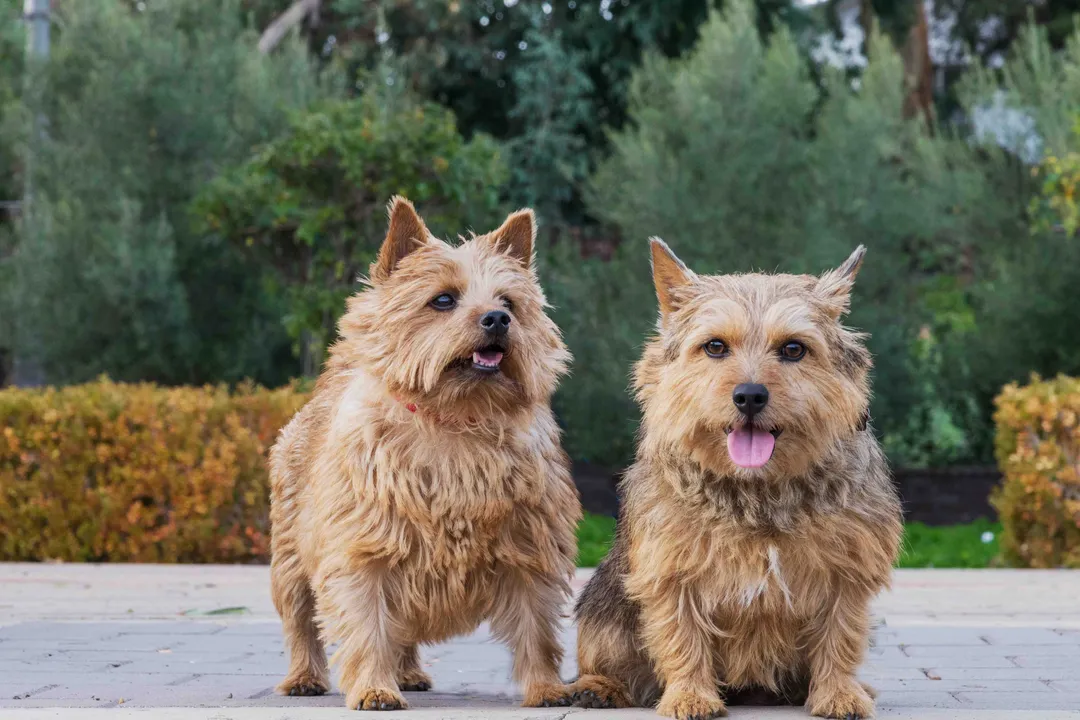
The breed today maintains the characteristic small size, weighing around 11 to 12.1 pounds, standing about 10 inches high, and is defined by its erect, pointed ears and wiry double coat, which comes in red, wheaten, grizzle, or black and tan. [4][7] The historical commitment to a hardy constitution remains relevant, though modern owners must be attentive to specific genetic predispositions common to small breeds, such as luxating patellas and respiratory concerns, which require careful health screening. [5][9] Ultimately, the Norwich Terrier, once a rough-and-tumble ratter of the Fens, evolved through the collegiate halls of Cambridge and the formal rings of the Kennel Club into the spirited companion it is recognized as today. [1][6]
# Breed Characteristics
The transition from barnyard necessity to companion animal has yielded a dog known for its friendly, outgoing, and playful nature. [8] While they bond closely with their people and can be affectionate snugglers, their terrier heritage is never far from the surface. [5] They are known to be vocal, displaying barking and digging behaviors reflective of their hunting past. [5] Early and consistent socialization and training are vital, not only to manage these natural instincts but also because they are clever and can display stubbornness if not constructively engaged. [6][7]
A comparison of the modern Norwich with its historical roots shows that while the purpose has changed, the physical structure—short, sturdy, and equipped with a weather-resistant coat—still hints at the rugged dogs required to work the harsh farmlands of East Anglia. [1][6] The preservation of the prick ear, which grants the dog its distinctive, alert appearance, stands as the physical marker distinguishing it from its drop-eared relative, the Norfolk Terrier, a distinction formalized in the mid-1960s. [5][6]
The modern Norwich Terrier, though small, is indeed a "big dog in a small package," demanding an hour or more of varied exercise daily to keep that terrier energy channeled appropriately, whether through walks, training games, or earthdog trials. [6][7] The breed’s relatively small litter size, noted historically, also contributes to its continued status as a rarer breed, requiring dedicated attention from breeders to maintain its robust history and health profile. [4]
# Health Considerations
For those dedicated to the breed, understanding the specific health challenges that emerged alongside formalization is key to responsible ownership. [9] Contemporary Norwich Terriers may face several genetic predispositions that demand proactive veterinary planning. [9]
A notable area of concern relates to the respiratory system. Some Norwich Terriers present with an upper respiratory obstructive syndrome, which studies have linked to specific mutations in the ADAMTS3 gene, potentially leading to airway narrowing. [4] Owners are advised to use a harness instead of a collar to minimize pressure on the trachea, especially given the breed’s predisposition to tracheal collapse. [5]
Furthermore, conditions like Primary Lens Luxation (PLL), a painful eye condition, and Portosystemic Shunt (PSS), a liver disorder, are conditions where the breed shows a higher predisposition compared to mixed-breed dogs. [4][5] Another significant statistical difference noted in veterinary studies is a relatively high rate of labor complications, with a notable percentage of bitches requiring Caesarean sections for delivery. [4] This information underscores that the shift toward a more companion-oriented conformation, with potentially larger heads and smaller pelvic structures, may have inadvertently introduced physical challenges not present in the original, purely functional type. [1][4] Careful breeding choices, informed by DNA testing, are essential to ensure the breed's hardiness continues into the next century. [4]
The history of the Norwich Terrier is thus a narrative of adaptation, moving from a functional necessity in the rural East Anglian countryside to a highly standardized companion dog whose defining feature—the prick ear—is the very feature that separated it from its nearest kin. The breed carries the mark of its working past in its spirited disposition while navigating the health challenges brought on by modern, aesthetic refinement. [1][7]
# Key Historical Milestones
The evolution of the Norwich Terrier can be tracked through several official and cultural benchmarks:
- Late 1800s: Local utility terriers in East Anglia (Cantab/Trumpington types) bred for ratting. [1][2]
- Rags (c. Turn of Century): Progeny of Jodrell Hopkins' line, recognized as the founding sire for both Norwich and Norfolk types. [2]
- 1932: Official recognition by The Kennel Club (UK) as Norwich Terrier, accepting both prick and drop ears. [2]
- 1935: Black and Tan color admitted to the Standard, leading to Club President Jack Read's resignation. [2]
- 1936: First Norwich registered with the AKC (a drop-ear). [4]
- 1964: Drop-eared variety recognized as a separate breed, the Norfolk Terrier, in England. [2][6]
- 1979: AKC recognizes the two ear types as separate breeds. [3][4]
- 2009: The American parent club splits into two distinct organizations. [3]
The journey from the rough-and-tumble "Jones Terrier" of the sporting gentry to the formally recognized, sometimes delicate, companion of today reveals a constant tension between preserving the dog's ancestral working character and adhering to an evolving aesthetic ideal. [1] This commitment to the breed's core terrier spirit, despite the structural changes that followed formal recognition, is what defines the Norwich Terrier's enduring appeal. [6] The necessity of maintaining high standards for health and temperament, as fought for by early stalwarts and now continued by modern clubs, ensures that the next chapter honors the tenacity established in those marshy fields. [1][4]
The practical effect of the initial emphasis on working ability versus the later focus on show conformation is evident when contrasting the early 1930s standard, which penalized trimming, with the modern need for hand-stripping to maintain the proper wiry texture. [2][5] To maintain the weather-resistant coat texture desired in the show ring today, owners often need to hand-strip the coat a few times a year, a practice contrary to the early standard that discouraged trimming, though the goal remained a hard, wiry exterior. [2][5] This subtle yet persistent influence of aesthetics over pure utility marks a significant turning point in the breed’s history. [1]
Today, the Norwich Terrier remains one of the smallest working terriers, a description that captures the entirety of its historical narrative: small stature needed for vermin control, yet possessing substantial, courageous personality forged in the demanding environment of the English countryside. [4][6]
Related Questions
#Citations
Norwich History
Norwich Terrier
History of the Breed
Norwich Terrier Facts - Dog Breeds
Norwich Terrier Dog Breed Health and Care
History of the Norwich Terrier
Norwich Terrier Dog Breed Information
Norwich Terrier - Canine
Norfolk Terrier