What is the breed standard for a Polish Lowland Sheepdog?

The Polish Lowland Sheepdog, or Owczarek Nizinny, is a shaggy, hardy herding dog whose official description outlines a very specific blueprint for what constitutes an exemplary representative of the breed. Understanding this standard is crucial for breeders, exhibitors, and owners who wish to preserve the functional characteristics and unique appearance of this ancient working dog from Poland. [1][2][4][5] The standard isn't just an aesthetic guide; it describes a dog built for endurance, intelligence, and the demanding terrain of its homeland. [1][8]
# Temperament Essence
At the heart of the breed standard lies the dog’s character, which must reflect its history as a capable, independent herder. [1][2][4] A true Polish Lowland Sheepdog should possess a lively, self-assured nature. [2][4] They are expected to be intelligent and highly trainable, yet they retain an independent spirit suitable for working livestock alone. [1][5] In a domestic setting, this translates to a dog that is affectionate with its family but often reserved or wary around strangers. [4] They make excellent watchdogs, as they are naturally alert and possess a tendency to bark when something unusual occurs. [1][4][5] Any sign of extreme shyness, aggression, or undue nervousness is considered a serious fault, as the standard calls for a balanced temperament that is self-possessed and courageous. [1][8] This balance between affectionate family companion and serious guardian is the cornerstone of the breed's desired personality. [4]
# General Structure
The overall impression of the Polish Lowland Sheepdog should be one of strength, agility, and moderate substance. [1][8] They are described as strong, medium-sized dogs, appearing slightly rectangular rather than perfectly square in proportion. [1][5] The ideal height for males typically ranges from 45 to 50 centimeters at the wither, while females are slightly smaller, usually between 42 and 45 centimeters. [3][8] Considering weight, they generally fall between 15 and 20 kilograms, though specific kennel club standards may vary slightly in their accepted ranges. [1][5] The body should be compact, the back strong and level, and the chest deep, allowing for the stamina required for a full day's work. [1][8] When observing a group of PONs, one should notice an overall impression of a rustic, robust dog, more built for function than delicate elegance. [4]
# Head Profile
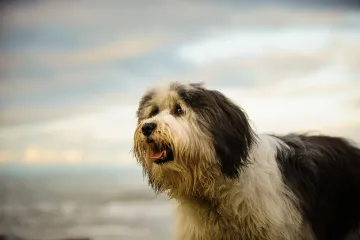
The head is a defining feature, set somewhat high on a strong neck. [1] It should be proportional to the body, never appearing too large or too fine. [8] The skull is broad and slightly rounded when viewed from the front or the side. [1][8] The stop, the indentation between the eyes, should be clearly defined but not abrupt. [1]
The muzzle is another critical area. It is shorter than the skull, tapering slightly toward the nose, which should be black and large. [1][8] The lips are tight-fitting, with dark pigment, ensuring there is no excessive flewing (hanging over the lower jaw). [1] A desired feature is the slight growth of hair over the eyes; this hair, often long, should frame the eyes without completely obscuring the dog's expression. [4][5] The eyes themselves are almond-shaped, dark in color, conveying an intelligent and piercing look. [1][8] Ear carriage is typically hanging, set rather high, and broad at the base, covered with long hair. [1][5] A dog whose ears fly back tightly against the head or stand erect would deviate significantly from this standard, which prizes the natural, somewhat obscured expression. [8]
# Coat Texture and Color
Perhaps the most immediately recognizable attribute of the Polish Lowland Sheepdog is its dense, long, shaggy, double coat. [1][4] The outer coat is harsh, thick, and somewhat wavy or straight, providing excellent protection against harsh weather. [2][8] Beneath this is a soft, dense undercoat, crucial for insulation. [1][8] This heavy coat naturally forms into cords or locks, especially in unclipped individuals, contributing to the breed's rustic appearance. [4]
The hair on the head is long enough to fall over the eyes, though it should not prevent the eyes from being visible. [8] The hair on the muzzle and chin forms a characteristic beard and mustache. [1]
Regarding color, the standard allows for a wide palette, though certain colors are more common or preferred in some registries. [5] Acceptable colors include all shades of grey, brown, or white, often with patches of color. [1][8] Solid white dogs are permitted, as are bi-colors (white with patches of black, grey, or brown). [2][5] Critically, deep black and any shade of brown are common base colors for the markings. [1][5] A purely black dog is acceptable, as is a dog with a prominent black mask. [8] One subtle difference in interpretation across major international standards is the emphasis: while most agree on the range, some specific clubs may have more detail on preferred shades or coat patterns, although the core requirement remains a thick, weather-resistant coat in the described colors. [2][3][8] If a dog is clipped entirely down to a uniform length—which happens frequently for pet maintenance—it loses the shaggy, corded texture essential to the standard's description of the coat structure. [4]
# Movement and Gait
The way a Polish Lowland Sheepdog moves speaks directly to its working background. The gait should be free, powerful, and ground-covering, suggesting endurance rather than explosive speed. [1][8] When moving at a trot, the dog should exhibit a steady, straight action, parallel to the line of travel. [1] The front legs should reach forward well, and the rear legs should provide strong propulsion, resulting in a smooth, effortless motion. [8] There should be no sign of crabbing (moving sideways) or excessive weaving. A good, level topline maintained while moving is essential; the back should not dip or arch excessively when the dog is in motion. [1] A dog that seems hesitant or shows a choppy, short stride is exhibiting movement faults antithetical to a functional herder. [8]
# Body Mechanics
The ideal structure is built for stamina. The chest must be deep, reaching down to the elbows, providing ample room for heart and lung capacity. [1][8] The ribs should be moderately sprung, not barrel-shaped. [1] The loin is short and firm, connecting smoothly to a strong, level back. [8] The croup should slope slightly toward the tail set. [1] The forequarters should be straight, well-muscled, and set well under the shoulders. [1] Rear angulation should be moderate, providing the necessary drive without appearing over-angulated, which can lead to strain. [8] The feet are strong and oval-shaped, with well-arched toes and tough pads. [1]
| Feature | Male Standard Range | Female Standard Range | Primary Characteristic |
|---|---|---|---|
| Height at Withers | 45–50 cm | 42–45 cm | Medium-sized, sturdy [1][8] |
| Weight | Approx. 15–20 kg | Approx. 15–20 kg | Moderate substance [5] |
| Body Shape | Slightly longer than tall | Slightly longer than tall | Rectangular profile [1] |
| Coat Texture | Harsh, shaggy, dense double coat | Harsh, shaggy, dense double coat | Weather-resistant [2] |
Table synthesized from height/weight data found in several referenced standards. [1][3][5][8]
# Faults and Deviations
Breed standards strictly define what the dog should not be, ensuring the preservation of the core type. Faults are deviations that detract from the standard, while disqualifications are serious errors that remove the dog from competition. [1]
Serious faults often involve temperament, such as pronounced timidity or aggression. [1][8] Structurally, any pronounced deviation from the required proportions—like being overly long or low to the ground—is faulted. [1] A distinctly domed skull or a muzzle that is either too short or too pointed would also be noted negatively. [8] In terms of movement, a weak, stilted, or cow-hocked gait indicates structural weakness that hampers function. [1]
Disqualifications, which vary slightly by organization but generally center on clear physical impossibilities or severe temperamental issues, often include:
- Any color or pattern not listed in the standard (though the range is broad, solid black or solid white without patches are sometimes called out depending on the specific club's interpretation). [5]
- Undershot or overshot bites that exceed what is minimally acceptable, though a precise scissor bite is preferred. [1][8]
- Cryptorchidism in males (undescended testicles). [1]
- Any dog clearly showing signs of physical or mental abnormality. [8]
When assessing a PON, particularly in a show setting, judges look closely at the coat's texture and pattern, as these are the breed's hallmark. A coat that is too soft or woolly, lacking the characteristic harsh outer layer, signals a breakdown in the standard's required weatherproofing quality. [4] Furthermore, if the heavy furnishings on the face obscure the eyes to the point that the dog appears "blind" or the expression is lost, it misses the mark on the required intelligent gaze. [5] The overall impression must always lean toward the functional shepherd rather than an overly stylized companion pet.
# Working Mentality Maintenance
For the everyday owner who doesn't compete, understanding the standard's emphasis on temperament and structure provides an actionable roadmap for responsible ownership. The standard calls for a dog capable of independent decision-making on the farm; translating this means providing mental stimulation beyond simple obedience drills. [2] A PON that is bored by repetitive, simple tasks may become destructive or excessively vocal, displaying poor temperament stemming from unmet intellectual needs. [4] Ensuring the dog has challenging puzzle toys or engaging training sessions that utilize its natural problem-solving skills helps maintain that desired "lively and self-assured" disposition described in the documents. [2] Also, while the coat is heavy, recognizing that the texture should be harsh—not silky or cottony—in an adult dog can inform grooming choices; for example, excessive bathing with moisturizing shampoos can soften the outer coat over time, slowly eroding the breed’s characteristic feel. [8] Maintaining the standard is as much about mental enrichment as it is about physical grooming and structure. [4]
Related Questions
#Citations
Official Standard of the Polish Lowland Sheepdog General ...
Polish Lowland Sheepdog | Breed Standards
Polish Owczarek Nizinny - Breed Standards
Polish Lowland Sheepdog Dog Breed Information
Polish Lowland Sheepdog
FCI-Standard N° 251 POLISH LOWLAND SHEEPDOG ( ...
Polish Lowland Sheepdog Breed Standard
POLSKI OWCZAREK NIZINNY
POLISH LOWLAND SHEEPDOG
Polish Lowland Sheepdog