How much do De Brazza's monkeys weigh?

The question of how much the De Brazza’s monkey weighs is one that immediately leads to a fascinating discussion about this distinctively bearded primate, known officially as Cercopithecus neglectus. [4] Far from being a uniform unit of measure, the size difference between the sexes is quite pronounced, marking them as one of the most sexually dimorphic species within the guenon family. [3][4] Understanding their mass provides a tangible measure against the backdrop of their famously elusive nature in the wild. [4]
# Weight Metrics
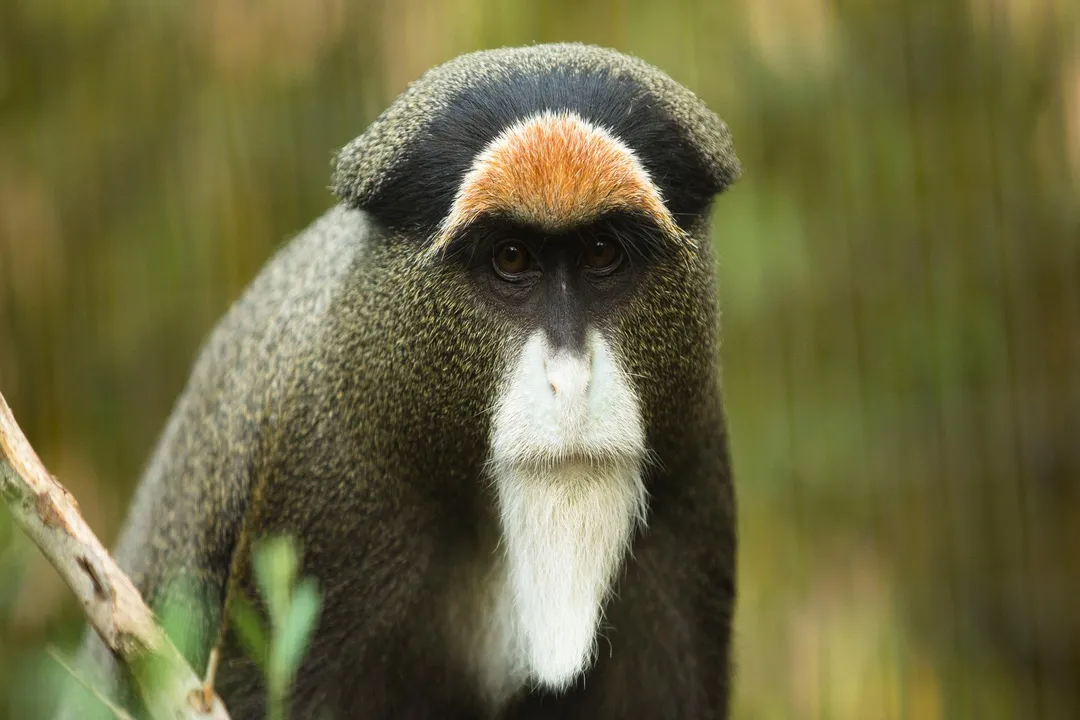
When assessing the typical mass of a De Brazza’s monkey, it is essential to look at the data separated by sex, as they do not weigh the same. [1][3] Generally speaking, the adult male is significantly heavier than the adult female. [2][5] For the males, figures cluster around 15 pounds, [1] or slightly higher, with some sources noting a range reaching up to about 17 pounds (approximately 7.7 kg). [2] Females, conversely, are considerably lighter, averaging around 8 pounds [1] or sometimes cited closer to 4 kilograms (about 8.8 pounds). [3][5]
If we look at the broader picture across available data, the recorded mass range for the species sits between 8 and 15 pounds (or 4 to 7 kg). [2][5] This range, while helpful for a quick reference, is heavily skewed by the difference in male and female averages. [2]
# Sexual Differences
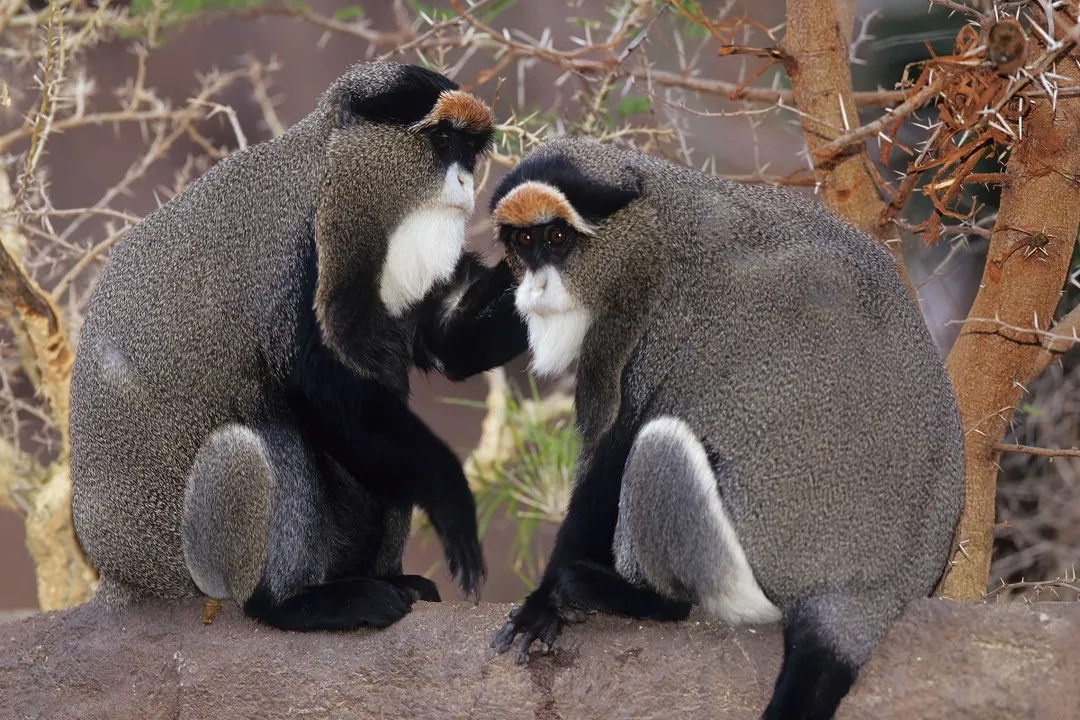
The clear size discrepancy is a defining feature of the species. [3] Males are often described as nearly doubling the size of the females. [2][3] This substantial difference is visually underscored by the male's notable physical trait—a distinct blue scrotum—which is absent in females who display a red perianal region. [3][5][6] This pronounced sexual dimorphism in body weight is a key indicator of the species' social organization, suggesting that males likely invest considerable energy into competitive displays or territorial defense to secure mating opportunities. [5]
Interestingly, when you consider the male’s upper range of around 17 pounds (7.7 kg) and compare it to the female’s average of 8 pounds (3.6 kg), the male is more than twice the mass of the female. This level of size disparity in a small African primate often implies a polygynous mating system where the most successful males pass on their genes, a structure that aligns with observations of their social life where single, dominant males lead troops. [3][5] While this pattern suggests intense intrasexual competition, their generally shy and cryptic behavior offers a unique contrast to their physical investment in size. [3][4]

# Contextual Mass

To give some perspective to these figures, considering the De Brazza’s monkey is noted as the largest species in the entire guenon family, their weight places them at the upper end for that group. [3][4] A male weighing in near 17 pounds is comparable to the mass of a small house cat or a standard sack of white rice. For the females, at around 8 to 8.5 pounds, they are closer in weight to a large bag of sugar or a heavy bowling ball. Understanding this mass helps contextualize their physical capabilities, such as their long legs and adeptness at moving quadrupedally through the forest understory. [1][5] While they are excellent swimmers, this relative weight must be easily managed for their lifestyle, which involves spending significant time in the trees. [2][6]
# Appearance Defined
While weight is an internal metric, the physical attributes that accompany these masses are what truly set them apart. De Brazza’s monkeys are instantly recognizable, not just for their size relative to other guenons, but for their facial adornments. [4][6] Both sexes feature a striking white beard and muzzle, contrasted by a black face and a reddish-orange crescent or diadem atop the head. [1][3][5] Their bodies are generally covered in speckled olive-gray fur, with black coloring on the limbs and tail. [2][3] A further distinguishing mark includes white stripes on their thighs and rump area. [1][5] These primates also possess well-developed cheek pouches, allowing them to store gathered food, a feature that becomes particularly useful when one is trying to move food back to a safe place away from potential competitors or predators, perhaps explaining why they sometimes forage in more open areas despite the risks. [2][5]

# Behavior Tactics
The De Brazza’s monkey’s physical structure and weight are closely linked to its defensive strategy. When alarmed or confronted by predators like leopards, eagles, or chimpanzees, their primary response is to freeze. [3][4][5] They can remain perfectly motionless for extended periods, sometimes up to eight hours. [8] This freezing behavior is so characteristic that their scientific name, neglectus, actually translates to meanings like "to be neglected" or "to pay no attention to". [3][4] The combination of their camouflage (gray fur, hidden white markings) and immobility makes them very difficult to spot. [4][5] If the threat approaches too closely, they may resort to booming vocalizations or aggressively shaking branches to distract the danger away from the group. [3][5]
# Conservation Status
Despite being the most widespread forest monkey in Africa, with a vast geographical range, the status of the De Brazza’s monkey on the IUCN Red List is Least Concern. [1][2][3] This broad classification contrasts with localized pressures they face, such as habitat loss from agricultural expansion and logging. [2][6] Furthermore, they are hunted for bushmeat and sometimes targeted as agricultural pests. [1][6] The presence of managed captive populations in zoos across North America and Europe, often under a Species Survival Plan (SSP), is a proactive measure. [3][4] While SSPs are usually reserved for more critically threatened species, their inclusion here helps maintain a healthy, genetically diverse reserve population, showing foresight in conservation planning even for species not yet in immediate crisis. [3][6] This ongoing management, despite their current 'Least Concern' tag, suggests that monitoring their population weight—not just in pounds, but in terms of absolute numbers across their range—remains important due to their cryptic nature, which prevents accurate population estimation. [4]
Related Questions
#Citations
De Brazza's monkey - Wikipedia
DeBrazza's Monkey, Cercopithecus neglectus
Cercopithecus neglectus (De Brazza's monkey) - Animal Diversity Web
Minnesota Zoo De Brazza's Monkey - Animals
Monkey, De Brazza's - Safari West
De Brazza's Monkey | Franklin Park Zoo
[PDF] De Brazza's Monkey | Idaho Falls
De Brazza's Monkey | Birmingham Zoo