What two breeds make up a Maine Coon cat?

The lineage of the Maine Coon cat is often shrouded in romanticized lore, leading many curious admirers to ask which two specific breeds combine to create this magnificent, rugged feline. The simple, two-parent answer expected for a modern designer crossbreed simply doesn't apply here, which is a crucial distinction for understanding this breed. [7] The Maine Coon is primarily recognized as a natural breed, meaning its characteristics developed through adaptation to the harsh New England environment rather than through planned human selection to combine two established modern breeds. [1] This historical context means we are looking back at potential ancestral influences rather than a documented cross between, say, a Persian and a Siamese. [7]
# Natural Evolution

The Maine Coon’s identity is inextricably linked to the state of Maine itself. [8] These large, long-haired cats evolved naturally in the rugged, demanding climate of the region. [1] This process of natural selection favored traits that aided survival: a thick, shaggy, water-resistant coat, large paws suitable for walking on snow, and a bushy tail that could wrap around the body for warmth. [6] Unlike breeds that trace their ancestry to a specific pairing documented in the late 19th or 20th centuries, the Maine Coon's origins are much murkier, dating back to the early settlers of North America. [8]
The lack of a singular, traceable pairing is what separates a natural breed from a hybrid or crossbreed. A crossbreed is the intentional mating of two distinct, recognized breeds—for example, crossing a purebred Ragdoll with a purebred Siamese to create a first-generation mix. [2] The Maine Coon's development was organic. Early domestic cats, both short-haired and long-haired types, arrived in the area perhaps with seafarers or early colonists. [1] Over time, through natural breeding within the local feral and farm cat populations, a distinct type emerged that became known as the Maine Coon. [1][8] It is this slow process of environmental conditioning, rather than a specific breeder's intentional combination, that forged the breed we know today. [7]
# Ancestral Speculation

While we cannot name two specific modern breeds as the 'parents,' experts and enthusiasts often speculate about the long-haired cats that may have contributed to the Maine Coon's genetics. [1] The prevailing theory suggests that long-haired cats brought to North America by European seafarers or settlers introduced the long-hair gene into the local gene pool. [1]
The breeds most commonly cited as potential genetic cousins or contributors, due to striking physical similarities, are the Norwegian Forest Cat and the Siberian cat. [1][2] These breeds also developed naturally in cold, harsh climates and share features like large size, semi-long coats, and tufted ears. [6]
It is vital to note the difference here: these breeds are suspected ancestors or close relatives that share a similar evolutionary path, not confirmed parents in a pedigree chart. [1] For instance, a cat with Maine Coon heritage that is mixed with a common domestic longhair will exhibit many Maine Coon traits but will not be a purebred Maine Coon. [6] If a cat has clear features of another established breed—say, a very short muzzle or an extreme flat face—it's more likely to be a deliberate mix or a cat whose ancestry is a blend of the native New England stock and later introduced domestic lines, rather than the classic, pure, naturally developed Maine Coon. [2]
The defining physical features of the Maine Coon—the dense, flowing coat that is shorter on the shoulders and longer on the stomach, and the distinctive ear tufts—are evidence of this long period of natural selection. [6]
# Distinguishing Natural Ancestry from Modern Crosses
To appreciate the natural ancestry, it helps to look at what happens when a Maine Coon is intentionally crossed with another breed today. Organizations that track mixes often list outcomes when a Maine Coon is bred with breeds like the Domestic Longhair (DLH) or even other purebreds. [5]
Consider a hypothetical comparison between the original development and a modern mix:
| Feature | Natural Maine Coon Ancestry (Historical) | Modern Maine Coon Mix (Example: with DLH) |
|---|---|---|
| Origin Method | Natural selection in Maine's climate | Intentional human breeding program |
| Coat Length | Consistent semi-long, shaggy, water-resistant | Variable; may lean toward the length of the non-Maine Coon parent |
| Muzzle Shape | Square, strong muzzle developed for efficient eating [6] | Can be rounded or less pronounced depending on the partner breed |
| Genetic Source | Local domestic cats + introduced longhairs (Norse/Siberian type) | Documented purebred Maine Coon + documented purebred X |
This comparison shows that tracing the Maine Coon's "parent breeds" leads us into the murky history of early American domestic cats, whereas tracing a modern crossbreed leads to clear pedigree papers. [5] Those looking for a true Maine Coon are seeking the outcome of the natural process, not the result of a calculated pairing. [7]
# Defining "Pure" Lineage

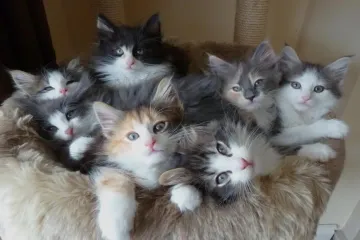
When breeders speak of a "pure" Maine Coon, they are referring to a cat whose ancestry is exclusively registered Maine Coon lines, indicating they are the result of breeding Maine Coons to other Maine Coons for generations. [1] This practice ensures the standardized traits recognized by cat associations are preserved. If you observe a cat exhibiting traits common to mixes, such as a very short coat or extreme color patterns not typical of the breed standard, it suggests a greater influence from non-Maine Coon lines. [2]
For example, some owners of mixed cats, perhaps a Maine Coon crossed with a domestic short-haired cat, report that while their cat shares the size and temperament, the coat might lack the distinct density or the bushy "britches" common in the purebred line. [4] Another observation from the community suggests that while mixed cats often retain the gentle nature, their overall structure might not be as distinctly square in the muzzle as a cat bred strictly to standard. [6]
# Analytical Perspective on Ancestry
The idea that the Maine Coon must descend from exactly two breeds is a human tendency to simplify complex biological histories into neat formulas. In reality, the founding population of Maine Coons likely involved a genetic pool comprised of many different, undefined domestic cats existing in the area during the 18th and 19th centuries. [8] The long-haired trait might have entered the gene pool multiple times through different ships or routes. Over time, the local climate acted as a stringent filter, culling weaker, less adapted coats and reinforcing the genes for the hardy, insulated fur we see today. [1] Therefore, the true "parents" were the environment of Maine and the entire local population of adaptable domestic cats, rather than two specific, named breeds currently recognized by cat fanciers. [7]
# Recognizing Traits in Mixed Cats
Because the Maine Coon is so popular, crossbreeding—whether intentional or accidental—is common. Understanding the ancestral look helps enthusiasts identify a purebred versus a cat with a partial background. [5]
If you are assessing a cat that you suspect has Maine Coon lineage, look for a few key indicators that point toward that natural heritage:
- Ear Furnishings: Lynx tips (tufts of hair coming off the ears) and heavy ear furnishings (hair inside the ear) are hallmark signs often inherited from the speculated wilder ancestry. [1]
- Bone Structure: Purebreds typically have a substantial, rectangular body shape and a strong, square muzzle. [6]
- Tail Length: The tail should be long, tapering slightly, and extremely bushy, often described as resembling a raccoon’s tail—hence the "Coon" in the name. [1]
When a Maine Coon is crossed with a non-pedigreed cat, like a common domestic longhair, the resulting offspring might inherit the size and some of the fluff, but the consistency of the traits fades. [6] For instance, a mix might be large but possess a softer, less dense coat that doesn't shed water well, or they might have a distinctly rounded muzzle that contrasts with the purebred's square profile. [2] This variation is the observable evidence of a less filtered, more mixed genetic history.
It is worth noting that while temperament is often cited as a consistent trait—Maine Coons are known for being sweet-tempered and dog-like—this is a behavioral trait reinforced by selection among breeders, but also present in many large, secure domestic cats. [3] A mix will usually retain the gentle nature, though individual personalities always vary. [4]
# Practical Considerations for Owners
For an owner of a cat displaying Maine Coon characteristics, the most important takeaway isn't precisely identifying the two parent breeds of its distant ancestors, but understanding the coat's maintenance needs, which directly relate to its environment-driven history. The water-resistant, shaggy double coat requires regular grooming to prevent matting, especially the longer fur on the stomach and "britches" (hindquarters). [6] This coat structure, developed to handle Maine winters, is a practical legacy of its wild beginnings. [1]
If you encounter a cat advertised as a "Maine Coon mix," such as a "Maine Coon/Ragdoll cross," you are dealing with a second-generation hybrid where the parentage is known for that specific pairing. [5] These crosses are distinct from the ancient, natural development of the pure Maine Coon itself. Keeping track of these second-generation pairings is simpler, as the resulting appearance is often a predictable blending of the two known parents' traits. [2] For example, a Maine Coon crossed with a breed known for a specific eye color might statistically increase the chance of that eye color appearing, whereas in the original natural development, eye color was selected based on what was present in the general pool and deemed acceptable by early breed enthusiasts. [8]
The long history of the breed, which has seen it win national competitions, proves that the survival of the line depended on its adaptability, not on a specific blueprint handed down from two named sources. [1] The two "breeds" that truly made the Maine Coon were the harsh New England climate and the resilient population of domestic cats that survived within it long enough for their superior traits to become the breed standard. [8] This inherent hardiness is perhaps the most defining, if abstract, element of its heritage.
Related Questions
#Citations
Maine Coon - Wikipedia
How to recognize a Maine Coon crossbreed cat? - Ziggy
What 2 breeds are included in the Maine Coon Breed group?
Who else has a mix of breeds & how are they together? : r/mainecoons
Identifying Maine Coon Mixes
Is My Cat a Maine Coon
Is a Maine Coon a mixed breed? - Quora
Are Maine Coon Cats Really From Maine? | Maine Public