How much should my dog eat per day?
Determining the precise amount of food your dog needs each day is one of the most common puzzles dog owners face, yet it remains fundamentally personal to your canine companion. Feeding your dog correctly is a cornerstone of their overall health, preventing the risks associated with both underfeeding, like nutritional deficiencies and low energy, and the far more common issue of overfeeding, which contributes to obesity and related ailments like joint disease and heart problems. [2][3][7] There isn't a single, universal measurement that works for every dog; instead, finding the right quantity requires understanding several interlocking factors and using the packaging guidelines as a flexible starting line, not a final destination. [2][5]
# Key Factors

Several variables dictate how many calories your dog burns and, therefore, how much fuel they require daily. Paying attention to these nuances allows you to move beyond the general advice and create a more tailored approach. [3][5]
# Life Stage Changes
A dog's age causes significant shifts in nutritional requirements. [3][5][7] Puppies are in a phase of rapid growth, demanding extra protein and calories to build muscle and bone structure—their needs are higher per kilogram of body weight compared to adults. [3][5][7] For this reason, puppy food is specifically formulated to meet these high demands. [5] For feeding puppies, recommendations are often based on their target adult weight, and frequency is higher, sometimes requiring three to five meals daily for very young pups. [3][5] As dogs transition to adulthood, their needs stabilize. On the other end of the spectrum, senior dogs, generally those aged 7 to 12 depending on size, experience a natural slowing of metabolism and decreased activity. [3][5] This often means they need fewer total calories than their younger, more active counterparts, though senior diets may also feature ingredients tailored for cognitive or joint support. [3][7]
# Weight Status
While age dictates what your dog needs, their current weight and Body Condition Score (BCS) determine how much of that food they should receive. [3][5] The BCS, typically scored by a veterinarian on a 1 to 9 scale, is the visual assessment of fat and muscle, with an ideal score usually being 4 or 5—meaning you can easily feel the ribs without seeing them, and a waist is visible from above. [1][3] If your dog is carrying excess weight (a higher BCS), their caloric intake must be reduced to work toward that ideal weight. [3][5][7] Conversely, a dog that is too thin needs an increase in calories. [3] Always use the dog's ideal weight goal, not their current weight, when calculating feeding amounts for weight management, and this calculation should always be done in partnership with your veterinarian, especially for significant weight loss programs. [1][3][6]
# Activity and Status
Activity level is a huge determinant of energy expenditure. A dog that spends its day hiking or working burns significantly more calories than one whose main activity is napping on the sofa. [1][2][3] Feeding recommendations on food bags are typically based on an average activity level, so highly active dogs will likely require portions on the higher end of the suggested range, while sedentary dogs need less to maintain a healthy weight. [2][5]
Another physiological factor is reproductive status. Dogs that have been spayed or neutered generally experience a slight drop in metabolism and often require about 20% to 30% fewer calories to maintain the same healthy weight compared to intact dogs. [1][2][5] Conversely, a pregnant or nursing female dog has substantially increased energy demands and needs a diet formulated to support that need. [3][5]
# Food Type
Even if you perfectly calculate your dog's caloric need, not all food measures the same. Calorie density varies dramatically between dry kibble, wet food, and raw diets, and even between different brands of kibble. [1][3][5] A cup of one brand might contain significantly more kilocalories (kcal, the term used on pet food labels for calories) than a cup of another. [3] This variability means that the feeding chart provided on the specific bag you are using is essential, as it is calibrated for that product's energy content. [2][3]
# Calculating Portions
Translating these factors into a measurable quantity can happen in a couple of ways, but they all point toward the ultimate goal: an ideal body condition. [1]
# Percentage Rule
A common guideline suggests that dogs generally need to consume between 2% and 4% of their body weight in food daily. [5] This percentage range often correlates with size: smaller dogs, which have higher metabolisms per pound, tend to fall on the higher end of this scale (closer to 2.5% to 3%), while larger, older dogs are closer to the 2% mark. [4][5] For instance, a small dog under 10kg might consume 150–300 grams per day, while a large dog over 25kg might need 750 grams up to 1.5 kilograms, according to one breakdown. [4]
# Calorie Estimation
For a more scientifically derived baseline, owners can look toward Resting Energy Requirement (RER) formulas, such as the one used by some veterinary guidelines: . [1][5] This calculation provides an estimated daily caloric need for a dog at a healthy weight under specific lifestyle conditions. [1] While online calorie calculators can help process this math, remember that these figures are mathematical estimates, and individual needs can be 50% more or less than the calculated result. [3][5]
When using these baseline calculations, you must then cross-reference them with the kcal information on your dog’s specific food package. [1] If your food packaging says it contains and your dog needs , you know to feed $2.5$ cups daily.
A vital part of the equation that owners sometimes overlook is everything that goes into the mouth. Treats, chews, and any table scraps count toward the daily caloric total. [1] A generally accepted guideline, often reinforced by groups focused on preventing pet obesity, is that treats should not exceed 10% of the total daily calories allowed. [1][6] If you provide treats, those calories must be subtracted from the main meal allowance to prevent inadvertent overfeeding. [1]
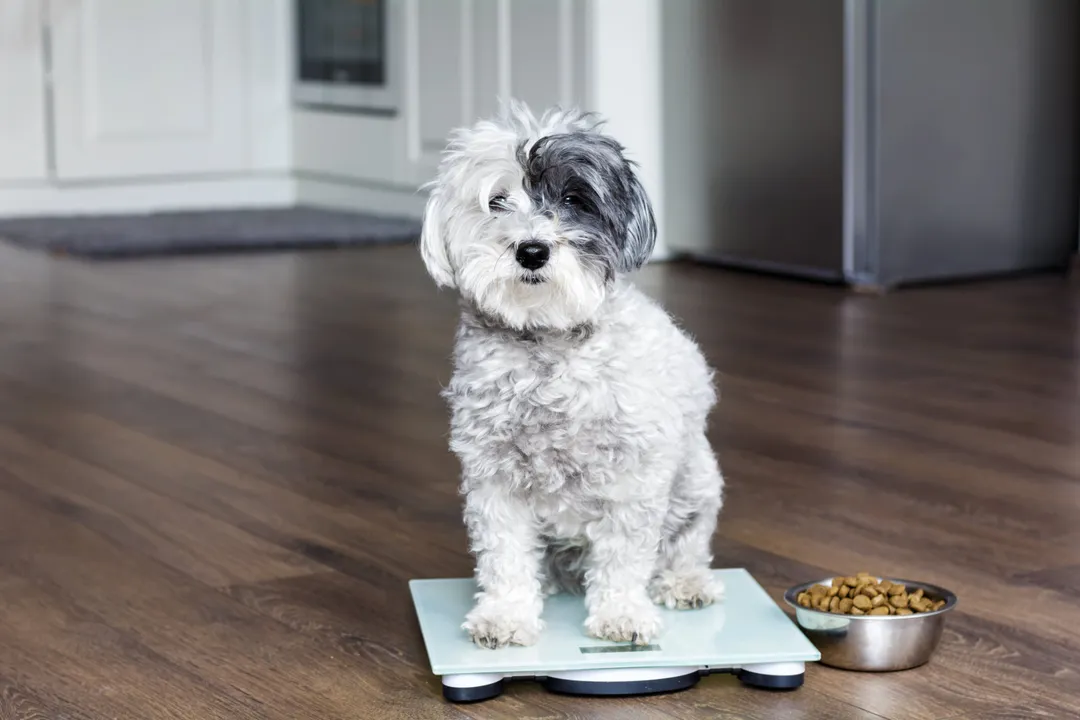
One practical step for greater consistency, especially when dealing with dry kibble measured by volume, is to weigh the recommended daily cup measurement once with a kitchen scale. This allows you to then divide that total weight into your chosen number of daily meals in grams or ounces, providing a far more accurate and repeatable measure than scooping, as the actual weight of one cup varies based on kibble size and density. [1]

# Frequency Matters
Just as important as the total daily amount is how you divide that food across the day. While packaging charts usually list the total daily amount, most veterinarians recommend splitting that total into multiple feedings. [2][8]
# Routine Scheduling
For most healthy adult dogs, feeding twice per day—once in the morning and once in the evening—is considered the ideal frequency. [2][3][5][8] This routine provides security and predictability, which can help manage the dog’s schedule, aid in house-training, and help manage hunger signals. [8][5] Dividing the total daily allowance into two equal meals helps to spread out energy levels and avoids intense hunger spikes that can occur if food is only offered once daily. [3][5] For large and giant breeds, splitting meals can also be a good practice to help reduce the risk of bloat. [4]
Puppies, due to their high caloric needs for rapid development, require more frequent feeding sessions, often three to four times a day initially, gradually settling into the adult twice-a-day schedule by six months of age or older. [3][7]
# Grazing Versus Meals
While the desire to let a dog graze all day is understandable—they certainly act like they’re starving between meals—free-feeding is generally discouraged by experts because it frequently leads to a gradual, unnoticed overconsumption and subsequent obesity. [3][5] Scheduled mealtimes create an expectation, making it easier to monitor precisely how much your dog is eating and ensuring they consume their required nutrients. [8] If you have a dog that is a picky eater and refuses to eat sufficient calories in one sitting, you might measure their total daily amount and offer it several times, taking the bowl away after a set time (like 10–15 minutes) if they haven't finished, rather than leaving it down indefinitely. [3]
# Monitoring Success
Once you establish a baseline amount and feeding schedule, the work shifts to observation. The numbers are only an estimate; your dog’s physique provides the true feedback. [3]
# Body Assessment
You must regularly assess your dog’s body condition to see if the current feeding plan is working. [5] You are looking for that visible waistline and ribs that are easily palpable but not visible. [3] If your dog appears to be consistently gaining weight despite following the chart for their ideal weight, they are receiving too many calories, and you must reduce the amount slightly. [1][7] Conversely, if they look lean or you can see their spine easily, they may need an increase. A practical insight here is that since breed size differences can sometimes lead to metabolic rate variance even within the same general activity category—a very sedentary Labrador might thrive on the low end of the 2% guideline, while an extremely lean, high-drive Border Collie might need closer to 3% despite similar weights—the Body Condition Score is the ultimate referee, not just the weight on the scale or the chart on the bag. [4][5]
# Adjustments and Consultations
Any time you switch food brands, you must re-evaluate the amount because the new food will have a different calorie density. [2][3] Furthermore, if your dog develops a new health condition, like the onset of arthritis or diabetes, their established routine needs reassessment with your veterinarian to ensure the diet supports their current medical state. [1][5] Sticking to a consistent schedule makes it easier to notice if your dog stops eating, which is a crucial early signal that a health issue may be developing. [8] Ultimately, your veterinarian is the most qualified resource to help you fine-tune the specific caloric target for your individual dog’s health, age, and lifestyle. [2][3][7]
Related Questions
#Citations
Dog Feeding Chart: How Much Food Should I Feed My Dog? - PetMD
Dog Feeding Chart: How Much Should I Feed My Dog? - Purina
How Much To Feed a Dog by Weight (kg) - PetLab Co.
Pet Calorie Calculator: Estimate How Much to Feed Your Dog or Cat
How Much Food Should I Feed My Dog? - Chewy
Calorie Calculator - Pet Nutrition Alliance
Feeding Chart For Dogs: A Complete Guide | Darwin's
How Much Should My Dog Eat? - Prudent Pet
Feeding Times and Frequency for Your Dog | VCA Animal Hospitals