How fast can agoutis run?

The agouti, a medium-sized rodent native to Central and South America, is often observed as a quiet, ground-dwelling forager, busy with the serious work of burying seeds. [7][9] These animals are known for their distinctive, large eyes and prominent ears, traits that hint at a life where awareness and rapid response are paramount. [2] While they may appear slow while carefully moving through the leaf litter or investigating fallen fruit, their physical capabilities are finely tuned for survival in environments teeming with predators. Understanding their speed isn't just about a simple top-end number; it's about when they can deploy that speed and how it fits into their daily existence. [1]
# Early Movement
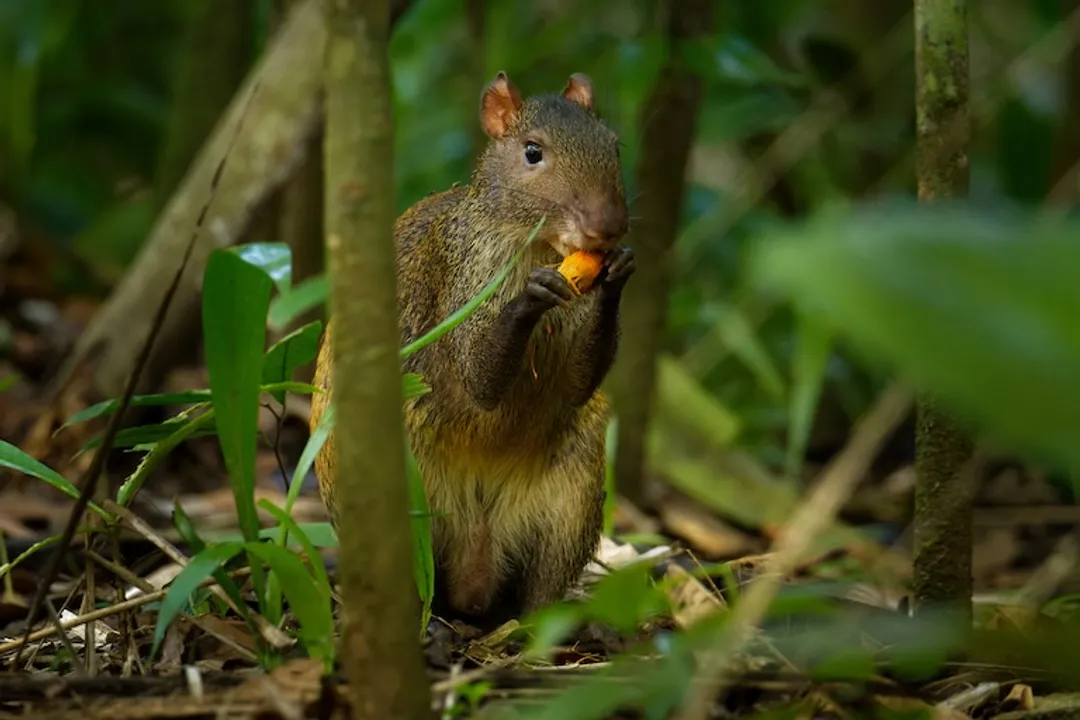
One of the most striking attributes of the agouti, particularly concerning its speed potential, is its precocious development. For many mammals, especially prey species, developing the ability to flee predators quickly after birth is a matter of life or death, and the agouti exemplifies this pressure. [6] The Red-rumped Agouti, for example, is astonishingly quick off the mark. A newborn of this specific species is actually capable of running within just an hour of taking its first breaths. [6] This immediate mobilization capacity contrasts sharply with many other young mammals that require weeks or even months to achieve basic coordination. [6]
This rapid onset of mobility suggests an intense selective pressure for immediate self-sufficiency in their native habitats. [6] It requires a mature central nervous system ready to coordinate complex motor skills almost instantly, indicating that their entire physiology is geared toward a survival strategy that begins the moment they are born. [6] This early competence means the mother does not need to guard stationary, helpless young for long periods, allowing her to return to foraging sooner, a critical advantage in resource-scarce environments.
# Quick Escape
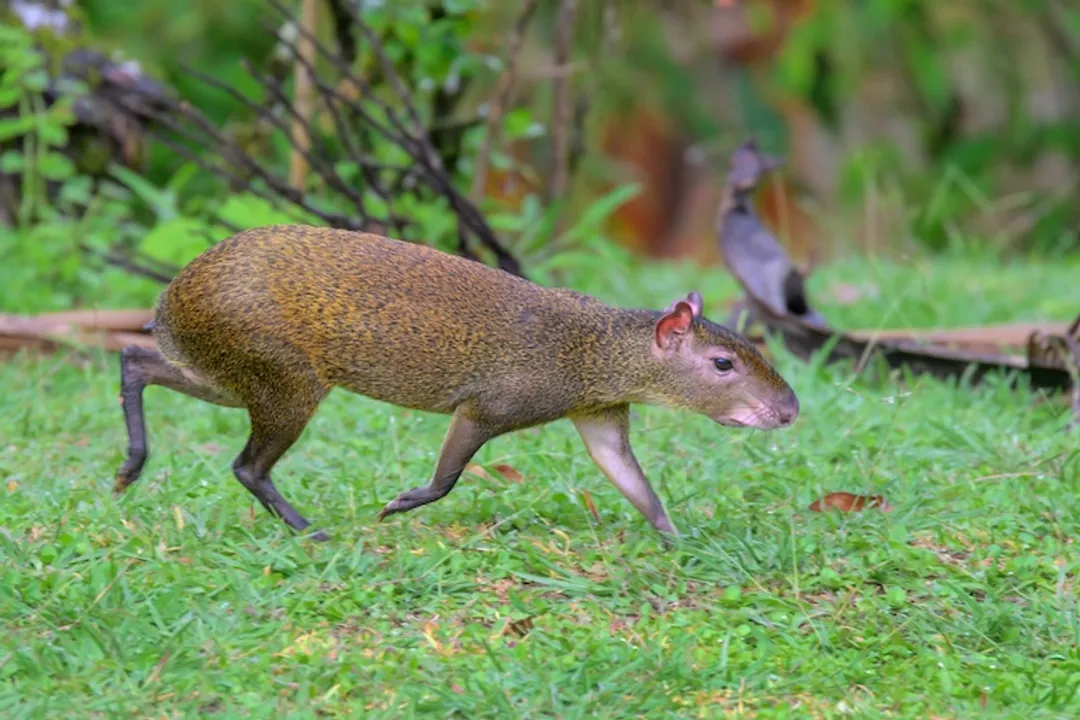
When an agouti does sense danger, its speed is primarily utilized as a means of immediate evasion rather than prolonged pursuit. Agoutis are built for short, sharp bursts of acceleration necessary to reach cover, such as dense thickets, burrows, or rock crevices. [2][9] Their powerful hind legs are key to this capability, providing the necessary thrust to propel them away from threats like jaguars, ocelots, or large snakes. [1]
Their running style is characterized by rapid, directional changes. If you were to observe an agouti fleeing, you would see them darting rapidly between obstacles rather than maintaining a straight line. [9] This agility is as vital as sheer top speed; in a cluttered forest floor or dense undergrowth, the ability to pivot and weave is often the difference between escaping and capture. [2] While the sources available do not provide a specific maximum velocity in miles per hour, the descriptions consistently emphasize their swiftness and alertness, suggesting that their pace is more than adequate to outstrip most terrestrial predators over short distances. [1][2][3]
A noteworthy observation regarding their general movement is that the agouti often travels along established routes or trails, which are cleared by frequent use. [7] While these trails might appear efficient for standard travel, they also serve as pre-planned escape corridors, allowing the animal to maximize its velocity when fleeing, as they do not waste crucial milliseconds navigating unpredictable terrain.
# Jungle Needs
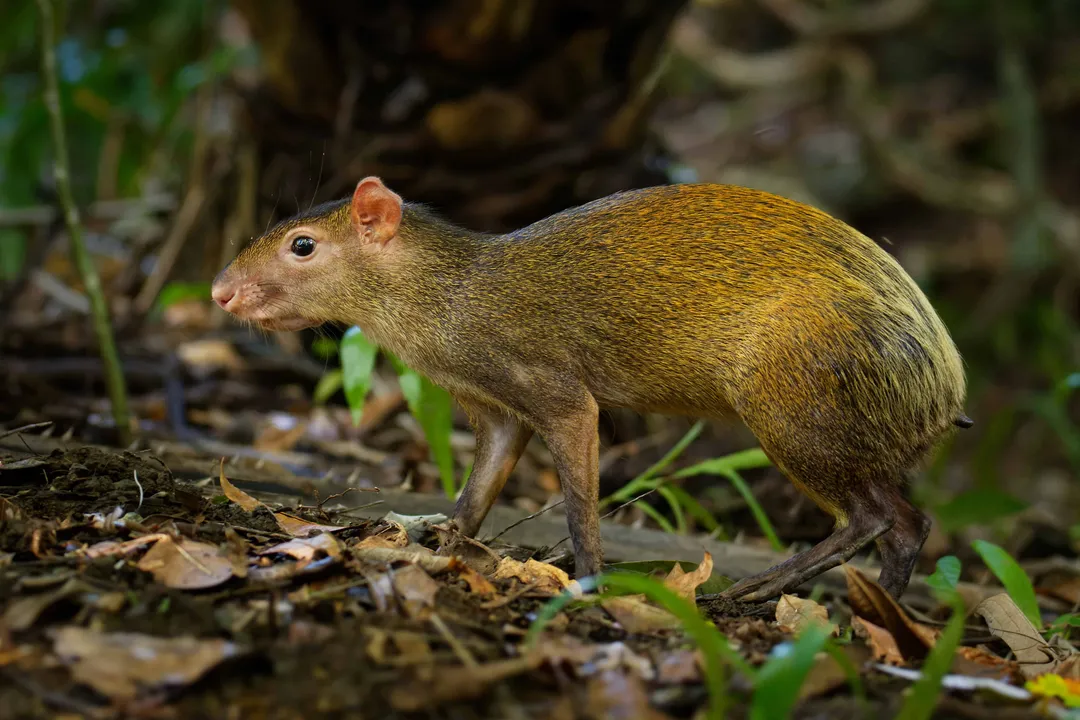
The environment where the agouti lives dictates the necessity for its specific type of quickness. Found throughout Central and South American rainforests, dry forests, and thickets, these areas are rarely open expanses where sustained, high-speed sprinting is an advantage. [1][2] Instead, speed needs to be coupled with maneuverability to navigate the complex three-dimensional environment of the forest floor. [9]
For instance, species like the Red-rumped Agouti are found in diverse regions, from the Guianas to northern South America. [4][5] In these settings, predators rely on stealth, meaning the agouti must react to the slightest disturbance, rather than seeing a threat coming from afar. Their entire sensory apparatus—large eyes and acute hearing—works in concert with their explosive leg power to ensure near-instantaneous escape initiation. [2] This reliance on immediate reaction speed over marathon stamina is a clear adaptation to this type of dense habitat.
# Forager Traits
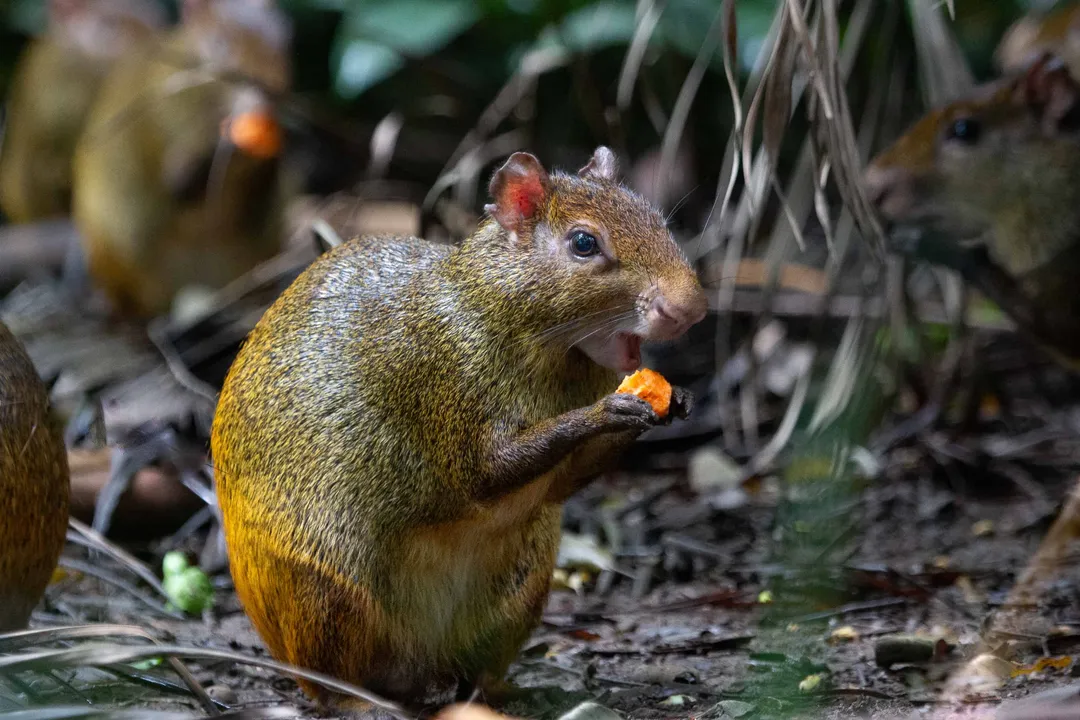
The agouti’s feeding habits present an interesting dichotomy when considering its running speed. They are famous for their role as "scatter-hoarders," burying seeds and nuts across the forest floor to consume later. [7][9] This behavior requires periods of slow, methodical searching, digging, and covering of caches. [7] An animal that relies on such meticulous, ground-level activity must be able to switch instantaneously to a high-alert, high-speed mode.
Considering the Red-rumped Agouti can run within an hour of birth, [6] it suggests a population where developmental time is severely compressed, making the transition from a vulnerable newborn to a self-reliant, evasive adult almost immediate. This rapid maturity contrasts with the deliberate, slow nature of their foraging, suggesting that the default state is "prepared to run," with foraging being the necessary, brief interruption. While one source notes that the agouti in the Yucatan Peninsula is a "quiet forager", [9] this quietness is a necessary precursor to the loud, fast dash needed when that quiet is broken by danger. If an animal spends most of its time focused on burying food, its escape mechanics must be highly efficient to compensate for the reduced time spent practicing evasion maneuvers compared to, say, an animal constantly moving across open ground.

# Species Variation
It is important to recognize that "agouti" is a general term encompassing several species, and while their core survival strategies are similar, slight differences exist in appearance and potentially in precise movement capabilities across their range. [1][4] For example, the Red-rumped Agouti, as its name implies, possesses a distinct red or reddish-brown coloration on its rump area. [4][5] While the speed and agility remain fundamental to all species, the ecological niches and specific predator pressures might cause subtle variations in their preferred terrain usage, which in turn affects how they utilize their running capacity. [3] The universal requirement, however, remains immediate flight, whether you are dealing with a species in the Amazonian lowlands or one inhabiting the drier regions of the Yucatan. [9]
Related Questions
#Citations
Agouti Facts & Photos | Wowzerful
Agouti | San Diego Zoo Animals & Plants
Agouti Animal Facts - A-Z Animals
Red-rumped Agouti - Perth Zoo
Red-rumped agouti | Smithsonian's National Zoo and Conservation ...
Did you know? The red-rumped agouti is able to run within an hour ...
AGOUTI - Rainforest Expeditions
Agouti Facts - Fact Animal
The Agouti: The Quiet Forager of the Yucatan Peninsula