How far can a bullfrog jump?
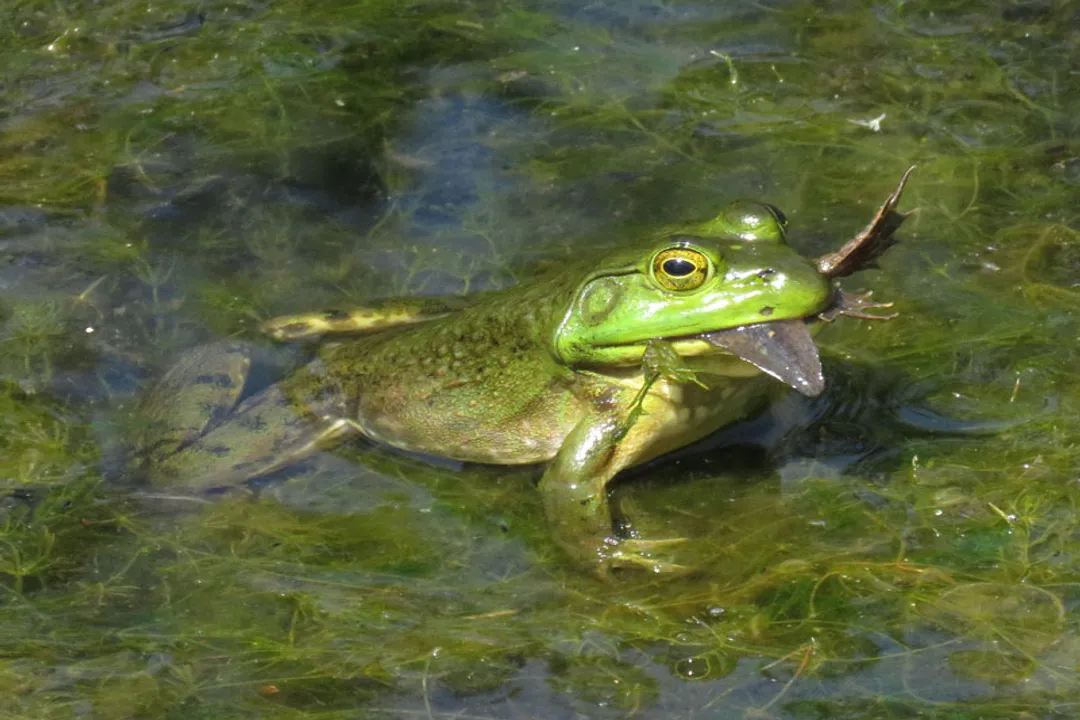
The American Bullfrog, Lithobates catesbeianus, is perhaps the most recognizable amphibian across much of North America, known for its deep, resonant calls that echo across wetlands. While their booming jug-o-rum call often precedes their appearance, it is their incredible locomotive ability—the jump—that truly speaks to their powerful physique. The question of how far these massive frogs can propel themselves is fascinating, especially when considering their seemingly cumbersome, squat bodies, which can grow quite large. A typical adult American Bullfrog can reach lengths of up to 8 inches, though some specimens might be smaller or larger depending on the environment and age.
# Leap Measurement
When analyzing amphibian acrobatics, distinguishing between an average leap and a maximal effort is important. For the American Bullfrog, general observations suggest they are capable of propelling themselves forward a distance averaging around 3 feet in a typical escape maneuver or short move. This is a significant distance for an animal that spends much of its time sitting still, waiting for prey or avoiding predators.
This common distance offers a useful mental benchmark. Imagine stepping three full feet in a single bound without any wind-up, a feat that requires immense, instantaneous muscle contraction originating from those powerful hind legs.
# Maximum Distance
While 3 feet represents a common, everyday jump, the bullfrog is capable of truly impressive single-leap performances when motivated. Records indicate that they can achieve a single jump extending up to 6 feet. This nearly doubles the standard observed leap distance, illustrating the difference between routine movement and an all-out effort, likely motivated by immediate danger.
It is important to recognize that these distances are relative to the frog’s massive size. When we look at the mechanics, the relationship between the jump and the frog's body size becomes the more compelling metric for true athletic assessment.
# Relative Size Jumps
Comparing the jump distance to the animal’s physical dimensions highlights the disproportionate power of the frog's musculature. Some sources suggest that bullfrogs can achieve leaps equivalent to 20 times their own body length. If we take a conservative average adult length of about half a foot—or 6 inches—a 20-times-body-length jump would equate to 10 feet. This theoretical maximum, based on body length ratios, suggests that the documented 6-foot maximum leap might not represent the absolute limit of their potential under ideal, perfectly executed conditions, or perhaps that the 20x ratio is achieved by smaller individuals who have a relatively larger jump capacity compared to their mass.
Consider a mid-sized bullfrog, say one measuring 7 inches from snout to vent. A 6-foot jump is approximately 13 times its body length. This suggests that while the 20x ratio is an impressive upper bound for the species' capability, most recorded, sustained, long-distance jumps recorded in field observations cluster closer to the 12 to 15 times body length mark. This discrepancy between anecdotal field records (6 feet) and theoretical maximums (up to 20 times length) prompts an interesting consideration: Are the factors inhibiting the absolute maximum jump in the wild related to ground surface, moisture, or perhaps the immediate psychological need for safety that dictates the 6-foot limit? This difference between the observed 6-foot maximum and the potential 10-foot maximum is one area where observing their launch mechanics in controlled settings could yield fascinating data on energy transfer efficiency.
# Why Not Jump
It seems counterintuitive that an animal so perfectly adapted for explosive jumping might choose not to. Yet, there are scenarios where the great leaper chooses to remain stationary. One finding suggests that bullfrogs might exhibit reluctance to jump under certain conditions. While the reasons are complex, relating to immediate environmental cues or perhaps energy conservation, understanding when a bullfrog won't jump is almost as informative as knowing how far it can jump. For naturalists observing these animals, noticing stillness can be just as important as witnessing flight, as it often indicates the frog is secure, conserving energy, or perhaps even preparing for a quick, short strike at passing prey rather than an escape.
# Frog Facts
The American Bullfrog holds the title of the largest true frog found in North America. They are masters of camouflage, often blending in perfectly with their aquatic environments, which contributes to their success both as predators and as survivors. Their diet is famously broad, consisting of nearly anything that fits into their large mouths, including insects, crayfish, other frogs, small snakes, and even small birds or rodents that venture too close to the water's edge. Their classification as a "true frog" means they belong to the family Ranidae.
They also possess distinct physical characteristics that aid their amphibious lifestyle. The species is easily recognized by its large, prominent tympanum, or eardrum, which is larger than its eye. Males typically have a tympanum that is noticeably larger than their eyes, whereas a female’s tympanum is usually about the same size as her eye.
# Notable Ribbiters
The prowess of the bullfrog has even earned some individuals a measure of fame. For instance, an American Bullfrog named Rosie the Ribiter became something of a local celebrity in California. While specific details about Rosie's jumping capabilities are not widely documented, her notoriety stems from her exceptionally loud, distinctive calls, showcasing that vocalizations are just as defining a characteristic of this species as their leaping ability. The very existence of these named frogs suggests a level of interaction and familiarity between humans and this specific species, often built around their observable behaviors in local habitats.
In summary, the bullfrog is a creature of impressive contrasts: huge in size yet capable of leaps many times its own length, often appearing placid yet ready for instantaneous, powerful propulsion. The typical 3-foot hop provides daily utility, while the 6-foot maximum jump offers a clear demonstration of reserve power when survival is at stake, making them an extraordinary study in biological engineering.
Related Questions
#Citations
[PDF] Jump Like a Frog - The Maryland Zoo in Baltimore
Five Fun Facts About Bullfrogs - Forest Preserves of Cook County
Five things about those boisterous bullfrogs
[PDF] American Bullfrog | NC Wildlife
Jump, frog, jump! Bullfrogs can generally leap about 3 feet and able ...
Introducing North America's largest native frog - Instagram
TIL about Rosie the Ribiter, the American Bullfrog that holds ... - Reddit
How far can bull frogs jump? (And why it matters!) - Apple Podcasts
Why Won't Bullfrogs Jump For Science?
American Bullfrog | Squam Lakes Natural Science Center