species articles - Page: 5
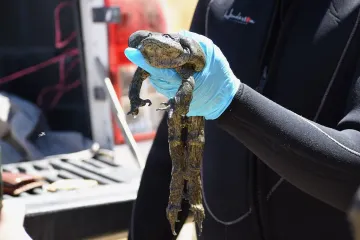
What feature gives the Titicaca Water Frog its common name?
How does the Titicaca Water Frog primarily sustain itself physiologically?
At what approximate elevation above sea level is Lake Titicaca situated?
According to official definitions, what is the IUCN conservation status of *Telmatobius culeus*?
What alarming population decline estimate has been noted over the last decade for this species?
What is the most pervasive threat contributing to the rapid decline of the species?
Why does the frog's reliance on cutaneous respiration make it acutely sensitive to water pollution?
For what purposes is the frog often harvested for local traditional remedies?
What type of conservation strategy involves maintaining colonies outside of Lake Titicaca, such as at Chester Zoo?
What must be aligned with the survival of the frog for long-term in-situ success?
Which species was most notably crossed with the Père David's deer in documented hybridization studies?
What characteristic was specifically noted about the first-generation (F1) hybrids resulting from the Père David's deer imes Red deer cross?
Why is the Père David's deer largely extant today?
The successful hybridization between Père David's deer and Red deer is noteworthy because they belong to which different taxonomic ranks?
What action was successfully performed using the fertile F1 hybrids and one of the parental species?
What is the current status of natural hybridization involving Père David's deer?
What management consequence arises from the high genetic compatibility observed between Père David's deer and Red deer?
What was the result of mating F1 hybrids back to the Red deer parent species?
What is the primary conservation objective for managing Père David's deer populations?
What specific aspect of reproductive biology is investigated by comparing the viability rates between reciprocal crosses involving Père David's deer and Red deer?
What is the Comet Moth's primary defense mechanism against nocturnal predators like bats?
Why is the adult Comet Moth unable to feed after emerging from its pupa?
What significant difference exists between the male and female Comet Moth antennae?
What measurement can the extraordinarily long trailing tails of the male Comet Moth reach?
What is the primary reason *Argema mittrei* is considered endangered in its natural habitat?
Which plants are listed as key food sources for the *Argema mittrei* caterpillar?
What is the approximate maximum wingspan for the male Comet Moth?
How does the typical lifespan of a female Comet Moth compare to a male?
What is the approximate duration of the pupal stage for *Argema mittrei*?
What feature references the genus name *Argema*?
Which individual officially described the species *Argema mittrei* and in what year?
PreviousPage 5 of 5