Caecilian articles
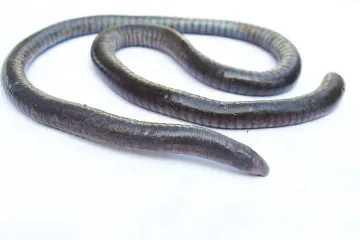
To which unique biological class do caecilians belong, despite superficial resemblance to worms?
What fundamental internal structure confirms a caecilian's identity as a vertebrate, unlike an earthworm?
What specialized, retractable sensory adaptation is located between a caecilian's eye and nostril?
What type of skeleton do earthworms utilize for structure and movement, in contrast to caecilians?
What feature embedded in the skin uniquely sets caecilians apart from frogs, salamanders, and worms?
What evolutionary process explains the superficial similarity between burrowing caecilians and large earthworms?
How do caecilians' reproductive strategies diverge from many aquatic worms?
What characteristic confirms the caecilian developmental link to tetrapods, which snakes lack?
How do caecilians move through soil using their vertebrate anatomy, unlike the worm's hydrostatic movement?
According to the comparison table, what is the Phylum classification for an earthworm?

To which order of amphibians do caecilians belong?
According to modern molecular phylogenetics, which two groups are considered sister groups relative to caecilians?
Approximately when is the initial divergence of the caecilian lineage from the ancestor of modern frogs and salamanders estimated to have occurred?
What major factor significantly limits the paleontological understanding of caecilian ancestry?
What ancient trait, retained by caecilians but lost by modern frogs and salamanders, suggests the common ancestor of Lissamphibia had dermal armor?
Which ancient fossil, dating to the Early Jurassic, helps bridge the morphological gap between extinct early tetrapods and modern Gymnophiona?
What unique sensory organ helps caecilians detect vibrations and chemicals in the soil?
Why does the caecilian branch appear relatively longer than the frog or salamander branches on a simplified phylogenetic tree based on genetic distance from humans?
What reproductive strategy, often seen in caecilians, contrasts with the generally ancestral amphibian mode tied to aquatic larvae?