sun articles
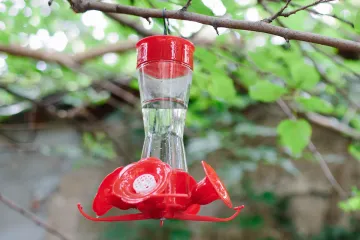
What is the general consensus for the ideal feeder placement when balancing nectar freshness and visibility?
What visual sign indicates that a feeder placed in the sun is spoiling too quickly?
During which time window is direct, gentle morning sunlight generally recommended for feeder placement?
What is the primary danger associated with feeding hummingbirds spoiled sugar water?
How does the elevation of a feeder influence the rate at which the nectar heats up?
What critical maintenance mistake should feeders owners avoid when refreshing the solution?
When temperatures soar above 90°F, what is the suggested frequency for cleaning and replacing the nectar?
Why might placing a feeder in deep, consistent shade be detrimental to attracting birds?
In relation to protective cover, what is the recommended distance for positioning a feeder for security?
How should placement priorities shift when moving from peak summer heat to moderate spring or fall temperatures?
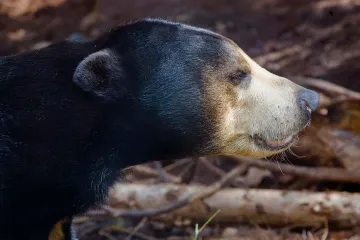
What taxonomic classification makes the sun bear unique among extant bears?
Who initially described the sun bear species in 1821 under the name *Ursus malayanus*?
Within which Order is the sun bear placed, grouping it alongside animals like seals and cats?
What key morphological difference primarily distinguishes the Bornean subspecies (*H. m. euryspilus*) from the nominate subspecies?
Genetically, which bear lineage is noted as representing the first group to radiate out from the main *Ursinae* group along with the sun bear?
What key behavioral trait linked to environment prevents the sun bear from entering a period of dormancy?
What is the taxonomic Class assigned to *Helarctos malayanus*?
The genus name *Helarctos* is derived from Greek words combining *hēlios* (sun) and *arctos* (bear) and what other primary element?
The nominate subspecies, *Helarctos malayanus malayanus*, is geographically distributed across which two primary areas?
In what year did Thomas Horsfield formally separate the sun bear into its own genus, *Helarctos*?
The sun bear's physical traits, such as short fur and inward-turned feet, are adaptations for what specific lifestyle in tropical forests?
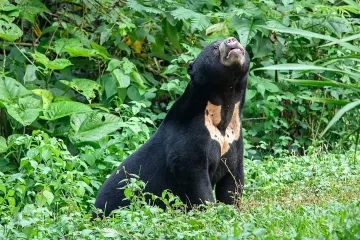
To which biological family does the sun bear, *Helarctos malayanus*, firmly belong?
How does the sun bear compare in size to other members of the Ursidae family?
What anatomical feature allows the sun bear to extract insects and honey from deep crevices?
What feature gives the sun bear its common name?
What is the primary function of the sun bear's short, coarse, and sleek coat?
What is the maximum recorded length of the sun bear's claws?
Which conservation listing has the International Union for Conservation of Nature (IUCN) assigned to the sun bear species?
What characteristic makes sun bears highly dependent on primary, undisturbed rainforests?
What are the two primary drivers causing the decline of the sun bear population across its range?
Sun bears are often described as frugivores or insectivores because their diet leans heavily toward which three primary food types?
What role does the sun bear play in the health of Asian forests?