How tall is the Chilesaurus?
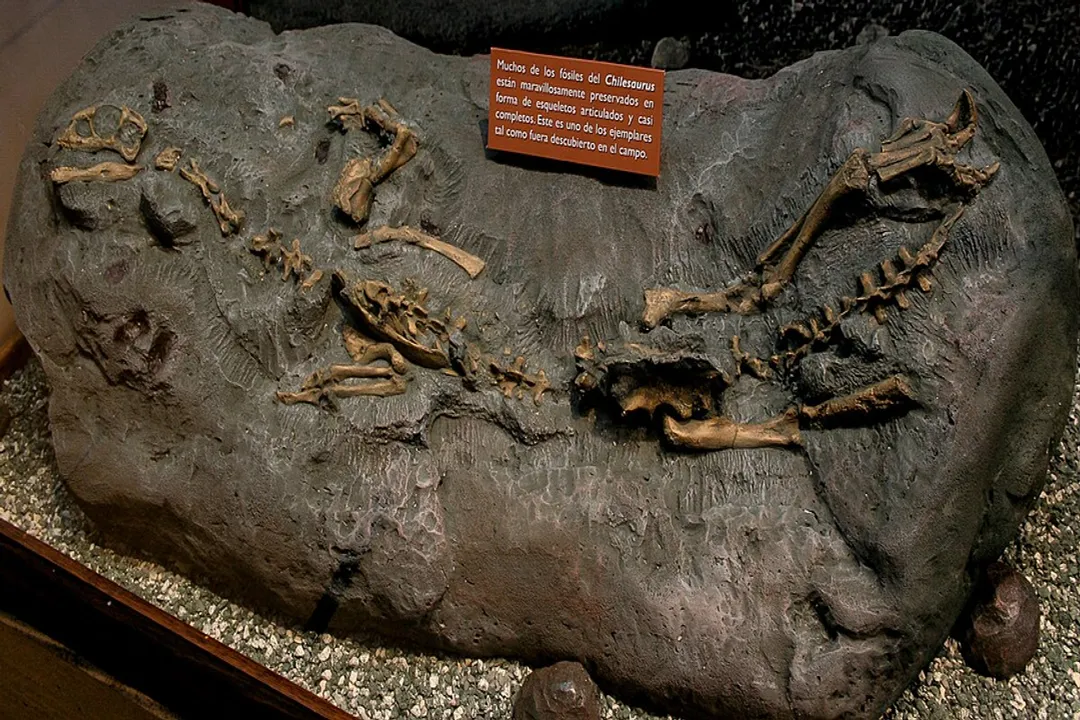
The South American dinosaur Chilesaurus diegosuarezi is a paleontological puzzle box, famed not just for where it was found, but for its baffling collection of physical traits. While the public often seeks to categorize dinosaurs by their sheer vertical presence—how tall they stood—the evidence for Chilesaurus primarily focuses on its length, painting a picture of a dinosaur that was surprisingly modest in stature compared to many of its contemporaries. This creature, which roamed what is now Chile during the Late Jurassic period, approximately 145 million years ago, was far from the towering giant one might picture when thinking of Jurassic fauna.
# Size Estimate
When we attempt to measure Chilesaurus, we rely on the fossil material recovered from the Toqui Formation. The specimens represent several individuals at different stages of growth, which is crucial for understanding its full dimensions.
The initial specimen, designated as the holotype, belonged to a skeletally immature individual. Based on this juvenile, scientists estimated its length in life to be around 1.6 meters (5.2 feet). This gives us a baseline measurement for a young Chilesaurus.
For the adult size, researchers examined the paratypes, which represent at least four other individuals, including fully grown ones. By scaling up the juvenile's proportions or analyzing the larger, more complete adult skeletons, the team inferred that a fully grown Chilesaurus would have reached a total length of about 3.2 meters (10.5 feet). Other assessments place the typical adult length in the range of two to three meters or up to 3 meters long.
While these figures describe length—from snout to tail tip—they do not directly state the hip height or shoulder height. However, considering its body plan, which included a long tail for balance and bipedal locomotion, a 3.2-meter-long animal was likely comparable in height to a modern large goat or a small pony standing at the shoulder, perhaps reaching shoulder heights in the range of 1.2 to 1.5 meters, though this is an extrapolation based on typical ornithischian/small theropod body architecture. If you consider a typical mid-size sedan, the Chilesaurus would have been roughly as long as the entire vehicle, but much lower to the ground, indicating it occupied a niche closer to the underbrush feeders than the canopy browsers. This relatively compact size meant it was certainly among the smaller dinosaurs found in that ecosystem.
# Bizarre Build
The actual dimensions are perhaps less remarkable than the anatomy that produced them. Chilesaurus has earned nicknames like the 'platypus' dinosaur because its body parts seem borrowed from entirely unrelated dinosaur groups. This phenomenon, where similar features evolve independently due to similar lifestyles or environmental pressures, is known as mosaic convergent evolution.
It has features we usually associate with meat-eaters (theropods), such as its bipedal stance and grasping forelimbs, yet its diet was strictly vegetarian. Its jaws and teeth were adapted for slicing foliage, not tearing flesh; the teeth were elongated and spatula-shaped, protruding forward—a signature trait of a plant-eater unlike any other theropod. Furthermore, its pelvis exhibited a backward-pointing pubic bone, an adaptation often seen in herbivores to accommodate the larger gut required to process plant matter, a feature typical of the ornithischian, or 'bird-hipped,' dinosaurs.
The uncertainty surrounding its classification—whether it is a primitive theropod or an early ornithischian—stems directly from this anatomical mashup. Some researchers even suggested it represented a genuine missing link between the two major dinosaur branches.
# Locomotion Clues
The structure of the hind limbs offers clues about how this medium-sized herbivore moved. Unlike many speedy carnivorous theropods, Chilesaurus seems to have been somewhat less adapted for rapid, sustained running. Evidence for this comes from its feet and shinbones. The presence of a broad foot with a weight-bearing first toe suggests a posture built more for stability than for agility. Additionally, the cnemial crest on the top front of the shinbone was small. These features suggest that while it could move around, it likely preferred a slower gait compared to its predatory relatives like Allosaurus. Defense might have relied more on its relatively strong arms, which possessed a large claw on the first finger, rather than pure escape speed.
# Naming and Finding
The discovery of Chilesaurus is a story tied intimately to the region it inhabited. The first bones—a vertebra and a rib—were found in 2004 by a seven-year-old boy named Diego Suárez in the Aysén Region of Chilean Patagonia. The species name, diegosuarezi, honors this young discoverer. The genus name, Chilesaurus, is simply derived from Chile and the Greek suffix for 'lizard'. The site, the Toqui Formation, has yielded enough material to provide a fairly good idea of the animal’s appearance, thanks to the excavation of several nearly complete skeletons. The fact that this is the first complete Jurassic dinosaur recovered from Chile makes the find particularly significant for understanding dinosaur diversity in the Southern Hemisphere during that era.
# Ecological Context
The existence of Chilesaurus in the Late Jurassic dramatically expands our understanding of where herbivory evolved among dinosaurs. While plant-eating traits were known in bird-hipped dinosaurs (Ornithischia) and later in bird-like theropods (Coelurosauria), Chilesaurus shows that this dietary shift occurred much earlier among the broader Tetanurae group than previously theorized. Seeing a dedicated herbivore arising deep within the typically carnivorous theropod line demonstrates that evolutionary pressures favoring a vegetarian diet were strong and recurrent across different dinosaur lineages. Analyzing the complete skeleton, despite its confusing features, helps paleontologists test modern hypotheses about the core branching patterns of the entire dinosaur family tree, particularly the relationship between theropods and ornithischians.
Related Questions
#Citations
Chilesaurus - Wikipedia
Chilesaurus | Dinopedia - Fandom
Chilesaurus diegosuarezi: New Herbivorous Dinosaur ... - Sci.News
Dinosaur Q&A: What was Chilesaurus diegosuarezi?
Chilesaurus - Prehistoric Wildlife