Are springboks marsupials?
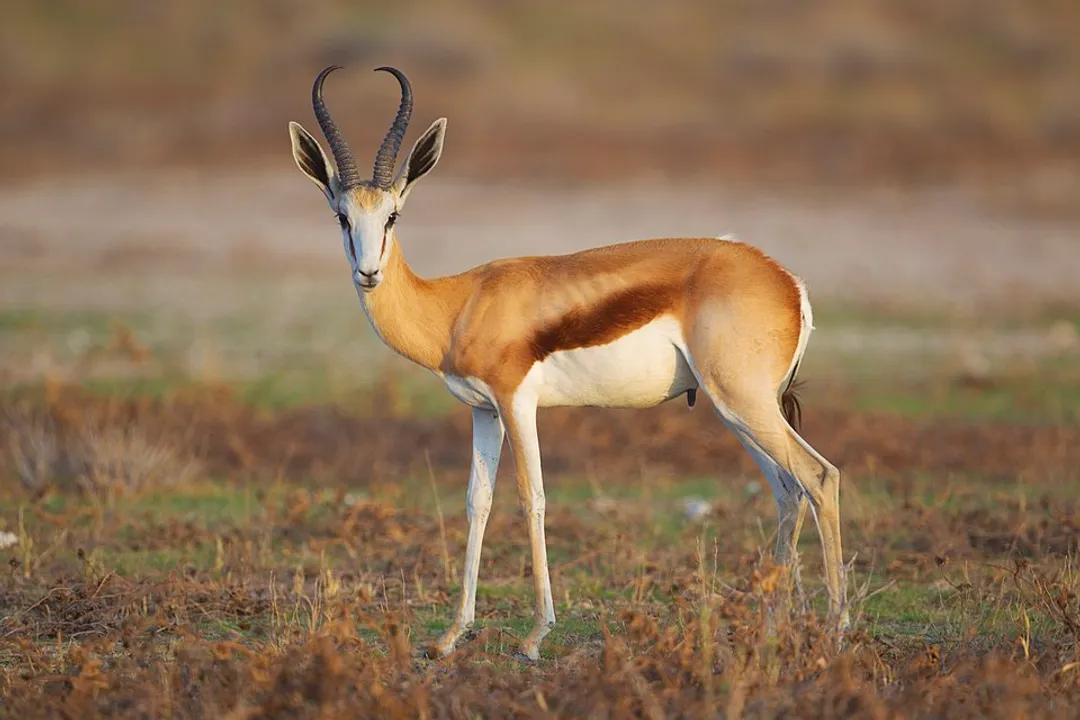
The slender, graceful antelope known across Southern Africa as the springbok (Antidorcas marsupialis) often prompts a very specific, yet scientifically inaccurate, query about its taxonomic status due to a confusing element in its scientific designation. Despite the Latin suffix in its name suggesting otherwise, the answer is definitive: no, the springbok is absolutely not a marsupial. [2][3] It belongs firmly within the lineage of placental mammals, a vast and diverse group that includes everything from humans to cattle.
# Antelope Family
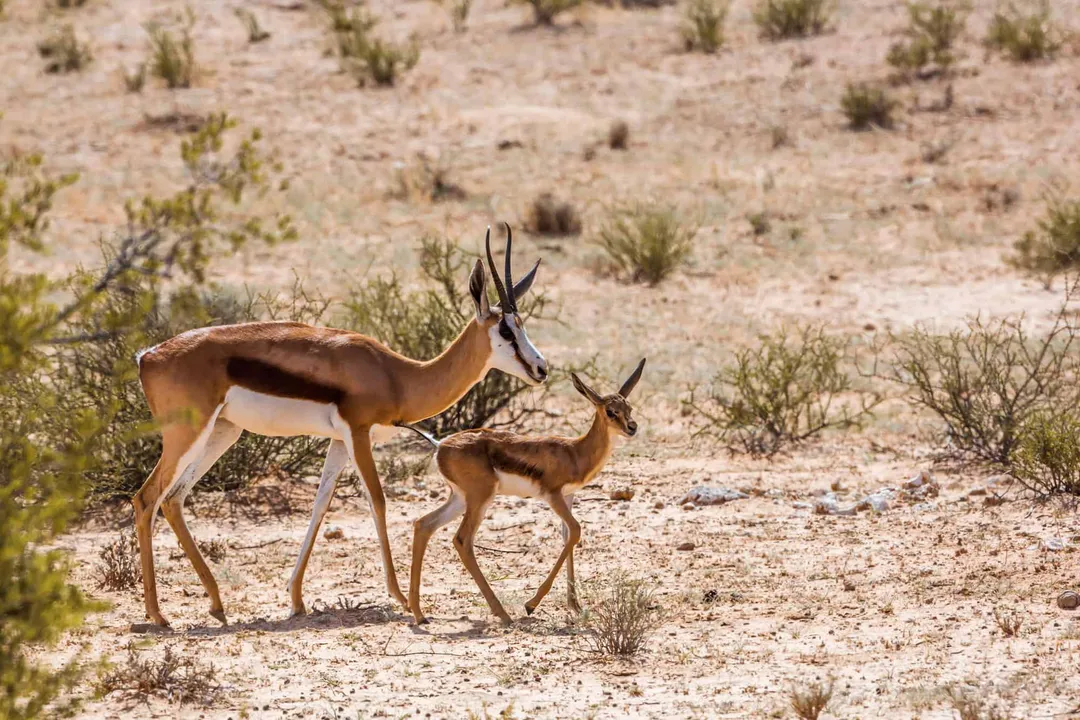
To understand why the springbok isn't a marsupial, we must first establish where it actually fits in the grand tree of life. The springbok is a bovid, placing it squarely within the family Bovidae. [3][6][7] This places it in the same broader taxonomic grouping as sheep, goats, cattle, and various gazelles and antelopes. [2][6] More specifically, it falls under the Order Artiodactyla, the even-toed ungulates. [2][3][4]
As a member of the Class Mammalia, it shares the core traits of all mammals—hair, the ability to regulate body temperature internally (endothermic), and nourishing young with milk—but its reproductive strategy is defined by having a placenta that nourishes the fetus during a relatively long gestation period within the mother’s uterus. [4][6]
# Naming Confusion
The source of the common misconception lies entirely in the species' scientific name: Antidorcas marsupialis. [2][3][7] The specific epithet marsupialis is derived from the Latin word marsupium, which translates directly to "pocket". [2][3][7] This feature is often misinterpreted as referring to the abdominal pouch used by kangaroos or opossums for carrying and nursing their young. [2]
However, in the context of the springbok, this "pocket" is a unique anatomical feature entirely unrelated to reproduction: it is a fold-like pocket of skin that runs along the midline of the springbok's back, extending toward the tail. [3][4][7] When the animal is excited or performing its famous leaps, specialized muscles erect this fold, revealing a striking crest of long, pure white hair beneath it. [3][4] This flap is used in visual display, often accompanied by a strong scent secreted from a gland associated with the fold, serving as a visual alarm or communication signal, not a nursery. [3]
# Defining Marsupials
Marsupials (infraclass Metatheria) represent a separate branch of the mammalian class, distinctly different from placental mammals like the springbok. [2] The defining characteristic of marsupials is their mode of reproduction. While they do conceive internally, the gestation period is extremely short, resulting in the birth of highly underdeveloped, embryonic-stage young. [4]
These tiny newborns then undertake a difficult journey to attach themselves to a teat inside the mother’s external pouch, or marsupium, where they complete their development over a sustained period. [2] The springbok, conversely, has a gestation period lasting between four to six months, [2][4][6] culminating in the birth of a single, though altricial (undeveloped), calf that is hidden away rather than immediately placed in a permanent pouch. [3][4][6] This essential difference in reproductive physiology—placental development versus pouch-dependent development—is the fundamental reason why the springbok cannot be classified as a marsupial.
# Niche Specialization
Another fascinating aspect that sets the springbok apart is its evolutionary isolation within its genus. The springbok is the sole living member of the genus Antidorcas. [3][7] Its scientific genus name, Antidorcas, actually means "opposite gazelle," derived from the Greek anti (opposite) and dorcas (gazelle). [3] This name acknowledges that while superficially similar to gazelles, the springbok diverged evolutionarily millions of years ago, possessing distinct differences in dentition, nasal structure, and horn configuration compared to true gazelles. [3] This status as a monotypic genus suggests a successful, highly specialized evolutionary trajectory adapted specifically to the arid landscapes of Southern Africa. [3][6]
# Arid Habitat
The environment these animals thrive in highlights their specific adaptations. Springboks primarily inhabit the dry, open savannas and deserts of southern and southwestern Africa, including Namibia, Botswana, and South Africa. [1][4][6][7] They show a strong preference for areas with short grass or the edges of dry lake beds, actively avoiding areas of tall grass where visibility is obscured. [1][4]
Their dietary strategy is key to survival in this challenging climate. Springboks are intermediate feeders, switching between grazing grasses and browsing shrubs and flowers depending on the season. [4][6] Critically, they possess an extraordinary ability to conserve moisture. They frequently derive all the water they need from the high water content found in succulent foliage, roots, and flowers, allowing them to survive for extended periods, even years, without drinking from open water sources. [1][2][3][6] This adaptation is a significant advantage over many other ungulates in drought-prone regions. [6]
# The ‘Pronk’ Behavior
Perhaps the most famous characteristic of the springbok is its athletic display, known as pronking or stotting. [1][4] This behavior involves a series of stiff-legged, repeated vertical leaps that can carry the animal up to 2 meters (about 6.6 feet) into the air. [1][3][4] The name itself comes from the Afrikaans word spring (jump) and bok (antelope). [1][7]
The exact reason for pronking remains debated, but theories suggest it serves multiple purposes: it may signal alarm to the herd, confuse a pursuing predator, or allow the jumper a better vantage point to spot a hidden threat. [3][4] When a ram is courting or displaying during the rutting season, this action is also a show of fitness, as the effort required indicates superior physical condition to potential mates. [4]
It is an interesting evolutionary pressure that has shaped the muscle composition of this species. Studies have shown that springbok possess a high concentration of glycolytic fast-twitch muscle fibers, necessary for explosive sprinting power, alongside a high antioxidant capacity—a combination that makes them elite sprinters, though they are still slower than a determined cheetah. [3]
# Herd Dynamics
Springboks maintain flexible social structures, usually forming mixed-sex herds or harems comprising several females and a few dominant males. [3][4] Males without established territories typically gather in all-male bachelor herds. [3] Historically, when populations were vastly larger, these animals engaged in massive migrations known as trekbokking, with herds sometimes numbering in the hundreds of thousands or even millions, crossing landscapes over several days in response to drought. [3][6]
This historical behavior has largely ceased due to habitat fragmentation from fences, hunting, and farming expansion. [3] Today, while they are still found widely, the majority of the population exists on private farmland or within protected reserves like Kruger National Park. [1][4][6]
# Current Standing
Despite historical population crashes caused by intense hunting pressure from early settlers who viewed them as crop pests, the springbok is currently classified as a species of Least Concern by the IUCN Red List. [1][3][7] In fact, the overall population trend is estimated to be stable or even increasing, a turnaround largely credited to conservation efforts and the booming wildlife ranching industry in Southern Africa. [3]
Ranching for venison and high-quality skins has provided a significant economic incentive for landowners to maintain healthy springbok numbers. [1] This commercial value helps ensure habitat preservation, acting as a modern safeguard against the historical overexploitation that nearly wiped them out in regions like the Free State and the former Cape Province. However, there is a recognized need to manage the industry carefully, specifically by discouraging the intensive selective breeding for rare color variants (like pure white or pure black forms), as this can lead to inbreeding and the loss of genetic diversity needed to cope with future environmental stresses like climate change. Maintaining genetic health across the various ecotypes, such as the Kalahari versus Karoo groups, is an ongoing management priority to ensure the species' long-term resilience.
Related Questions
#Citations
Springbok - Wikipedia
Springbok Animal Facts - Antidorcas marsupialis
Springbok (Antidorcas Marsupialis) - EL Education
Springbok - Facts, Diet, Habitat & Pictures on Animalia.bio
Antidorcas marsupialis (springbok) - Animal Diversity Web
Springbok - Antelope - South Africa - Kruger National Park
[PDF] Springbok - Antidorcas marsupialis - Endangered Wildlife Trust