Are nilgai ruminants?

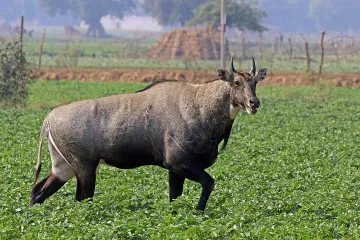
The nilgai, often affectionately or confusingly referred to as the "blue bull," is one of Asia's most recognizable large antelopes, endemic to the Indian subcontinent. [1][4][5] Its very name, derived from the Hindi words nil (blue) and gai (cow), hints at the confusion surrounding its identity—it is decidedly not cattle, but rather an antelope, even if its status as a large herbivore has invited comparison. [1][5] While its physical appearance, with a sturdy build, sloping back, and relatively long legs, is distinct, understanding its internal workings reveals a deeper connection to familiar livestock like cows and sheep. The fundamental question of its digestive system—is the nilgai a ruminant?—is answered definitively by its taxonomic placement.
# Bovine Kinship

The nilgai (Boselaphus tragocamelus) belongs firmly within the family Bovidae. [1][5][8] This massive family encompasses not just antelopes, but also cattle, goats, and sheep. [5] In the world of ungulates, the term ruminant is applied to animals that possess a specialized, multi-chambered stomach and are known for chewing their cud. [5] Since the nilgai is classified as an antelope, and the vast majority of antelopes fall into this category, we can place the nilgai squarely among the hollow-horned ruminants. [5] Some sources are even more direct, identifying the nilgai specifically as an "even-toed ruminant". [1]
This shared classification means the nilgai shares the complex digestive machinery necessary to extract maximum nutrition from fibrous plant matter. This strategy contrasts sharply with monogastric herbivores, like horses or rabbits, that must process vegetation in a single pass through a much simpler stomach system. For the nilgai, successfully inhabiting diverse dry and scrub forest environments depends entirely on this specialized gut. [1][5]
# Digestive Proof

What does it truly mean to be a ruminant, and how does this apply to the nilgai? It means the animal possesses a stomach divided into four distinct compartments: the rumen, reticulum, omasum, and abomasum. [9] This structure is the engine that permits herbivorous survival on low-quality forage.
The process, commonly simplified as "chewing the cud," involves the initial ingestion of food, which is mixed and stored in the large fermentation vat known as the rumen. [5] Here, vast numbers of symbiotic microbes begin the difficult work of breaking down tough cellulose. The animal then regurgitates this semi-digested material—the cud—back into its mouth for further mechanical grinding before it is swallowed again for a second pass through the system, primarily through the omasum and into the true stomach, the abomasum. [5]
Evidence supporting this ruminant status extends even to the microscopic level of reproductive biology. Studies examining the nilgai's pregnancy confirm its place in this group. The structure of the nilgai placenta is described as polycotyledonary epithelio-chorial, a configuration that possesses "all the characteristics of ruminant placentas". [9] Furthermore, physiological data collected from nilgai often fall within the expected ranges for wild ruminants studied for comparison. [9] These anatomical and reproductive details serve as biological confirmation for what the taxonomic classification suggests: the nilgai functions physiologically like domestic cattle or sheep when processing its diet.
# Feeding Ecology

The nilgai's identity as a ruminant directly dictates its foraging behavior. In its native Indian range, the animal is characterized as a browser or mixed feeder, consuming woody plants, foliage, flowers, and herbs, with grasses being prominent during the rainy season. [1][5] This flexibility is a massive advantage. Because the microbial fermentation in the rumen is highly effective at breaking down cellulose, the nilgai can successfully utilize tougher, less digestible vegetation when preferred grasses are scarce. [5]
Interestingly, when populations were introduced to the drier environments of South Texas, the nilgai adapted its primary habit to become predominantly a grazer, relying heavily on grasses found there, though they still browse on shrubs like mesquite and oak. [1][5] This adaptability, supported by their ruminant capabilities, allows them to endure long periods without drinking water, surviving for several days in cooler weather. [1][5] This efficient, slow-burn digestive strategy contrasts with the reliance on easily digestible food seen in hindgut fermenters. For example, an obligate browser that relies solely on hindgut fermentation might need to consume a much larger volume of food daily or only consume high-quality, young leaves, whereas the nilgai's system allows for periodic, efficient processing of bulky forage. [5]
We can observe how this specialized digestion allows the nilgai to occupy a niche similar to native deer populations but with greater resilience in arid conditions. While white-tailed deer in Texas have good eyesight and hearing comparable to the nilgai, their simpler digestive tracts may necessitate a different balance between grazing and browsing to maintain energy, particularly during periods of drought when the nilgai's fermentation system can still extract sustenance from tougher browse material. [7] The capacity to survive extended dry spells by effectively processing dry, fibrous material is a signature benefit of their ruminant status.
# Cultural Context
The nilgai’s relationship with humans is complex, reflecting local cultural and ecological pressures, which in turn loop back to their consumption habits and shared biology with cattle. In India, where the species is native, Hindus traditionally hold cattle as sacred, and the nilgai's name itself incorporates the word for "cow" (gai). [5][6] This association, whether literal or symbolic, has historically protected them against widespread hunting, though they are often simultaneously considered pests due to crop raiding and damage. [1][5][10] The high numbers of nilgai in some Indian states have led to official declarations classifying them as vermin to allow for culling to protect agricultural livelihoods. [1][5]
Conversely, in parts of the United States, particularly Texas, where they were introduced in the 1920s or 1930s, the nilgai are seen as an exotic game animal, with sport hunting and meat supply being the primary methods of population control. [2][5][7] This cultural contrast—protected by association with the sacred in one place, hunted commercially in another—is striking, especially when considering that both cattle (sacred in India) and nilgai share the same fundamental ruminant digestion strategy that allows them to thrive on local forage. [5] The nilgai's beneficial side effect, that their nitrogen-rich droppings can actually improve soil fertility, is a detail often overlooked amid the conflict over crop destruction. [10] This dual identity—sacred/pest, native/exotic—makes the nilgai a fascinating study in how human perception, rather than pure biology, often dictates an animal's management.
Their success outside Asia, thriving in the South Texas brush country, is a testament to the efficacy of the ruminant digestive system in adapting to new, semi-arid environments, provided water sources remain accessible during the hottest periods. [5][7] The continued expansion of feral populations demonstrates that for this large antelope, the evolutionary advantage of being a cud-chewing herbivore remains highly successful.
Related Questions
#Citations
Nilgai
Nilgai | NatureRules1 Wiki - Fandom
Nilgai Fact Sheet - Texas A&M AgriLife Extension Service
Is the Nilgai a cow or a bull? - Animal Kingdom - Quora
Nilgai | Habitat, Diet & Conservation
TIL that while the Nilgai (a kind of antelope) are considered ...
Nilgai Antelope: History, Habitat, and Management in Texas
Blue Bull Blues: The Plight Of Nilgai
Nilgai Antelope (Boselaphus tragocamelus)
Boselaphus tragocamelus (nilgai) | INFORMATION